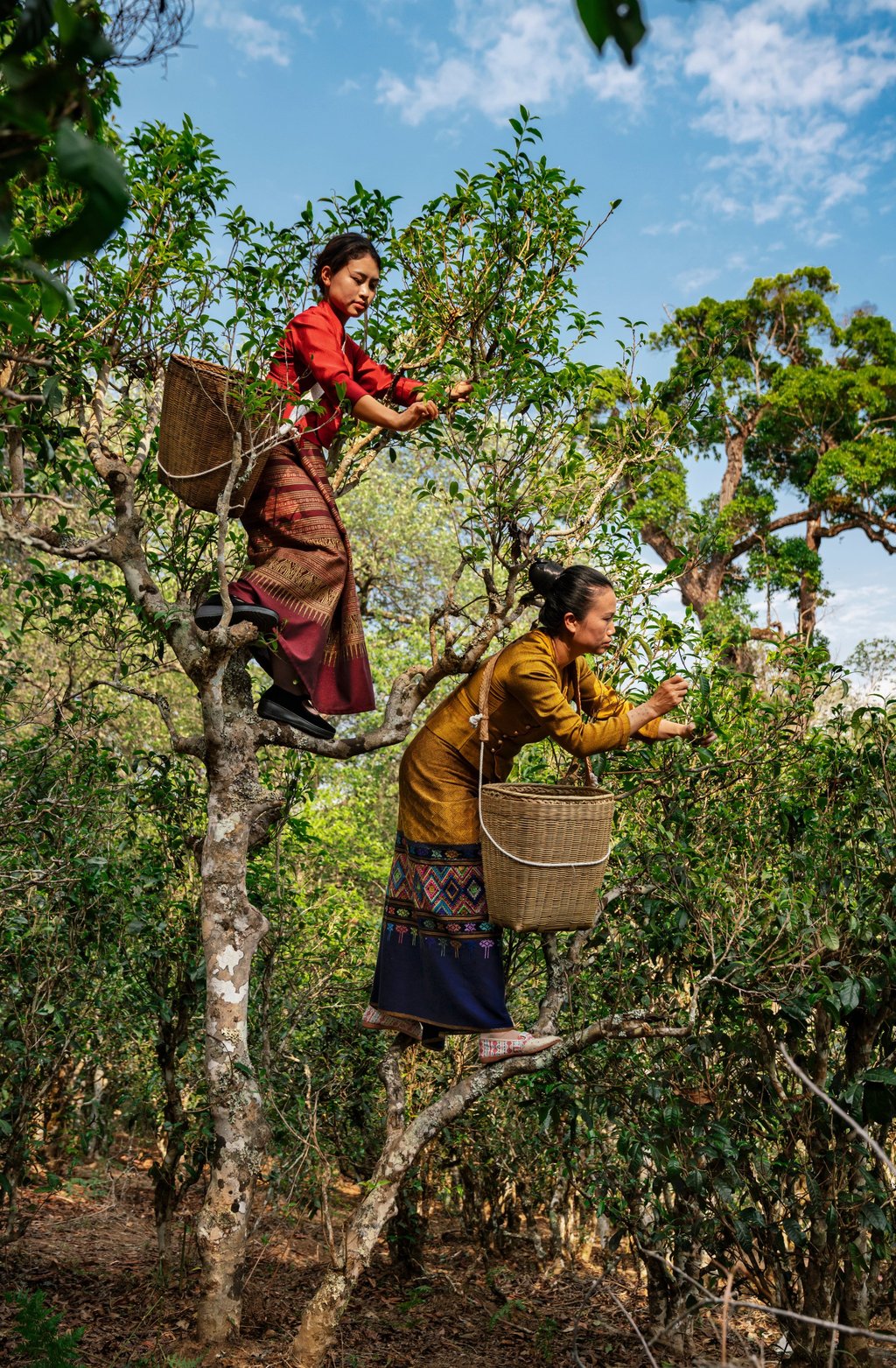
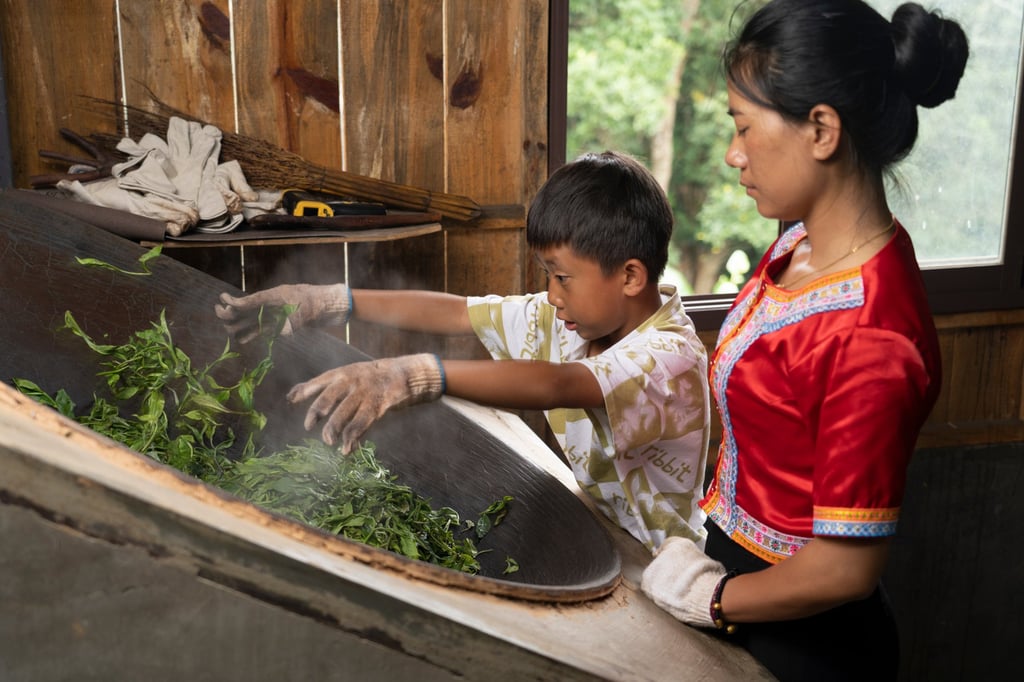
Deep in the Jingmai Mountain forests, in China’s Yunnan province, clouds of steam rise from a huge wok in which Yu Jing is roasting tea leaves. That morning, she had climbed high into a tree, pinched off some large leaves then, back on the ground, spread them on a reed mat to lose moisture and wither. Now, as Yu roasts the tea leaves, the nutty aroma fills her home, becoming more intense as the tea warms.
Yu gently lifts a tuft of emerald green leaves from the wok with gloved hands. Her young son watches from the side, basket in hand, ready to collect the leaves she has prepared, carrying on techniques her ancestors developed a millennium ago. What she passes to her son is cultural treasure. In 2023, Unesco declared the Jingmai region a World Heritage site, the only tea-growing region in the world with that status.
Tea grower Yi Zhang and her stepdaughter Ye Nanen from the Dai indigenous community climb old tea trees to pluck leaves in Da Ping Zhang, one of the five tea forests on Jingmai Mountain. Photo: Justin Jin
The blast of heat prevents browning of the leaves, killing most of the enzymes that would cause oxidation. This step is called “kill green” and is essential for Puer tea because, unlike black tea, it should not oxidise. The cooking temperature is relatively low, so a small proportion of enzymes remain active, allowing the tea to develop its special taste as it ages. Solid-state fermentation, which encourages the growth of microorganisms such as bacteria and fungi, creates the tea’s characteristic flavour. This process transforms the tannins and bitter compounds, so a highly fermented Puer tea tastes softer, richer, earthier and slightly sweet, and does not leave a furry feeling on the tongue.
Advertisement
When the leaves cool, Yu rolls each one by hand, breaking open cells and allowing the aroma to spread. Later, she dries the tea until it is ready to be pressed, packaged and matured. A good Puer tea remains in storage for decades. As the saying goes, “Grandparents make the tea that grandchildren drink.”
Helped by her son, tea grower Yu Jing from the Blang indigenous community heats tea in a process called “kill green”, at their home in Mangjing village. Photo: Justin Jin
Fermented and pressed into flat cakes, one gram costs just under six yuan (HK$6.50) when sourced from the farmer, though at shops it can cost much more. Current Jingmai tea prices from these old trees are around 6.5 times higher than ordinary plantation tea, and the longer it matures, the more expensive it becomes. Last year, a tea cake estimated to date back as far as 1917 fetched almost HK$3.5 million at auction in Hong Kong. All of which is fitting – it was the city’s teahouse culture that had sparked Puer’s first boom decades earlier.
Grandparents make the tea that grandchildren drink