Bi Rongrong weaves urban ‘skins’ and ancient motifs into layered art
Textiles allow artist Bi Rongrong to take a more immersive journey through the cities that provide her with inspiration

That spatial sensibility still guides her work, but instead of brush and ink, Bi now uses the materials of the city: architectural patterns, street posters, tiled facades, even Neolithic motifs.
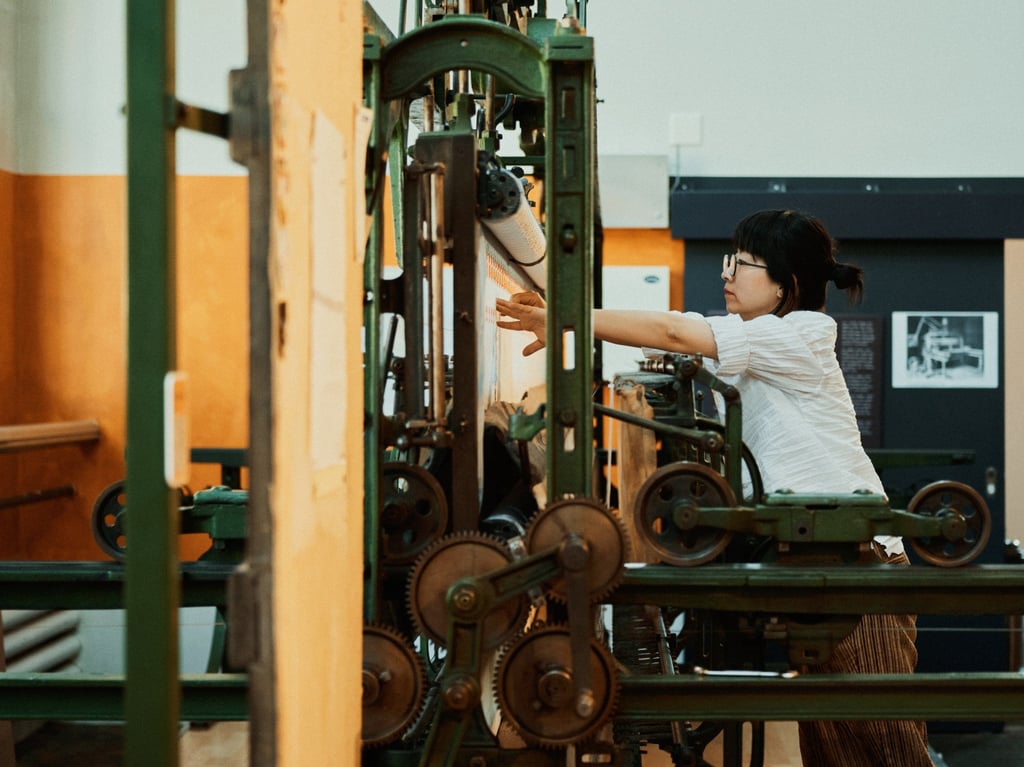
“I started collecting what I call the ‘skin’ of the cityscape,” she says, a practice that began during a 2014 residency at the Centre for Chinese Contemporary Art in Manchester, Britain, and expanded into a broader investigation of surface, memory and cultural inheritance.
Textiles entered her work not by design but by intuition. “I never studied textiles,” she admits, but “the material was calling to me”. Her impressions of city life in paint became work in textiles, and textiles became the foundation for immersive pieces.
In her latest, now on view at the M+ museum as part of the Sigg Prize 2025 shortlist, Bi fuses six large textiles into a layered composition that channels both ancient Chinese design and contemporary visual noise.
“For me, the move into three-dimensional work wasn’t a big decision,” she says. “It was a natural evolution, like adding more depth to what I already knew from Chinese painting.”