-
Advertisement
PostMag
Life.Culture.Discovery.
Locals' Guide
PostMagTravel

Insider’s guide to Bengaluru: a city that welcomes you in

Lush parks, buzzing markets and a thriving music scene define the Silicon Valley of India

Reading Time:4 minutes
Why you can trust SCMP
The streets outside the KR (Krishna Rajendra) Market. Photo: Getty Images
Zinara Rathnayake

Bengaluru, the capital of the southern Indian state of Karnataka, is an adopted home that food stylist and photographer Sanskriti Bist never tires of. Bist, whose recent projects have included learning the techniques of hand-pulled noodles in northwestern China and documenting the kitchens of Berlin, Germany, says her favourite aspect of Bengaluru is the city’s embrace.
“People are so welcoming,” says Bist, who moved from Raipur, in central India, to Bengaluru – formerly known as Bangalore – nearly a decade ago, for university. “I don’t see that in other cities; a community of people who are always, like, ‘We’ll help you.’”
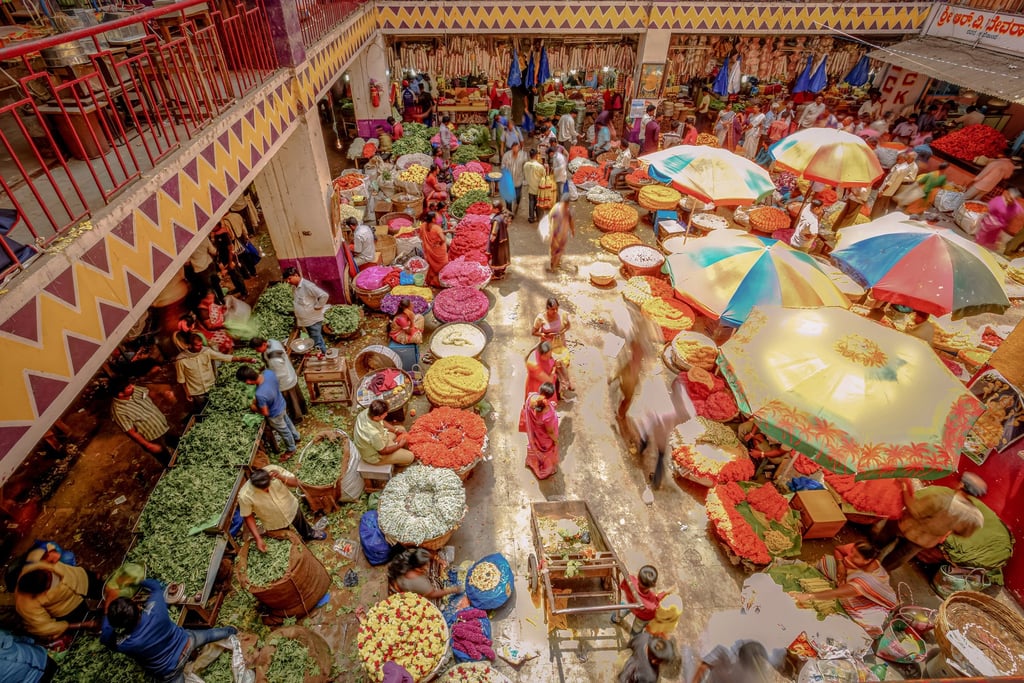
The KR Market, in central Bengaluru, primarily sells flowers. Photo: Shutterstock

What to do

Bengaluru’s soul, Bist explains, is tied to the markets that dot the city. “When I looked for a home after college, I wanted a place next to a market,” she says, of Thippasandra Market and her apartment in New Thippasandra, in the east of the city. “So when I go down now, there are flowers, vegetables and meat stalls. It’s these everyday interactions that make me feel like I’m part of the city.

Advertisement

“The HAL [Hindustan Aeronautics Limited] Market [in Jyothi Nagar, about 2km from Bist’s home] sometimes has exotic vegetables like different kinds of mushrooms that we don’t always see.”

A local picks up a fish at the HAL Market, in Jyothi Nagar. Photo: Sanskriti Bist
For visitors, Bist recommends Russell Market, in Shivajinagar. One of Bengaluru’s oldest, the market is set inside a British-colonial-era structure dating back to 1927. With a steady supply coming from the coastal towns, it’s a hub for fresh seafood.
Advertisement
Advertisement
Select Voice
Choose your listening speed
Get through articles 2x faster
1.25x
250 WPM
Slow
Average
Fast
1.25x