Hong Kong’s financial revival: trading, tokenisation and governance in focus
Broadridge scales Hong Kong’s financial revival via unified trading systems, tokenised repo liquidity, and AI-driven digital governance solutions
.jpg?itok=_cl1n155)
[The content of this article has been produced by our advertising partner.]
.jpg?itok=thH24wrt "David Runacres, President of APAC at Broadridge, speaking at the APAC Trading Summit, the FIX Committee APAC’s annual flagship event in Hong Kong.")
For a while and not so long ago, confidence in Hong Kong’s financial markets appeared fragile. Trading volumes softened, and geopolitical tensions weighed on sentiment. The city’s status as Asia’s leading international financial hub began to come under question.
That tone is now beginning to shift.
Volumes are rising, IPO pipelines are rebuilding, and cross-border flows are accelerating in both directions. For Wout Kalis, senior country officer, Hong Kong at Broadridge – a global technology leader – the change reflects structural evolution rather than a short-term rebound.
“Chinese investors are increasingly using Hong Kong as a way of raising capital and selling their products to the globe,” Kalis says. “This is a massive change from before, and that’s great for Hong Kong.”
Trading at scale: volume and simplification
Naturally, as cross-border activity rises, operational demands across the market are increasing, too.
“For the sell-side… there is an increase in volumes,” Kalis says, pointing to the growing influence of quant and artificial intelligence (AI) driven strategies. At the same time, fee compression remains a persistent challenge. “Brokers, internationally, are offering trading almost for free. So they need to have other ways of making revenue.”
Pressure is also building on the buy-side. “You cannot charge the fees that you could previously,” he notes. The result is that firms are moving towards outsourcing and heavier investment in technology to become more efficient.
Hong Kong’s cross-border infrastructure, including Stock Connect, adds another layer of complexity. The response, Kalis believes, is simplification across operations. “Currently, there are still a lot of systems… a mixture of back office, middle office, front office,” he says. “Getting to a unified back-, middle- and front-office solution will help significantly.”
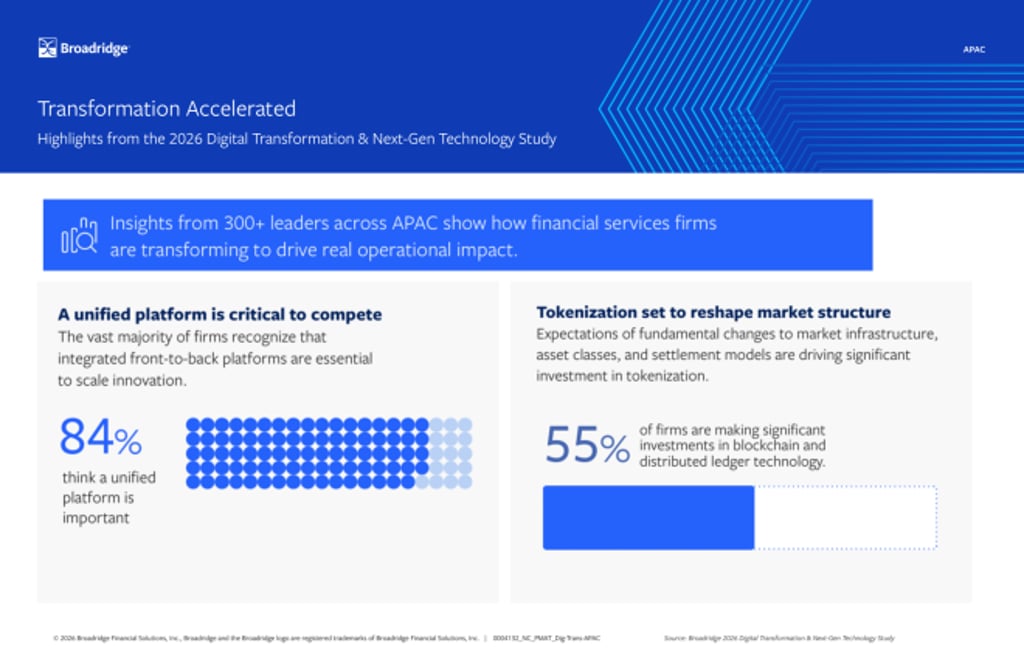
“From an operational perspective, I think a single platform reduces risk, because you get more integration of your data, you get less risk of errors.” In addition, consolidated data also strengthens AI capabilities.
As markets adjust to T+1 (trading day plus one business day) settlement cycles and extended trading hours, operational readiness is becoming a strategic issue rather than a purely technical one, he explains.
Tokenisation: from sandbox to impact
If trading modernisation defines the near-term agenda, tokenisation represents the longer-term transformation. Hong Kong’s regulators, particularly the Hong Kong Monetary Authority, have encouraged experimentation through sandbox-style initiatives. But Kalis believes adoption must be tied to practical use cases: “It needs to solve specific market issues.”
“Repo by itself is quite complex,” Kalis says. With tokenised collateral and smart contracts, “the ability to move the collateral and the cash becomes instant. Nobody’s waiting on each other. It creates liquidity by the minute.”
The implications are significant. Broadridge recently reported that its DLR platform achieved nearly 300 per cent year-on-year growth and processed an average of US$368 billion in daily repo transactions during April, with volumes totalling nearly US$8 trillion.
“That could really change the whole liquidity management,” Kalis says, particularly for banks operating across jurisdictions.
.png?itok=NqzROW9g "Key insights from Broadridge’s 2026 Digital Transformation and Next-Gen Study.")
Governance as a competitive edge
For Kalis, innovation must still reinforce trust.
“Firstly, solid governance and regulatory infrastructure is key for people to build trust and to invest in Hong Kong,” he says. “Moreover, transparency and shareholder participation remain equally important as IPO activity increases.”
On the digital front, Broadridge has been extending governance infrastructure into digital assets. The company recently went live with on-chain governance for tokenised equities, enabling investors to vote and receive communications across traditional and tokenised shares through a single platform. Technology is also reshaping governance more broadly, with AI-driven voting advisory tools aggregating issuer data and news into data-based reports.
As Hong Kong works to expand its equity market, Kalis believes governance will help determine whether the city can become “the New York Stock Exchange of Asia”.
“Good governance will be critical… because it will give the trust to investors,” he observes.
Broadridge is working with clients in Hong Kong across each of these three areas — helping firms simplify trading operations through more integrated front-to-back infrastructure, supporting the development of tokenised market use cases such as distributed ledger repo, and enabling stronger governance through technology that improves transparency and shareholder participation.
If Hong Kong can combine a unified trading infrastructure, scaled tokenisation and strong governance, its revival may prove not temporary, but transformational.
.jpg?itok=gDb44nB8 "Broadridge co-hosted a tokenisation forum with ASIFMA (Asia Securities Industry & Financial Markets Association), featuring Horacio Barakat, Broadridge’s Global Head of Digital Innovation, as a panel speaker.")