A global forum shaping the future of law
At Hong Kong Legal Week 2024, legal experts from across the country and the globe engaged in discussions on international law, ADR and rule of law

[The content of this article has been produced by our advertising partner.]
Hong Kong has once again affirmed its standing as a global legal hub by hosting the annual Hong Kong Legal Week (HKLW), the flagship event of the Department of Justice (DoJ).
The mega event, spanning five days from November 4 to 8, attracted legal professionals, policymakers and academics from around the world for thought-provoking discussions.
With the theme “Hong Kong Common Law System: World-Class Springboard to China and Beyond”, HKLW 2024 explored a broad spectrum of legal matters, reaffirming the city’s influence in driving legal developments across the Asia-Pacific region and beyond.
Global participation and key themes
With over 5,000 participants from more than 40 jurisdictions, HKLW 2024 served as a platform for insightful exchanges on legal developments spanning international private law, alternative dispute resolution (ADR), digital assets and the critical role of the rule of law in fostering economic growth.
Asia-Pacific International Private Law Summit
The five-day event opened with the Asia-Pacific International Private Law Summit, co-organised with the International Institute for the Unification of Private Law (UNIDROIT).
Titled “Springboard to Opportunities: Utilising International Private Law and Technology to Facilitate Access to Credit, Investment and Sustainable Development in the Asia-Pacific Region”, the Summit examined the vital role international private law plays in fuelling economic growth.
In his welcome remarks, the Secretary for Justice, Paul Lam Ting-kwok, spoke about the Summit’s focus on unlocking the Asia-Pacific region’s vast economic potential, fostering sustainable growth and advancing the harmonisation of private law.
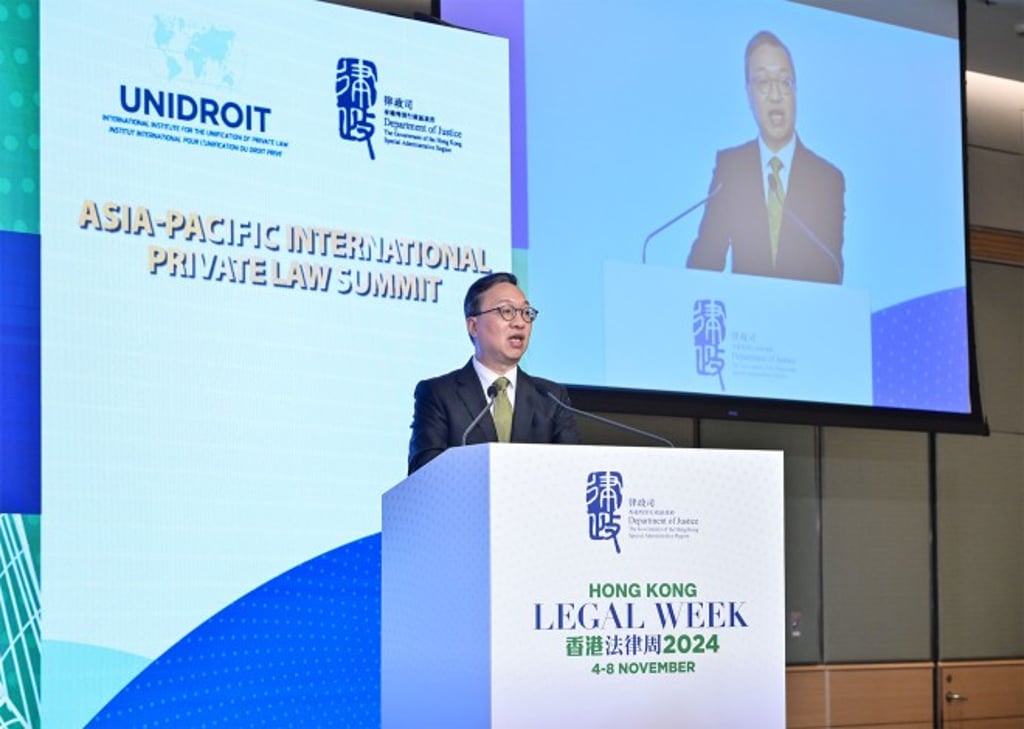
He noted the DoJ’s collaboration with UNIDROIT in developing international private law and expressed appreciation for UNIDROIT’s support of the DoJ’s secondment programme, which offers Hong Kong’s legal professionals experience at the UNIDROIT Secretariat.
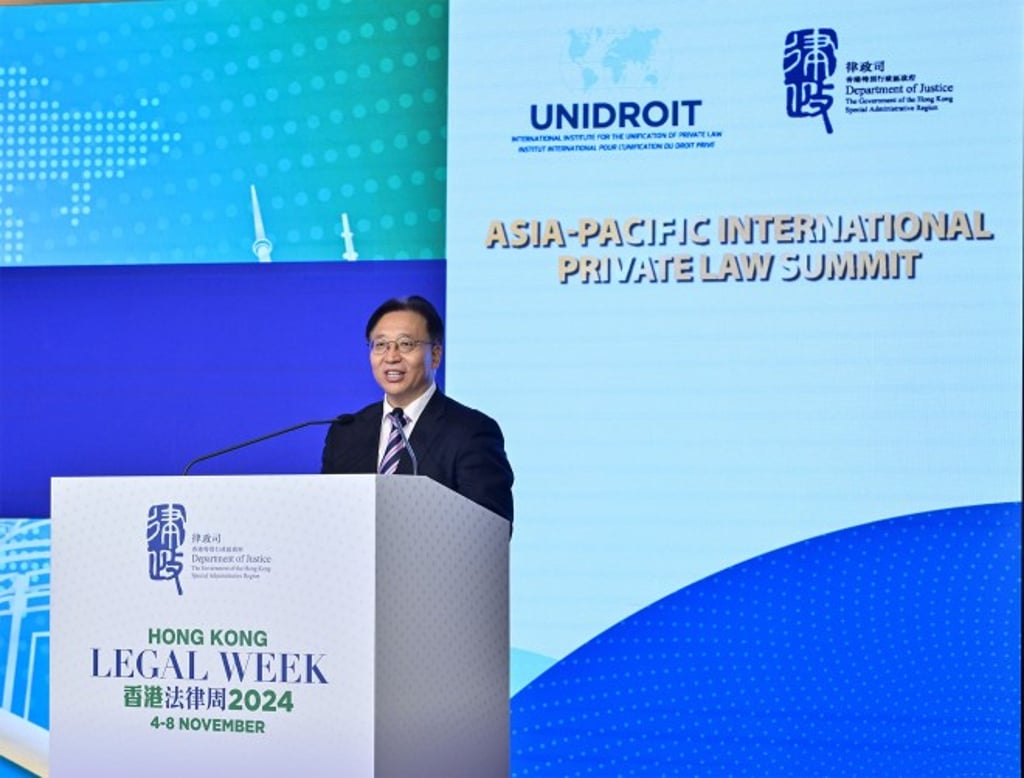
Additional remarks were given by the Commissioner of the Ministry of Foreign Affairs in HKSAR, Cui Jianchun, who noted China’s dedication to fair global governance and acknowledged Hong Kong’s proactive support of national development strategies. He underscored Hong Kong’s unique capacity to bridge China with the world through its systems, talent and location.
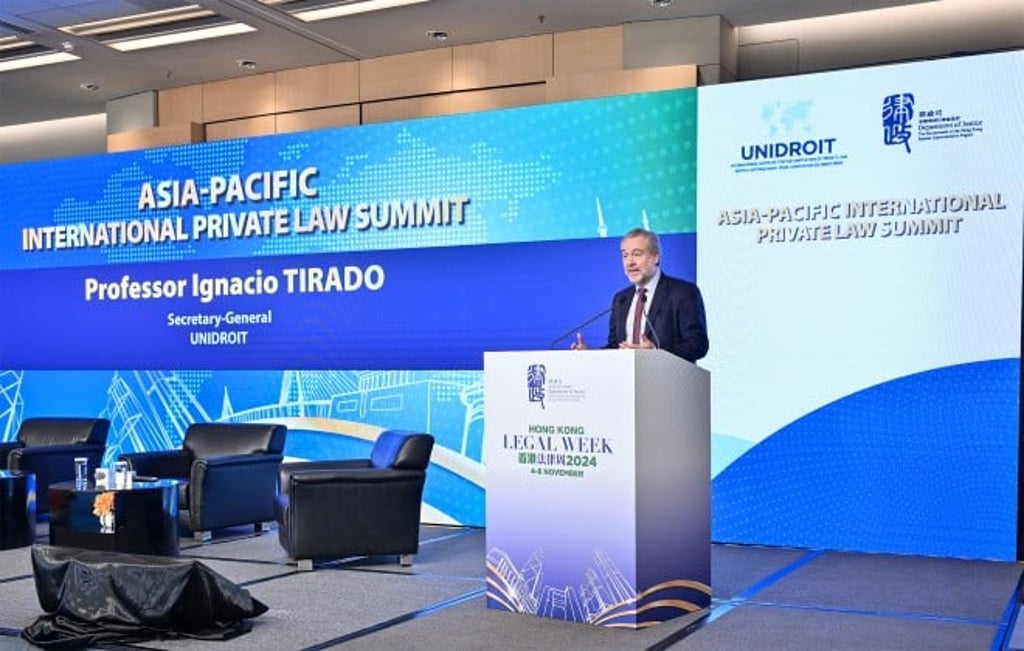
UNIDROIT Secretary-General Prof Ignacio Tirado described the Summit as “one of the legal world’s leading events in the international law arena”. He commended Hong Kong’s resilience post-pandemic and affirmed its status as a dynamic, cosmopolitan legal and financial hub recognised globally.
The event facilitated an in-depth exploration of how Hong Kong’s unique common law system, under the One Country, Two Systems framework, bridges East and West, positioning the city as a legal and commercial conduit in the region.
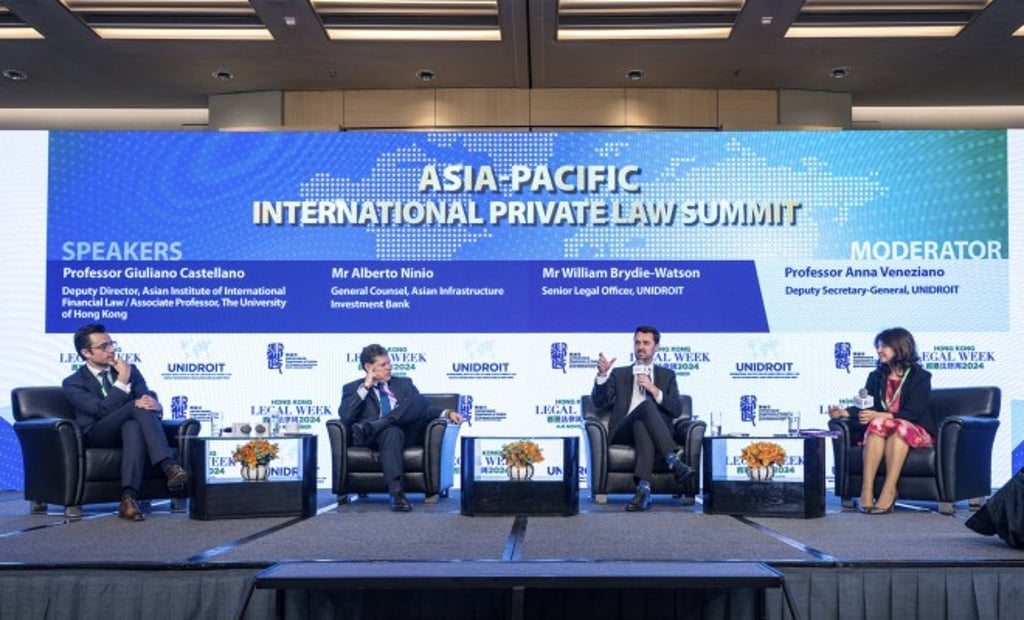
Aside from exploring the legal implications of holding, transferring, and securing digital assets, the discussions covered tokenisation and carbon credits, reflecting the increasingly complex legal and regulatory landscape surrounding digital finance.
The Summit also addressed secured transaction law reforms across the Asia-Pacific region, focusing particularly on the legal and regulatory challenges surrounding supply chain finance.
Another panel discussed how soft law instruments on international private law could promote investment and contribute to sustainable development for businesses.
The last panel with speakers from governments and international organisations exchanged views on how to strengthen engagement in the region, especially through capacity-building, and the pivotal role of Hong Kong as a capacity-building hub in Asia-Pacific in light of its unique strengths under its bilingual common law system.
Participants expressed their appreciation for the Summit, which offered invaluable insights. Rathavich Ariyapachpol, Appeal Court Justice of the Office of the President of the Supreme Court of Thailand, said the Summit was a great event that helped build lasting relationships across borders, and he looks forward to joining it again.
The Second Legal Forum on Interconnectivity and Development
Day 2 focused on how Hong Kong continues to play an integral role in China’s institutional opening up.
Co-organised with the Office of the Commissioner of the Ministry of Foreign Affairs in the HKSAR, the Second Legal Forum on Interconnectivity and Development explored the legal mechanisms that facilitate international trade and investment by linking China’s legal framework with global counterparts.
The keynote address was delivered by Alberto Ninio, General Counsel of the Asian Infrastructure Investment Bank, on promoting good governance and high-quality development under international law.
It was followed by an interactive exchange on the interconnectivity of rules and the contribution of the HKSAR to China’s institutional opening-up.
This included the HKSAR’s role as a “super-connector” bridging the Mainland and global markets, its unique strength in the interface of rules and mechanisms in the Guangdong- Hong Kong-Macao Greater Bay Area (GBA), and its extensive practice and experience in international arbitration.
The Legal Forum also discussed the importance of the rule of law in mitigating risks and safeguarding the HKSAR’s and national sustainable development, against the backdrop of financial sanctions, foreign interference, and the emergence of artificial intelligence.
Alternative dispute resolution and innovation
Day 3 of HKLW 2024 shed light on ADR, a hallmark and strength of Hong Kong’s legal framework, with the keynote speech delivered by Dr Sun Jin, Director-General of the International Organisation for Mediation Preparatory Office.
Themed “Beyond Litigation: The Vibrant Landscape of Alternative Dispute Resolution of Hong Kong”, the day focused on the latest advancements in mediation, with particular attention to emerging technologies and sector-specific developments.
The panel discussion “Mediation in Action: Harmony and Peace for All” reiterated the key role mediation plays in fostering social harmony and stability, providing an effective and accessible means of dispute resolution, while also encouraging a culture of mutual respect and inclusivity.
Afterwards, the panel titled “AI-Powered ADR: Exploring the Transformative Potential in Conflict Resolution” examined the integration of artificial intelligence (AI) in ADR, focusing on the benefits, challenges, and practical applications.
Speakers discussed how AI can streamline legal processes, including document review, legal research and e-discovery, allowing lawyers to manage large volumes of data more efficiently.
They also raised key concerns about data security, potential inaccuracies and ethical considerations. While AI can assist with routine tasks, the panel agreed that it cannot fully replace human judgment in complex or emotionally sensitive cases, such as mediation.
The last panel of the day focused on sports disputes. As stated in the Chief Executive’s 2024 Policy Address, with the thriving development of sports activities and the industry, sports disputes have become increasingly complicated.
Hence, Hong Kong will explore establishing a sports dispute resolution system and promoting sports arbitration. In this session, speakers shared their experiences and insights regarding the demand, application, effectiveness and challenges of sports ADR.
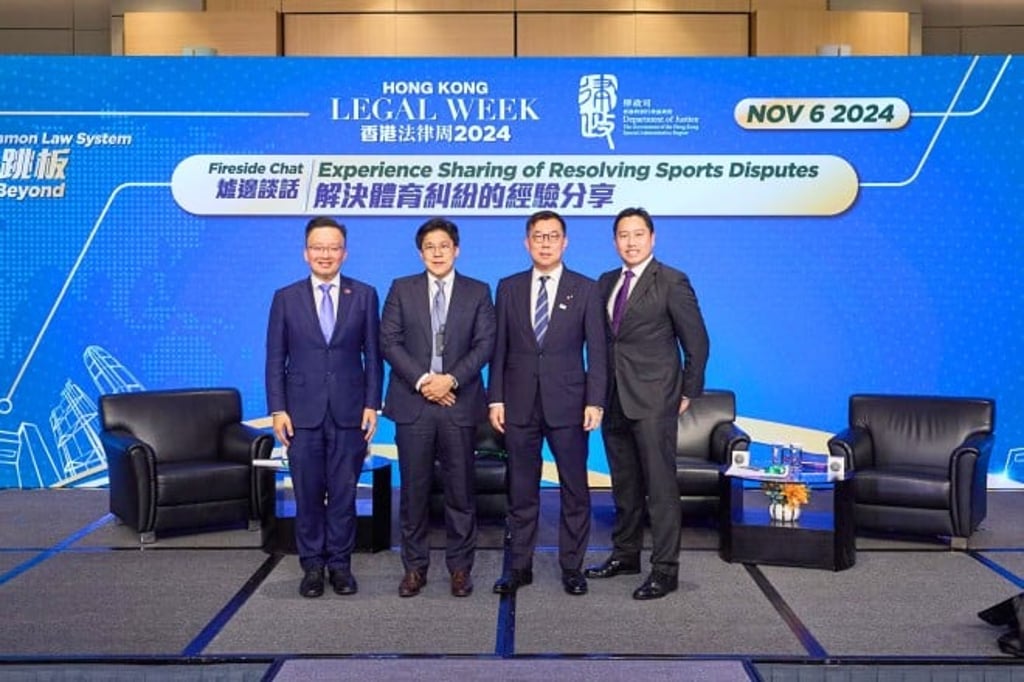
The day concluded with the Hong Kong Mediation Lecture 2024, co-organised by Herbert Smith Freehills. Prof Shahla Ali explored the role of mediation in sustainable development, particularly under the Belt & Road Initiative, where natural resource-related deals often present complex cross-border legal challenges.
Construction of rule of law in the GBA
Day 4 centred on Hong Kong’s contributions to the development of the rule of law in the GBA. The session, titled “Joint Contribution to the Construction of Rule of Law in the GBA”, explored the legal services enhancing trade, economic integration, and cross-border cooperation between Hong Kong, Mainland China and Macao.
The keynote speech was delivered by Judge Jiao Xiaoding, Deputy Chief Judge of the Fourth Civil Division of the High People’s Court of Guangdong Province. She shared practical experience on the judicial implementation of proof of foreign law.
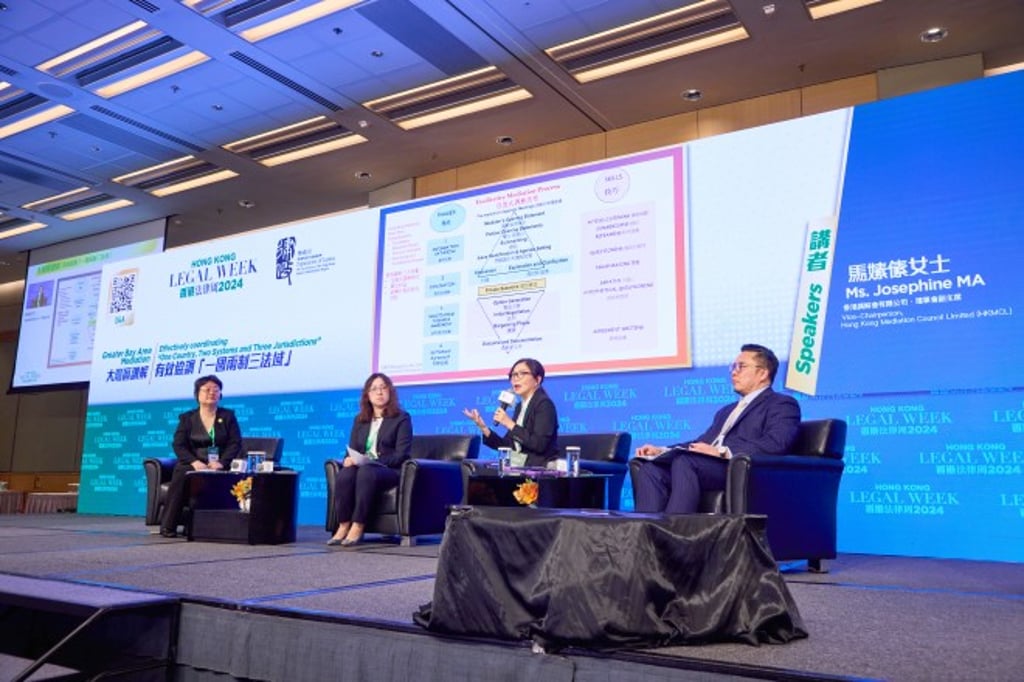
The afternoon session featured a mock mediation with mediators from Hong Kong, Mainland China and Macao, demonstrating effective resolution of cross-border disputes in the GBA while exhibiting cultural and procedural differences across the three jurisdictions.
The session also showcased the achievements of the GBA Mediation Platform, which promotes professional mediation standards across the region, reflecting the unique characteristics of “One Country, Two Systems and Three Jurisdictions”.
Rule of law as catalyst for business growth
The final day of HKLW 2024 focused on the strong connection between the rule of law and a healthy business environment.
The session, “Rule of Law: The Best Business Environment”, explored how Hong Kong’s robust legal system, regulatory frameworks, anti-corruption efforts, and intellectual property protections create a dependable foundation for business growth.
During the panel discussion “A Comprehensive Regime Provides a Stable Environment for Businesses to Grow”, representatives from the legal and business sectors shared how Hong Kong’s legal infrastructure supports innovation, investment, and expansion across the Asia- Pacific and beyond.
Success stories from Hong Kong-based enterprises were also featured, showing how they have leveraged the region’s legal advantages to seize new opportunities.
Hong Kong International Legal Talents Training Academy
The final day saw the opening of the Hong Kong International Legal Talents Training Academy, established to cultivate the next generation of legal professionals ready to contribute to national and global initiatives, including the Belt & Road.
The launch was officiated by the Secretary for Justice, Paul Lam Ting-kwok, alongside the Vice-Minister of Justice, Wang Zhenjiang, as well as the Secretary General of the Liaison Office of the Central People’s Government in the HKSAR, Wang Songmiao, and the Commissioner of China’s Foreign Ministry in the HKSAR, Cui Jianchun.
The inauguration was also witnessed by members of the Hong Kong International Legal Talents Training Expert Committee and distinguished guests from around the world.
Formed in October, the Expert Committee consists of distinguished legal experts and scholars from Hong Kong, Mainland China, and abroad. Three advisory boards were created to assist the DoJ in shaping training and capacity-building programmes and strategies.
The Secretary for Justice also witnessed the signing of a memorandum of understanding between the Law Society of Hong Kong and the Xinjiang Lawyers Association to facilitate regular exchanges and strengthen collaboration.
In his closing address, the Secretary for Justice described HKLW 2024 as a major success, citing the valuable insights and collaborations that emerged throughout the week and reaffirming Hong Kong’s indispensable role in connecting China with the international legal and business communities.
In his closing address, Chief Executive John Lee praised Hong Kong Legal Week 2024 as a clear endorsement of the city’s legal status. He reiterated Hong Kong’s unique role as a bridge between China and the world, supported by its common law system, close ties with the Mainland, and multilingual legal talent.
“The rule of law is no less essential to our success. As the bedrock of our legal framework, it ensures stability, security, and fairness – key elements that businesses consider when deciding where to invest and operate,” he said.
Exhibition showcases legal milestones
In parallel with the discussions and panels, HKLW 2024 hosted an exhibition focusing on the development of the rule of law in China and Hong Kong’s role in shaping external legal affairs. Guided tours for participants, including secondary school students, offered a deeper understanding of Hong Kong’s contributions to advancing the rule of law.