Tomorrow’s world of education: students learn online in Covid-19 lockdown, but what edtech advances can we expect?
- Lockdown closures of schools and universities in at least 194 counties sees more than 90 per cent of world’s students continue classes online
- Hong Kong well placed to promote rising number of new edtech ventures as education sector looks to embrace digital innovation

Covid-19 outbreak has sparked an edtech revolution – how do companies seize opportunities it brings?
[Sponsored article]
The Covid-19 pandemic caused schools in at least 194 countries to close at the start of April, which – at that time – had an impact on more than 90 per cent of the students around the globe, Unesco, the UN’s heritage body, reported.
For many months, housebound students worldwide relied on online communication tools to continue school and university classes, and the experience has inspired people around the world to reflect on the growing role technology can play in reforming education.
The development of education technology, or edtech, can provide innovative tools and media to help develop, communicate and exchange knowledge in a more engaging, inclusive and personalised way.
Education for the future
The dramatic e-learning changes away from classrooms – with teaching carried out remotely and on digital platforms – are likely to be here to stay, and have sparked keen debate about the need for education to be reimagined to meet the demands of the digital age and the effect it will have on studying worldwide.

The education sector has been too conservative and slow to adapt to change up to now, says Unesco’s International Bureau of Education, and there are fears that curriculums will not meet the future needs of the 21st century’s increasingly tech-savvy generations, which will include an estimated 2.7 billion students worldwide by 2035.
“A lot of what kids are learning [now] will become redundant,” said Anthony Chan, CEO of Isola Capital, a Hong Kong-based asset management firm, which invests in edtech ventures. “It doesn't really matter to teach people facts anymore for pure knowledge reasons, as information has become readily available online.”
He said current international education systems, which are heavily focused on rote memorisation, are becoming increasingly irrelevant as the rise in digital technology demands talented workers who possess problem-solving skills.
The digital revolution is expected to change job profiles significantly, too. Up to 85 million jobs could be left unfilled by 2030 because of a lack of suitably skilled workers, global management consulting firm Korn Ferry has estimated.
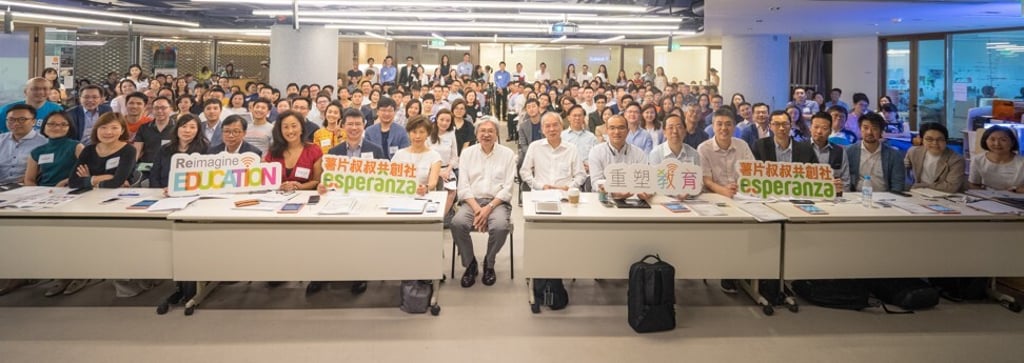
John Tsang, Hong Kong’s former Financial Secretary who has founded the Hong Kong non-profit organisation, Esperanza, with the mission to “build communities of kindred spirits to reimagine and co-create how we learn, live and work”, said that edtech involves more than simply integrating technology into classrooms.
“The global pandemic has highlighted the imperative of equipping our future generations with essential life skills,” he said, adding that technology can be used to enable experiential, inquiry-based and adaptive learning for students.
Technology can also increase teachers’ productivity, allowing them more time to offer personalised support to students. The role of teachers in future will not simply be to pass on hard facts to the next generation, but to help students build character and strengthen useful life skills, he said.
Even before the Covid-19 outbreak, there had been high growth in edtech. Last year global edtech investment hit a record US$18.66 billion.
Edtech start-ups are increasing around the world, with 1,385 of them – 43 per cent of the global total – with headquarters in the United States, followed by India with 327, Brazil (275), the United Kingdom (245) and China (101), according to RS Component’s EdTech Report 2019/20.
The report said Sweden, China and Italy are the top three nations for attracting venture capital (VC), with more than 50 per cent of their start-ups securing funding. Although most VC goes to US start-ups China, Luxembourg and India are the world’s top three countries in terms of VC funding per edtech company, it said.
New edtech innovation already includes things such as learning apps, the use of virtual reality (VR) and augmented reality (AR) in classes, such as a VR field trip, to create dynamic, immersive lessons, game-based learning platforms and artificial intelligence (AI), to help analyse, track and assess students’ learning progress.

Growth of edtech in China
Chan said edtech ventures in China that enable personalised learning and digital literacy, have attracted considerable funding in recent years.
“People are keen on investing [in start-ups] that create capability in people to be 21st century-competent,” he said.
Edtech ventures in the country are also exploring the use of AI and VR to motivate and empower learning.
In 2018, Squirrel AI Learning, a Shanghai-based edtech venture uses AI to design curriculums for students, attracted US$150 million from three rounds of fundraising and employs more than 3,000 teaching staff, it said.
The venture’s AI algorithms mean it can provide personalised lessons for K-12 – primary and secondary school education up to the age of 18 – Joleen Liang, one of the company’s partners, said.
First students take a diagnostic test, then AI algorithms help identify their areas of weakness, after which the students receive lessons that cater specifically to their needs. Liang says the system has cut unnecessary tutoring levels by up to 80 per cent.
“Artificial intelligence has definitely played a very big role in personalising learning,” said Maria Spies, co-founder and managing director of HolonIQ, an education market intelligence platform.

While edtech previously focused on enabling online learning, entrepreneurs are now focusing on how new technological trends can track and enhance learning for students worldwide.
Growlib, a VR-learning venture in Beijing provides solutions for schools across mainland China by designing interactive learning experiences for students.
It said its VR-powered underwater world allows students to explore its virtual ecosystem as they learn about marine life, which boosts their interest in the subject and encourages them to make better use of their knowledge.
By 2030, it is estimated that the world’s edtech market will be worth up to US$10 trillion – a rise of about 50 per cent compared with the current value, a report by HolonIQ said.
Asia remains the fastest-growing edtech market, with China and India representing more than two-thirds of the world’s total edtech capital, it reported.
Spies, who leads the market intelligence platform, said China’s edtech market has been thriving thanks to favourable government policies, huge consumer demand and an abundance of private venture capital.
“China has been pretty on top of education policy as it relates to innovation,” she said.
Last February, the State Council published a detailed blueprint for “modernising” education by 2035, including plans to support the use of information technology and digitalisation to construct “smart campuses” and improve learning.
China has provided a huge opportunity for overseas edtech ventures looking to grow beyond their home markets, says Rebecca Fannin, a media entrepreneur and author of three books on technological innovation in China, most recently Tech Titans of China, which examines the tech ecosystem in Greater China.
Growing influence of Hong Kong
“Many international ventures like to locate in Hong Kong because it is a good base for getting into the China market,” she said.
Hong Kong’s advantages are rooted in its free economic system and abundance of talent, which are crucial for edtech start-ups that hope to develop their businesses in mainland China and the rest of Asia.

Chris Geary, CEO of BSD Education, a Hong Kong-based edtech business, which develops digital learning programmes for schools in 11 countries, said the city is known as the “innovation centre” of edtech because of its sound financial regime and dynamic education system.
“The city has the financial resources to put behind edtech to solve problems in education,” he said.
The Hong Kong stock exchange has been ranked as one of the most attractive locations for initial public offerings (IPO), accounting firm PwC reported in January. Koolearn, a mainland China-based education provider, successfully raised about US$20 million after its IPO last year.
Geary said a dynamic education system is also crucial as edtech ventures often have to find ways to scale their products across different markets. Hong Kong can serve as a launch pad to other parts of Asia because it has “different kinds of schools within the education system”, he said.
The city’s local schools use three different languages as the medium of instruction – Cantonese, Mandarin and English – while international schools follow different curriculums, such as the International Baccalaureate and General Certificate of Education (GCE), he said. This allows him to develop and validate his products across many education systems before promoting them overseas.

Fannin said start-ups wishing to expand abroad should remember that the education landscape can vary depending on local rules and regulations.
“It is not a good idea to go in blindly,” she said. “They should go to incubators and accelerators, and become part of the scene before they make a determination of whether they are able to solve the needs of the local market.”
“They should discuss [things] with a good partner or industry adviser who can help to show you the way, so you don’t make unnecessary mistakes.”
One successful example of regional expansion is Hong Kong-based edtech company Snapask, founded in 2015, which provides an app that helps students with their homework online.
Founder Timothy Yu, who has expanded his business into other Asian countries, such as Singapore and Thailand, says education ventures hoping to develop beyond their home market should “always localise your product, your team and your technology”, as the education landscape can vary depending on local rules and regulations.
“You are trying to solve an issue that is bothering the users every day, so it all comes back to how close you are to the users,” he says.
“Being internationally localised is something any company that wants to succeed should do.”
The master development plan of China’s State Council said Hong Kong will join other southern Chinese cities and be transformed into a world-class innovative hub.
The Greater Bay Area currently consists of the most economically vibrant region in southern China, which added US$1.5 trillion to the Chinese economy, or 12 per cent of China’s national gross domestic product.
Esperanza is working on an initiative to bring innovative edtech ventures to the Greater Bay Area, as well as encourage international partnerships to help education innovators maximise their impact.
In November, the NGO will host the inaugural EdVentures Global Business Acceleration Fellowship, which will invite 12 promising growth-stage education ventures from around the world to a five-day programme in Hong Kong, Shenzhen and Dongguan.
One of the highlights will be the chance to join the Cyberport Venture Capital Forum, where participants can pitch ideas to influential investors, exchange intelligence with other tech start-ups and make new contacts.