When high jewellery becomes strategy

[The content of this article has been produced by our advertising partner.]
Richard Mille’s RM HJ-02 Automatic Tourbillon elevates haute joaillerie from embellishment to a defining force in contemporary watchmaking.
Strengthening a long-term vision for haute joaillerie
Across the industry, haute joaillerie has shifted from decorative flourish to a frontier where technicity, materials science and artistic expression converge. While many maisons regard haute joaillerie as an extension of jewellery, Richard Mille treats it as an integrated watchmaking discipline—engineering it directly into movement architecture rather than applying it just onto the case, a guiding principle that has been central to its 20-year expansion in contemporary horology for women.
The RM HJ-02 marks a decisive step in this evolution. More than a collection, it signals haute joaillerie as a structural, architectural and commercial pillar for the brand. Comprising 12 unique timepieces—each a distinct work of art with its own chromatic identity and composition of 1,399 precious and ornamental stones—the RM HJ-02 required more than three years of development to integrate high jewellery into every surface, from case and buckle to the movement itself. This process stablished the foundation for the collection’s distinct visual and chromatic identities.
A contemporary language of colour and form
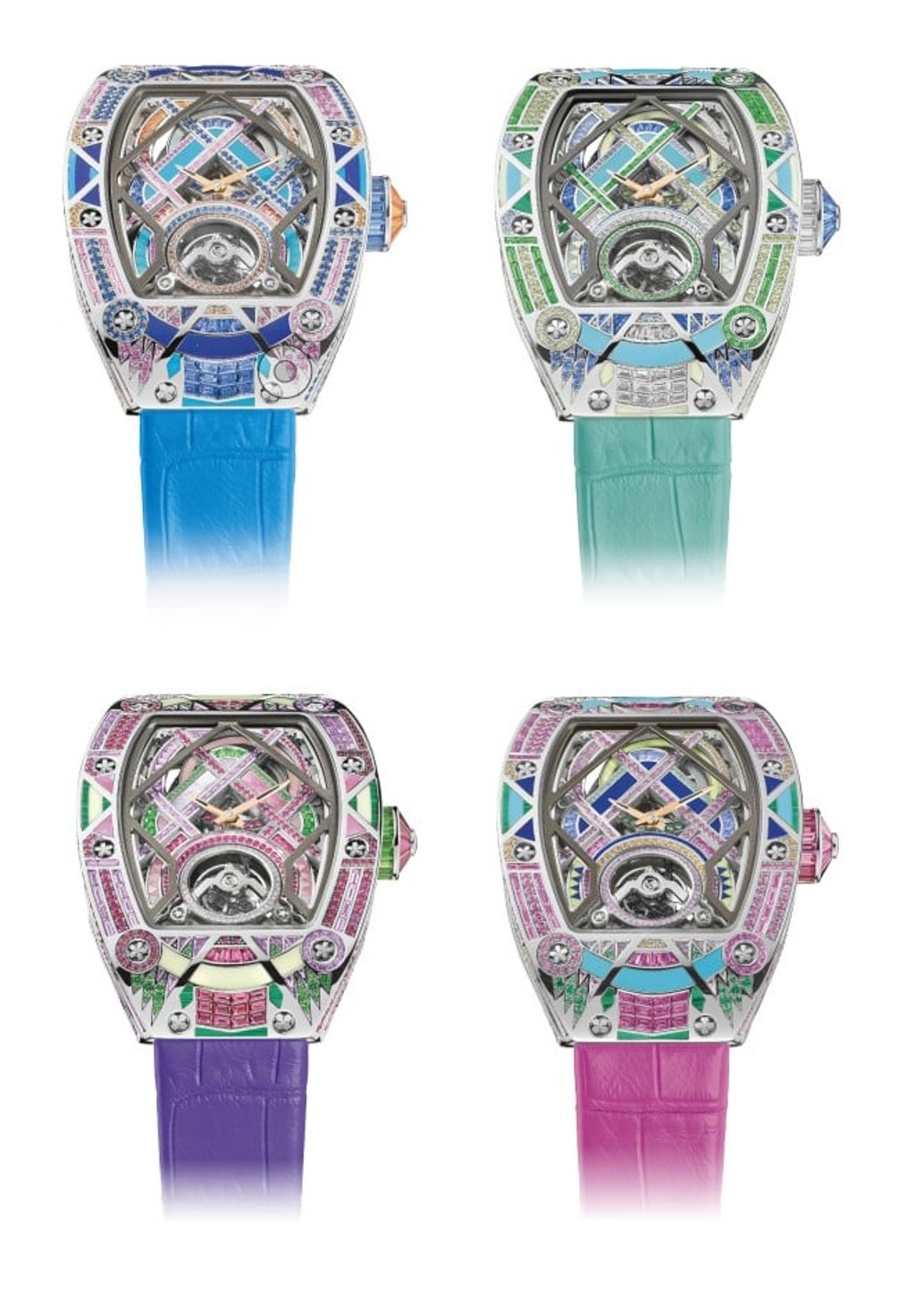
The RM HJ-02 unfolds across four colour families—Blue Ballet, Green Gambit, Violet Variations and Pink Pursuit—each presented in three distinct interpretations. It continues the trajectory set by the RM HJ-01, the brand’s first haute joaillerie line in 2020, which explored the signature tonneau case through the combined lens of high jewellery and Art Deco design. The RM HJ-02 applies this refined language directly to the case, re-drawing it as a three-dimensional form shaped by deliberate shifts in volume and line rather than a single continuous curve.
All 12 watches are one-of-a-kind, with completely different compositions and palettes of precious stones (rubies, diamonds, emeralds, tsavorites and multiple sapphire variants) and rare ornamental minerals including Paraiba tourmaline, turquoise, malachite, chrysoprase, sugilite, opal and mother-of-pearl. Every stone is selected individually from an extensive collection, resulting in highly personalised mosaic layouts notable for their striking visual lines and breath-taking workmanship.
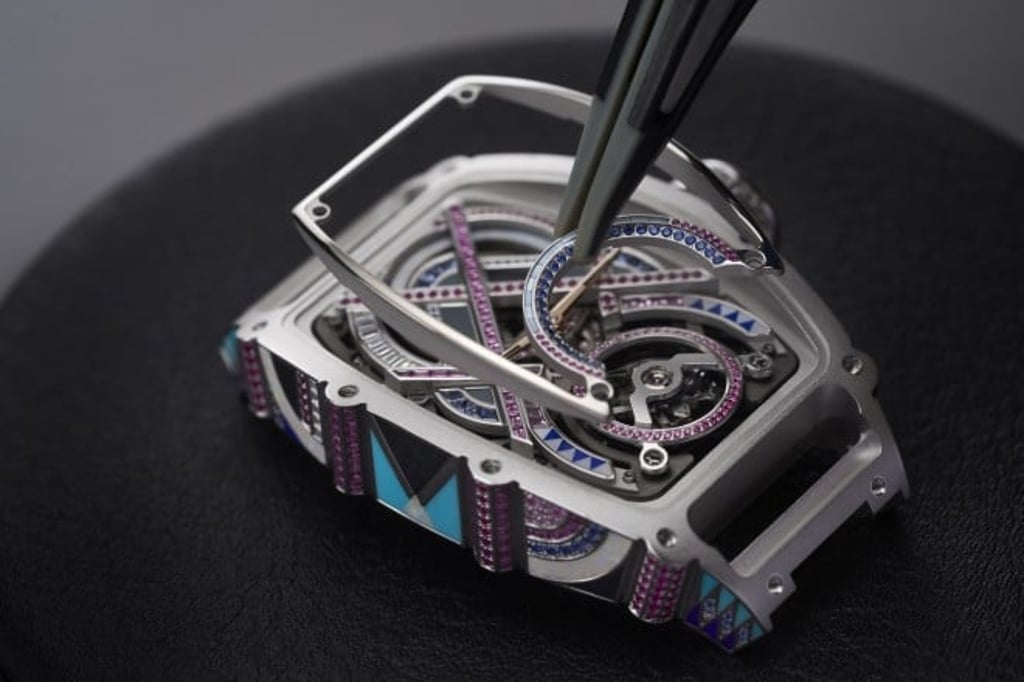
Snow, grain and bezel-setting techniques—chosen for their specific optical effect and architectural role—lend a modern edge to the composition. It emphasises the play of contrasts across the case, caseband and crown, all gem-set within an asymmetric tonneau architecture developed over more than a year.
This interplay of asymmetric geometry and advanced gem-setting signals a broader creative evolution shaped by new leadership and a balance of emotion, savoir-faire and innovation.
A strategic pillar in the Richard Mille ecosystem
The expansion of Richard Mille’s women’s collections—now more than a third of global sales—marked a structural shift for the brand, as Commercial Director Alexandre Mille noted in an interview with WorldTempus, reinforcing women’s watches as a primary growth engine in the company’s revenue mix. The arrival of Cécile Guenat in 2018 accelerated this evolution. As Director of Creation and Development, she introduced a design language that is playful, architectural and technically exacting, seen across the Bonbons, Talismans, Intergalactics and the RM HJ-01.
A graduate of the Geneva University of Art and Design, Guenat brings a multidisciplinary sensibility that dissolves the boundary between watchmaking and jewellery. Her references span sculpture, architecture, colour theory and material experimentation.
For the RM HJ-02, she drew from Art Deco geometry, the ordered gardens of Versailles, Victorian glasshouses and the rhythmic façade of Jaipur’s Hawa Mahal. Colour cues came from Claude Monet’s Water Lilies, The Artist’s Garden at Giverny and the contrasts of abstract painting.
Cross-disciplinary craftsmanship
In the RM HJ-02, gem-setting is the starting point. Each watch is conceived as a high-jewellery architecture in which stones form the structural foundation. This begins with precise lapidary work: many ornamental stones are too delicate for conventional cutting, so they are milled directly from the source to achieve the required accuracy.
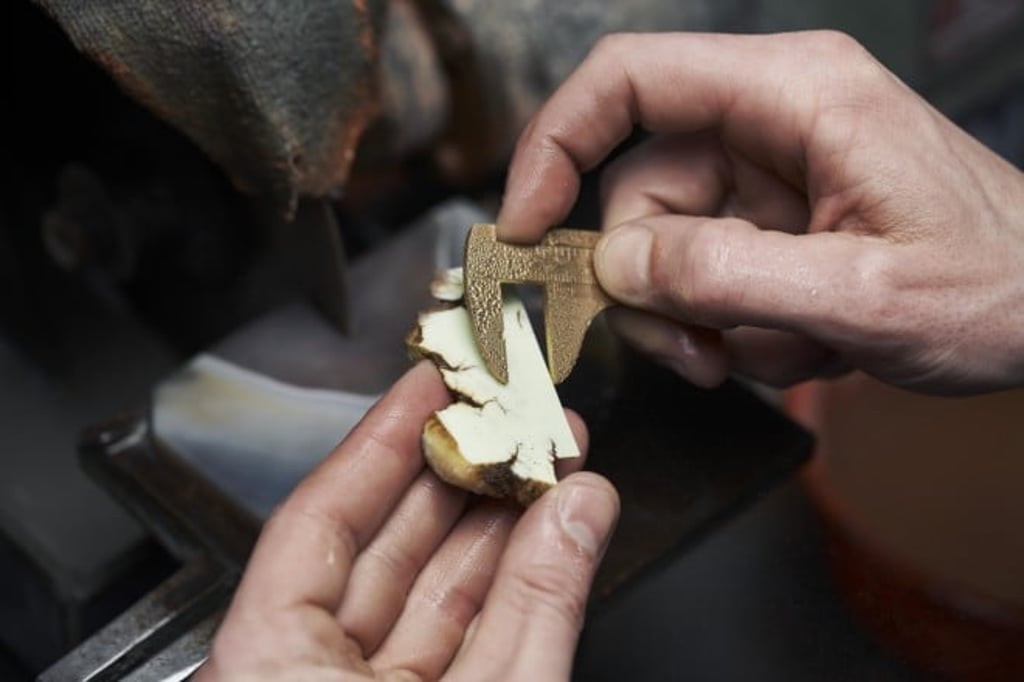
Each gem is chosen not only for colour and clarity, but for how it behaves in combination—how tsavorite anchors sapphire, how chrysolemon or mother-of-pearl softens, how opal or turquoise shifts a palette’s temperature. These combinations become three-dimensional layouts that must respect case tolerances, screw positions and movement constraints while still reading as effortless on the wrist.
Realising this vision demands a level of technicity that defines the brand’s craft. Snow, grain and bezel-settings are treated as structural decisions that determine how light, colour and geometry move across the watch.
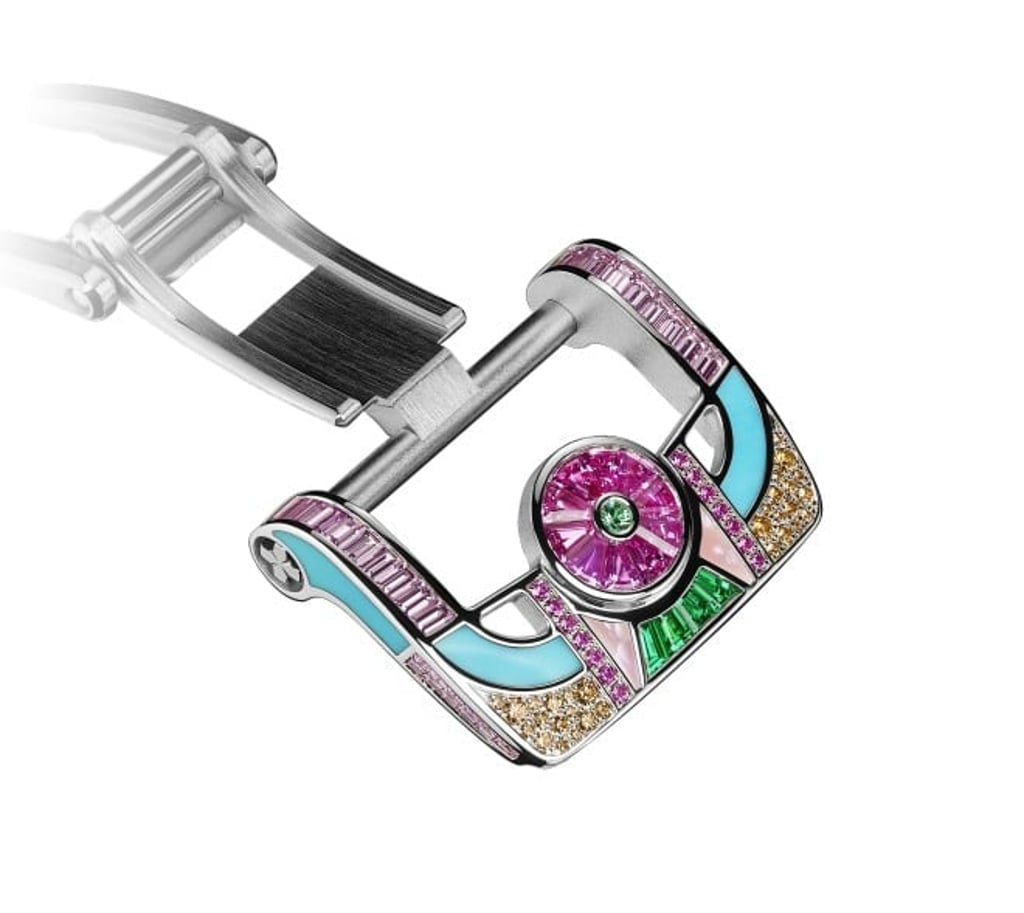
The creation of Richard Mille’s in-house gem-setting workshop in 2019 reflects a deliberate move toward vertical integration—an industrial strategy that strengthens control over innovation, execution and creative coherence. Engineers, designers and gem-setters work as a single unit, carving minute cavities with micron-level precision, and inserting gold claws by hand to secure each stone. The buckle is gem-set using the same techniques as the case and is treated as part of the overall architectural composition. The gem-setting work alone requires 458 hours, and with preparation, adjustments and quality control, nearly 700 hours are devoted to each watch.
A movement designed as part of the architecture
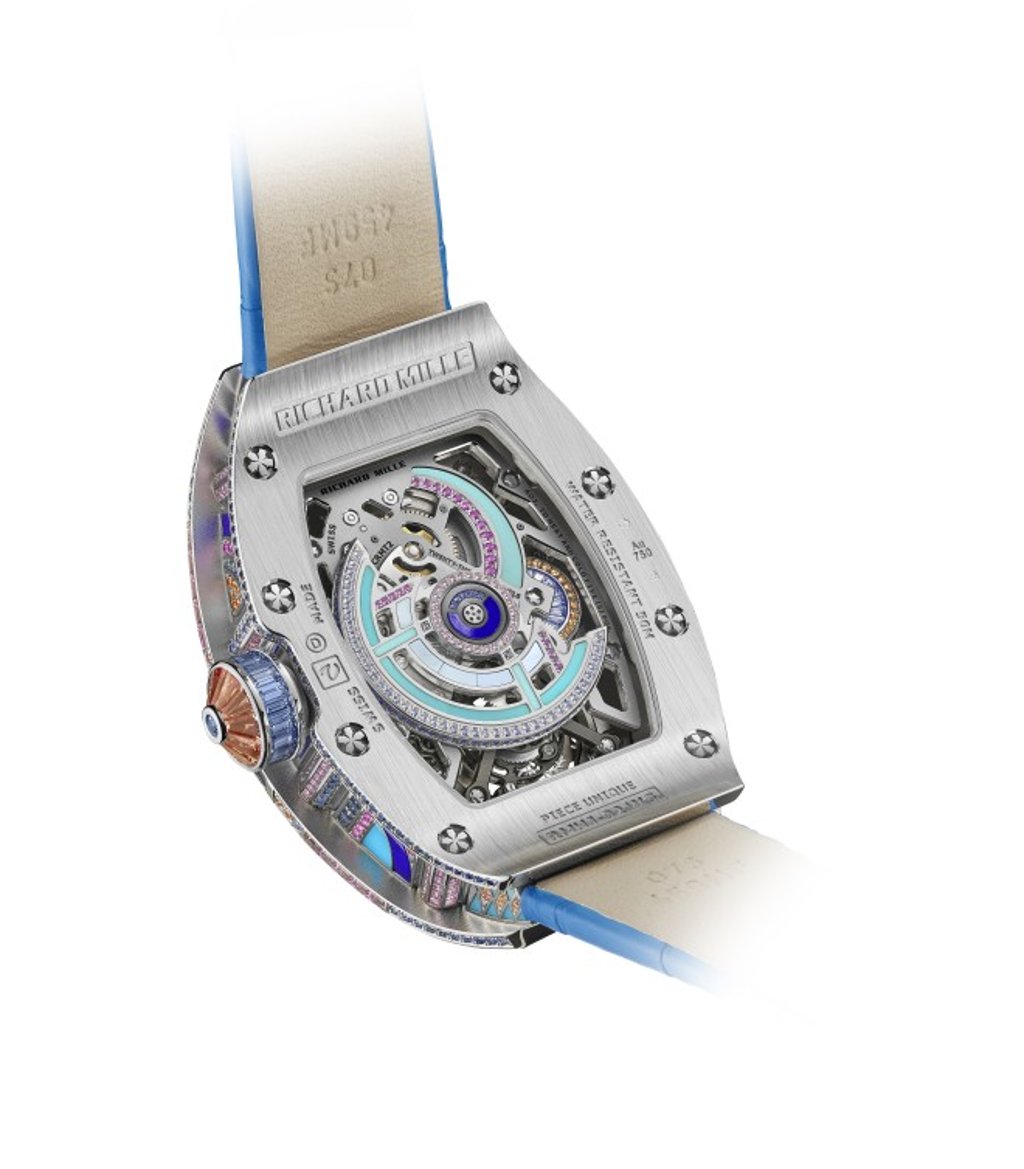
At the heart of the RM HJ-02 is the new skeletonised CRMT2 in-house automatic tourbillon calibre. Its white-gold baseplate and bridges are gem-set, creating visual continuity between the mechanical core and the exterior composition. Even the oscillating weight is gem-set, transforming a functional component into an artistic one without compromising performance.
The RM HJ-02 positions haute joaillerie as a strategic frontier for the brand, where engineering, architecture and jewellery function as a single discipline. It reframes high-jewellery watchmaking as a driver of future innovation, asserting Richard Mille’s leadership and signalling the direction in which the brand intends to move.