Cathay United Bank brings ESG lending to life
The Taiwanese lender launches its own Sustainable Product Framework in Hong Kong while expanding its sustainable portfolio across Southeast Asia

[The content of this article has been produced by our advertising partner.]
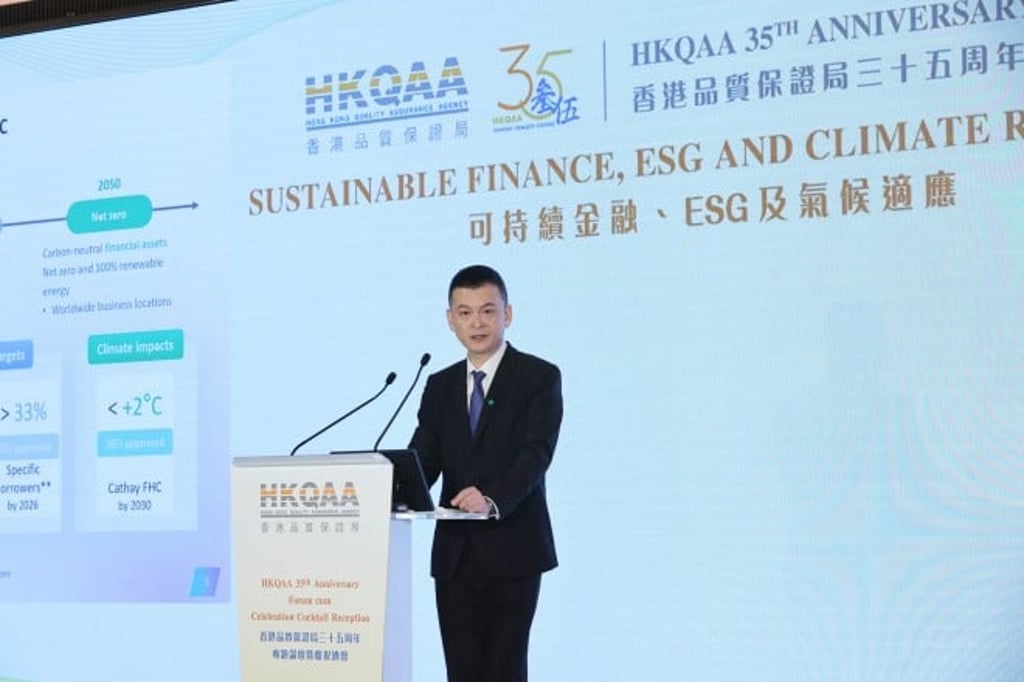
Cathay United Bank (CUB) has launched its Sustainable Product Framework in Hong Kong, with third-party validation from the Hong Kong Quality Assurance Agency (HKQAA).
The launch expands the bank’s green finance strategy in the region, enabling Cathay United Bank Hong Kong Branch (CUBHK) to offer a full suite of products – including Sustainable Deposits, Green Loans and Bonds, Sustainability-Linked Loans (SLL) and Bonds, as well as Transition Finance – all structured to meet international standards and deliver local credibility.
The new offerings build on CUB’s growing track record across Asia, from structuring SLLs with verifiable KPIs in Hong Kong to financing clean energy projects such as wind farms in Vietnam.
“Sustainability isn’t just a regional or short-term trend. Even with some governments changing direction, the reality of climate change and industrial transformation means finance has a responsibility to act – and act globally,” said Executive Vice President Michael Wen.
In a broader sense, he views sustainability as a cross-cutting imperative that spans borders, industries and company cultures.
Leveraging Hong Kong’s green finance ecosystem
Hong Kong’s aspiration to become Asia’s green finance hub has provided fertile ground for CUB to expand its sustainable finance portfolio.
Launched in August, CUBHK’s framework is the first of its kind among the bank’s overseas branches. It has already supported the rollout of a sustainable green deposit product for corporate clients.
"We wanted a structured approach," Wen explained. "This framework gives us a foundation to scale products systematically and credibly, aligned with international standards. HKQAA’s role as a verifier adds local credibility."
Locally, this framework enables CUBHK to introduce ESG products in Hong Kong and embed internationally recognized KPIs and performance targets into the structuring and monitoring of such deals.
Some high-profile deals closed earlier also reflect CUBHK’s ongoing commitment in advancing the green finance development in the city.
CUBHK served as the Mandated Lead Arranger, Bookrunner and Underwriter (MLABU) for Hong Kong Broadband Network’s HK$6.75bn syndicated SLL, with ESG-linked interest rate adjustments tied to climate and cybersecurity goals.
In a separate deal, CUBHK helped lead a syndicated SLL for Silver Dragon Water Supply Group, working closely with HKQAA to set verifiable ESG metrics.
CUB adopts a sector-inclusive approach to sustainable finance. “We don’t limit ourselves to certain industries. If a company is genuinely committed to ESG improvement, we’ll help arrange the most suitable financing solutions for them.” Wen explained.
In Taiwan, the bank’s SLL borrowers come primarily from tech and non-tech manufacturing, transportation, retail and so forth. In Hong Kong, CUBHK is exploring opportunities in clean energy, infrastructure and non-bank financial institutions.
Elsewhere, the bank is particularly active in Southeast Asia, with presence in nine of the ten ASEAN member countries, including Vietnam, Thailand, Singapore, Malaysia, the Philippines, Laos, Cambodia, Myanmar and Indonesia. Branches in Vietnam, the Philippines and Singapore have achieved significant progress in sustainable finance.
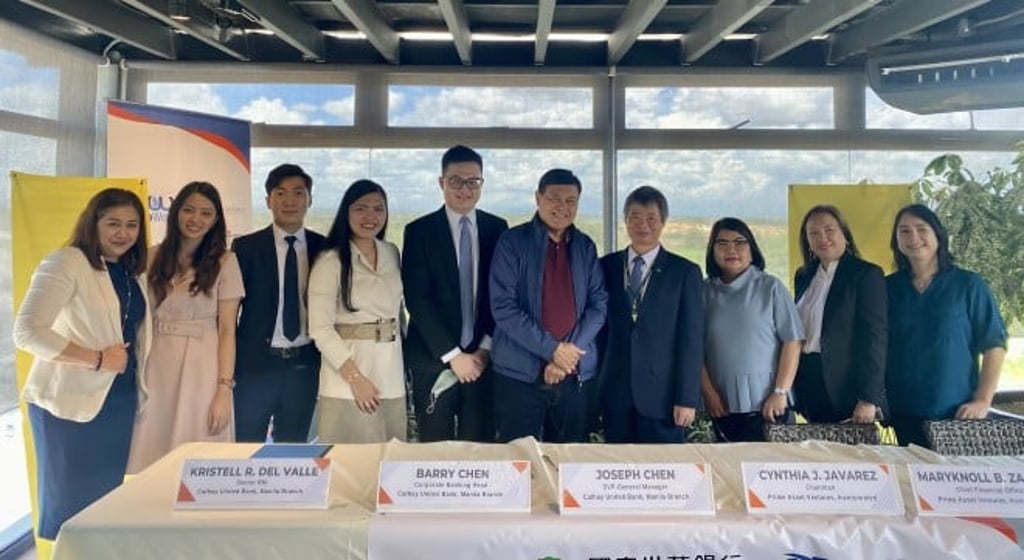
Wen cited an onshore wind farm financing in Vietnam, co-arranged with the Asian Development Bank (ADB) and a bilateral SLL with Prime Asset Ventures, Inc (PAVI) in the Philippines, supporting tap water supply system under the Villar Group.
“Vietnam has a population of over 100mn people, strong solar exposure and a growing manufacturing shift from China. It is ideal for clean energy infrastructure investment,” he said.
He answered: “For SLLs, we tailor KPIs and SPTs based on each borrower’s industry and material issues with potential for improvement. For green loans, we carefully designate the facility’s purpose and establish effective, feasible cash flow management approaches.”
Although most of CUB’s internal talent comes from a finance background, the bank draws on clients’ public disclosures and external experts for technical due diligence.
In Taiwan, it supplements internal capabilities through partnerships with quasi-governmental agencies and private research institutions.
A win-win for SMEs and employees
To make ESG finance more accessible, CUB adopts a unique approach that engage SMEs and individual employees.
In Taiwan, CUB has launched the “SME Sustainable Finance Partner Project”, which combines SLLs with its innovative sustainability-linked payroll accounts to reward both corporate borrowers and their employees for meeting sustainability targets.
“As long as a company meets its pre-determined targets for reducing water and electricity usage per unit of sales revenue, we offer benefits not just to the company but also to its employees, such as higher deposit rates or fee waivers,” Wen explained.
“It’s a win-win-win: the company reduces costs, employees feel engaged and receive tangible rewards, and the environment benefits.”
“We recognise that smaller companies often lack the resources for ESG disclosure and external verification. That’s why CUB typically uses standardised KPIs, water and electricity consumption per unit of sales revenue, which are known as water and electricity intensity.”
Although CUB tailors KPIs and SPTs for its SLL borrowers, it uses simpler yet verifiable metrics –utility intensity – for clients involved in this project, as utility consumption can be easily substantiated by utility bills. Additionally, electricity savings are directly linked to measurable carbon reduction.
While currently implemented only in Taiwan, the model has potential to expand into overseas markets. Wen added: “The idea is simple, but it’s a testament to the meaningful financial influence a bank can have.”
This level of discipline, he emphasised, is key to avoiding greenwashing, a concern increasingly raised by regulators and stakeholders.
Compared with other regional banks, Wen believes that the bank’s competitive advantage lies in agility, local insight and a willingness to engage SMEs others might overlook.
“We’re here to help our clients transition, grow responsibly and be part of something bigger.”