The AI enterprise that wins: why strategy, not software, makes the difference Eraneos – Anni Chi is a Business Reporter client.
A point of view on the future of the AI enterprise

[The content of this article has been produced by our advertising partner.]
Most executive teams are no longer asking whether AI matters. The harder question is why so many AI pilots, tools and experiments are yet to translate into measurable business value.
Across industries, many companies struggle to move from experimentation to scaled impact. The issue is rarely the technology. It is the lack of clarity on where AI should create value, who owns the agenda and how people should work with it every day.
AI is the most significant disruption any industry has faced since the Digital Revolution. It means rebuilding the company around a new kind of intelligence.
Two budgets, two ambitions
Most enterprises are running their AI agenda on a single track: chasing efficiency in finance, HR, operations and IT.
But efficiency is not a strategy. It is the entry ticket.
The companies that will define the next decade are running a second, harder programme in parallel: using AI to make their core competency materially better.
For a bank, that may mean better underwriting, fraud detection, compliance review or client advice. For a manufacturer, it may mean engineering knowledge retrieval, predictive maintenance, quality inspection or supply chain intelligence. For a logistics player, it may mean route optimisation and network design. For a healthcare group, it may mean diagnosis support, patient triage and a better patient experience.
These are not only productivity improvements. They are capability shifts that make the company harder to compete with.
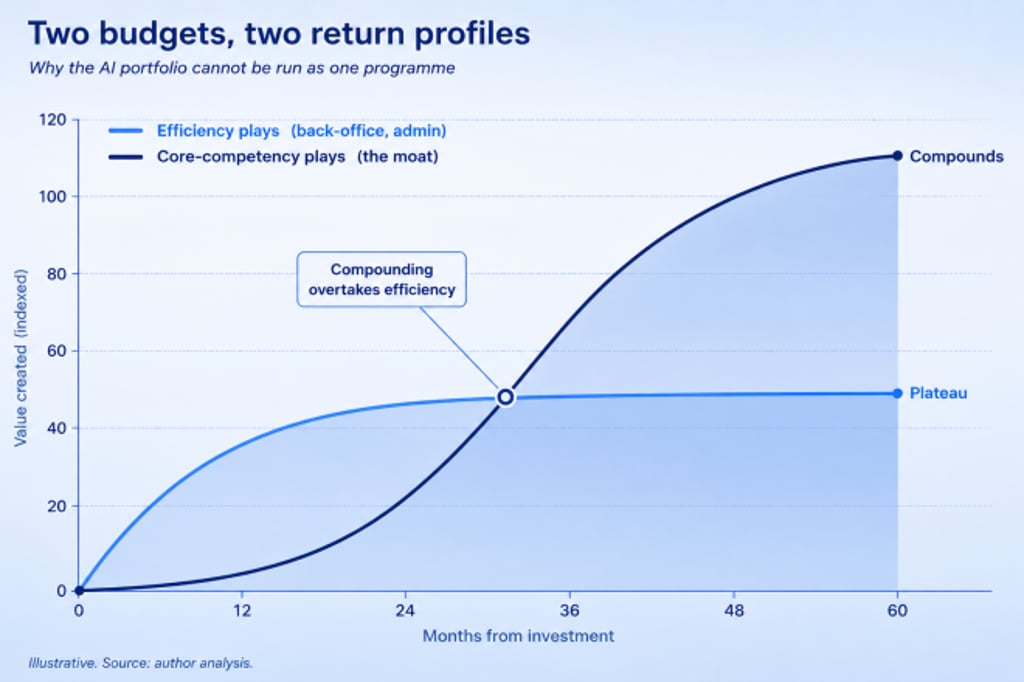
Confuse the two and you will end up with a tidier back office and the same vulnerable business.
Tools are not transformation
Many organisations are now buying AI platforms and copilots. But buying AI tools is not the same as building AI capability.
A tool can accelerate work. It cannot decide which use cases matter most, fix unclear ownership, weak governance, or turn scattered pilots into a repeatable capability.
That is the leadership task.
The companies that win with AI will not have the longest list of experiments. They will know which to stop, which to scale and how to embed them into the business. What they need is focus and the discipline to connect AI to how the company creates value.
AI will not replace people. People who use AI will replace people who do not.
The fear in the room is rarely about the technology alone. It is about identity. Will my job still exist? Will my expertise still matter? Expertise will still matter. But it will be expressed differently.
The analyst who uses AI to read 200 documents before lunch will outpace the one who reads 20. The cloud architect who uses AI to map application dependencies, size workloads and sequence a data centre migration in days will outpace the one who runs the same exercise in months. The engineer who uses AI to retrieve knowledge, test options and challenge assumptions will outpace the one who works only from memory.
The threat is not the machine. The threat is the colleague, competitor or new entrant who has learned to think with it.
As machines get smarter, human skills get more valuable
Here is the paradox: the more capable AI becomes, the more soft skills move to the centre of value creation.
When everyone has access to similar models, the differentiator is no longer who produces the first draft. It is who asks the better question, frames the sharper problem and judges the trade-offs.
Judgement. Curiosity. Ethics. Storytelling. Commercial instinct. The ability to disagree well. The ability to read the room and build trust.
These are not nice-to-haves in the AI enterprise. They are the scarcest, most expensive inputs into any decision worth making.
In a world where customers and partners increasingly suspect they are talking to a bot, genuine human interaction becomes a premium. The handwritten note, the unhurried meeting, the leader who listens: these are competitive advantages.
AI can produce options. Humans still create meaning, trust and commitment.
Are you running AI as a technology programme, or as a transformation of how your company creates value?
The first is a procurement exercise. The second is a leadership act that reshapes strategy, culture, talent and the rhythm of work.
Only the second produces winners.
Invest in efficiency to fund the journey. Invest in your core to win it. Invest in your people most of all, because in the end, the AI enterprise is still a human one.
Anni Chi is Managing Director and Head of Asia at Eraneos Singapore Pte Ltd. She has more than 15 years of consulting experience across Europe and Asia, advising boards on strategy, digital transformation and AI. She is an EMCC- and ICF-certified Executive Coach.
Contact: www.linkedin.com/in/anni-chi
Eraneos is an international strategy, transformation and technology consulting group with 1.300 employees and offices across Europe, Asia and the US.