How foreign investment shapes Chinese startups
A new study shows foreign firms help foster local businesses, until they start crowding them out

[The content of this article has been produced by our advertising partner.]
Cross-border capital flows are no longer just about money. When multinational companies build factories or expand operations overseas, they bring along technology, management know-how, supply-chain connections, and access to international markets. In this case, inward foreign direct investment is often viewed as an engine for local growth and competitiveness.
However, many also view foreign investment cautiously, citing concerns about potential harm to domestic industries. Policymakers around the world have issued regulations to limit foreign investment, such as national security screenings, sector-specific prohibitions, capital requirements, and the like, to safeguard local interests.
For China, foreign investment is paramount. The Ministry of Commerce reported that 70,392 new foreign-invested firms were established last year, a 19 per cent year-on-year increase, while pledging more policy support. Meanwhile, Chinese companies are actively expanding abroad and venturing into advanced technologies. There is clear evidence that foreign capital can boost local businesses, but to what extent?
“Over the past two decades, provinces in China that attracted significant foreign direct investments have experienced a rapid increase in the establishment of local firms, while less foreign-invested regions continue to struggle,” says Ma Xufei, Professor and Chariman of the Department of Management at the Chinese University of Hong Kong (CUHK) Business School. “Hence, we take a detailed approach to explore how foreign firms influence local entrepreneurs.”
Professor Ma’s new study, Beyond direct impact: Exploring inward FDI’s multifaceted effects on new venture creation, takes a close look at the conundrum. In collaboration with Luo Lingli and Lei Linan of Zhejiang University, as well as Yamanoi Junichi of Waseda University, Professor Ma finds that foreign investment brings opportunities for local startups, within certain limits.
The 48 per cent threshold
The team analyses data covering all Chinese-registered firms from 2013 to 2023, and discovers that more foreign investment isn’t always better. When foreign companies operate in the same industry and province as local firms, the benefits to local counterparts increase up to a point, and become detrimental as they move further, forming an inverted U-shaped trajectory. Such benefits peak when foreign firms account for 48 per cent of all the sales in a specific industry and province.
Below this threshold, local firms can learn technologies, managerial expertise and marketing insights from their foreign counterparts through knowledge transfer, or Professor Ma calls it spillover. “At this level, foreign firms still struggle to adapt to local markets, providing local entrepreneurs with novel opportunities to capitalise on,” he says.
As foreign investment rises, competition intensifies, and the space for new entrants narrows. At this stage, foreign firms’ domination drives up costs and attracts local talent with higher pay and benefits. “As a result, the influx of foreign competitors can discourage local startups and make it harder for them to survive,” he adds.
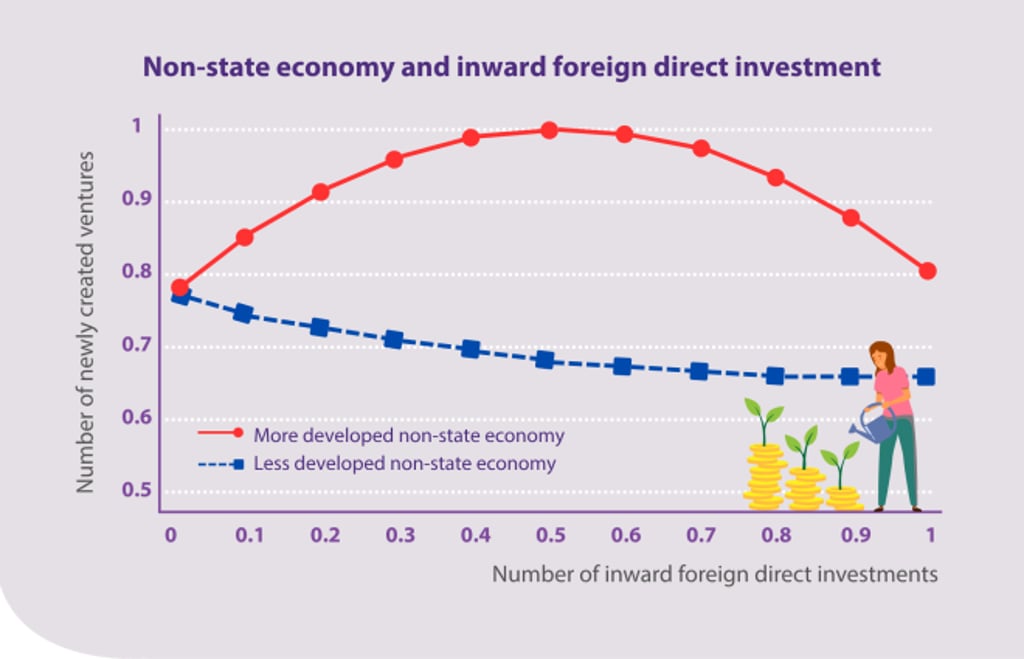
Entrepreneurial environments also shape the extent to which foreign investment helps or harms local businesses. Specifically, the study indicates that the more developed a region’s non-state economy, or how much a region is driven by private businesses and market forces rather than government control, the more it enhances the positive spillover effects.
A stronger non-state economy encourages cooperation between local and foreign firms and facilitates positive spillover. “Such supportive environments often have clearer rules, which make it easier and cheaper to do business, helping local entrepreneurs create and scale up their new ventures,” Professor Ma says.
Looking for a safe haven for local growth
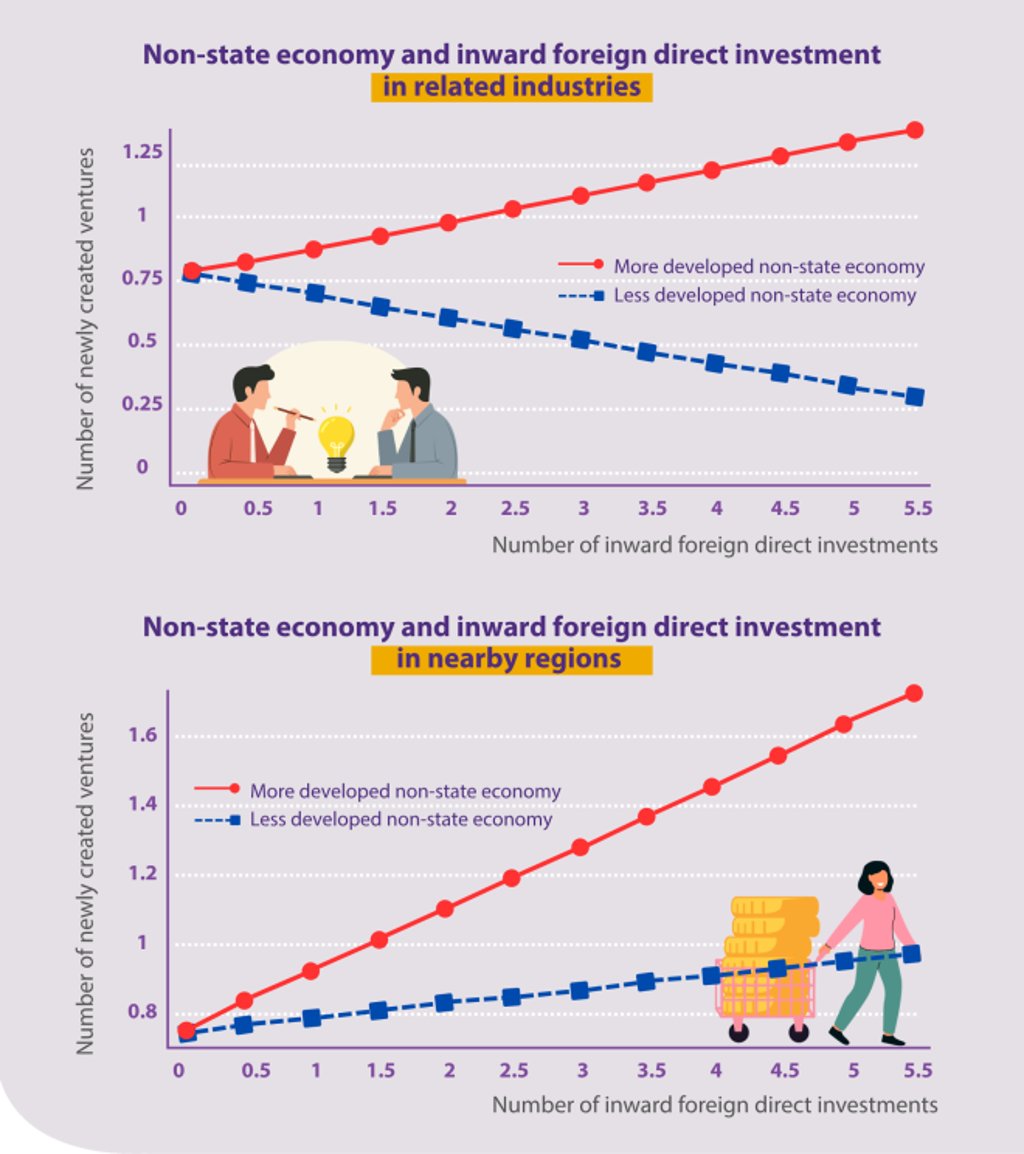
So, how can local entrepreneurs make the best of inward foreign direct investment? The study finds that instead of competing head-to-head, local entrepreneurs can learn from foreign friends and apply the know-how to related industries or other regions with similar customers, products, or operational requirements.
For instance, if foreign automakers invest heavily in a region, local startups in related industries, such as auto parts manufacturing or electric vehicle batteries, can benefit by supplying these firms or adopting their production techniques. In regions with significant foreign investment in the technology sector, startups in software development or IT services may leverage the knowledge and customer base built by foreign firms.
“Local entrepreneurs can identify the related industries by analysing value chains and looking for suppliers, distributors and customers of foreign-invested industries. After that, they shall identify industries that share labour pools, technologies, or customer bases,” Professor Ma adds. “By redirecting their target markets to related industries or neighbouring regions, local entrepreneurs can use what they learned with less direct competition from foreign firms.”
What can policymakers do?
While foreign investment can be a powerful engine for learning and growth, its benefits to local communities are not guaranteed. Therefore, Professor Ma suggests that local regulators implement targeted investment promotion, balanced competition policies, cluster development, and regular monitoring.
Attracting foreign firms in industries with high growth potential can be achieved by offering tax incentives, subsidies, or streamlined regulations. Regulators should also support local firms through subsidies, training, or access to financing to ensure they can coexist with foreign firms.
To facilitate spillover further, industrial clusters where foreign and local firms can collaborate would provide infrastructure and networking platforms. “The regulator should also continuously monitor foreign direct investment levels to ensure they do not exceed the threshold where competitive pressures outweigh learning opportunities, and adjust the policies accordingly,” he adds.
The findings can also be partially generalised to other countries, especially emerging markets, but with caution. Countries with diverse regions and significant economic disparities may experience dynamics similar to those of China, but countries with a weak non-state economy may observe different effects.
“The type of industries also matters,” says Professor Ma. “The presence of multinationals in industries like technology or manufacturing may generate effects comparable to those observed in China, but other sectors like agriculture or resource extraction might behave differently.”
About Professor Ma Xufei
Professor Ma Xufei is a Professor and Chairman of the Department of Management at CUHK Business School. His research focuses on strategic management, international business and innovation, and entrepreneurship. He received the Haynes Prize for the Most Promising Scholar from the Academy of International Business, became the first Chinese Dunning Fellow at the John H. Dunning Centre for International Business, and was awarded the Journal of International Business Studies 50th Anniversary Silver Medal.