A framework for a GBA future
Brought to you by: Qianhai International Liaison Services

[Sponsored article]
‘Innovation driven and reform led’ is the vision for future growth set out in the Outline Development Plan for the Guangdong-Hong Kong-Macao Greater Bay Area released last week by the Central Committee of the Communist Party of China and the State Council.
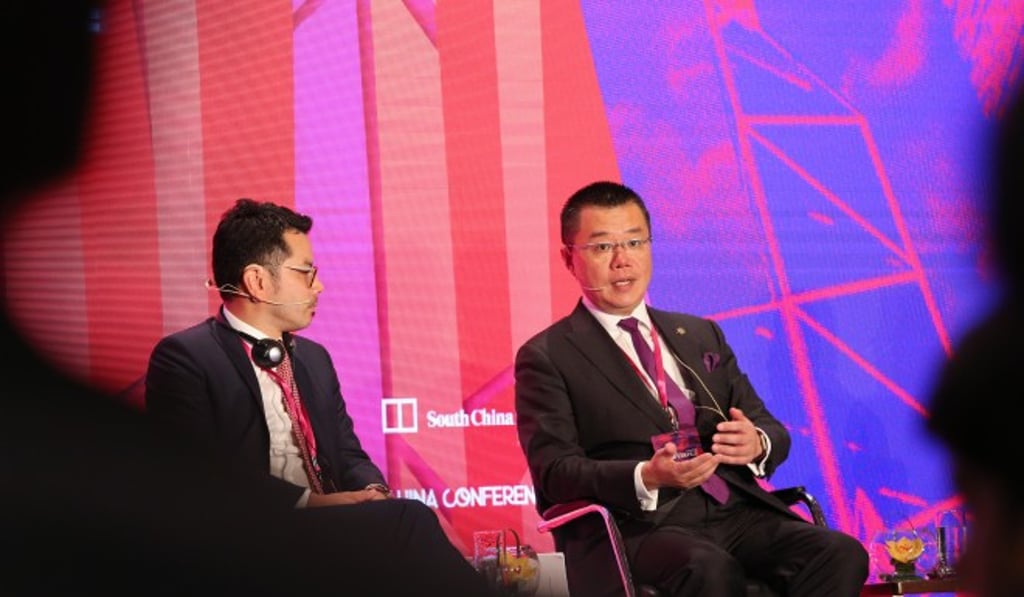
Speaking at the SCMP's 2019 China Conference, shortly after the launch, Professor Witman Hung, principal liaison officer for Hong Kong with the Shenzhen Qianhai Authority, said he was very happy with what he had read in the document, and agreed, “we need to grow the Greater Bay Area using technology and innovation.”
Reform is required, he added, because of the mismatch between Hong Kong and the mainland when it comes to areas such as their differing legal systems, business practices and administration procedures. This mismatch manifests itself in a number of ways, including in the processes used when applying for a company license, and in the difficulties Hongkongers have in accessing appropriate medical and education services when living and working across the border. “But these issues are all addressed in this document,” Professor Hung noted.
While a direction for development, and the supporting policies required for this development, are all described in the outline, he said it was right that Beijing wasn’t attempting to micro-manage the Greater Bay Area (GBA) project. “Instead, they’re letting the market decide and they’re letting the cities work together.”
Despite being “pleasantly surprised” that the outline places such a huge emphasis on Hong Kong’s role, he doesn’t see this as a case of unfair bias, just simple recognition of the fact that the SAR’s uniqueness is what makes this bay area different to other such regions within China.
“We have one country two systems, we have an international city, and we have an international financial centre,” he said. What’s more, the city is also a world-class centre for logistics and maritime trade, and the completion of Hong Kong International Airport’s third runway will only serve to cement its place as a global passenger and air cargo hub. In addition, he suggested, it has the legal system and talent to make itself the dispute resolution centre for Asia.
But, he emphasised, it is only when all these strengths are coupled with, for example, Shenzhen’s capacity for technological innovation and creativity, that the GBA can begin to realise its full potential.
The GBA document contains roughly 200 different policy items, both large and small. These aim to making it easier for businesses to operate and grow, and for individual people to live and work across the region.
One such point states that Hong Kong and Guangdong will be encouraged to establish a joint fund for investment on both sides of the border. “This is something we have been talking about for some time, but I wasn’t expecting it to be delivered in this document,” said Professor Hung. “Nonetheless, the success of the project starts with infrastructure.”
The ability to move smoothly and quickly within the cities in the GBA is essential, and he would like to see, in particular, the development of a cross-border mass transit system between Hong Kong and Shenzhen. Even more specifically, he suggested that a wider range of border checkpoints are opened up to the flow of ‘double plate’ cars in and out of Hong Kong.
Significant challenges await, though. One issue which will certainly need to be addressed is the removal of taxation disincentives across the GBA. And, Professor Hung added, research collaborations between industry and universities need to be strengthened. “This is one of the weakest links in our technology infrastructure. In China and Hong Kong there is not enough of this sort of collaboration in comparison to what’s happening in the States or in Japan.”
He said the problem had been that up until now the collaboration process had been based on a ‘push’ approach”, where the universities conducted research and then looked for a commercial use for their innovations, rather than having the research being industry-led.
The schedule laid out in the outline document states that the ‘framework’ of the GBA should be in place by 2022, and it should have become an effective economic system supported by innovation by 2035. Beijing has confirmed that the wording of the document’s text is significant and while, not prescriptive, a careful reading of the document uncovers the ‘how’s’ as well as ‘what’s’ that will enable this schedule to be met, Professor Hung believes.
“Many times in the document the phrase ‘under the market principle’ is used,” he pointed out, and it will therefore be up to the tens of millions of people living within the GBA to make the most of the opportunities that will be created.
Prof. Witman Hung is principal liaison officer for Hong Kong with The Shenzhen Qianhai Authority and was a speaker at SCMP’s China Conference on February 21.