Timeless Chinese wisdom to navigate business uncertainty
- A CUHK expert shares insights on how ancient teachings from the I-Ching help manage challenges in the current economic turbulence

[The content of this article has been produced by our advertising partner.]
In the time of geopolitical tensions, economic volatility and technological upheaval, individuals and businesses face a pressing question: How to thrive amid these constant disruptions? The insights may lie in a Chinese text with a history spanning more than five millennia: I-Ching, also known as the Book of Changes.
The I-Ching serves as a tool for divination in traditional Chinese knowledge and has become a profound philosophical classic. The book includes 64 symbolic hexagrams that represent various natural phenomena and mirror human life experiences.
Despite being an ancient text, the wisdom of the I-Ching is timeless as it emphasises adaptive thinking – an approach highly relevant to today’s world. Scholars and practitioners have used the book symbolically, often to provide guidance for moral decision-making. Its hexagrams can be interpreted in various ways, often adopting broader cosmological meanings applicable to daily life.
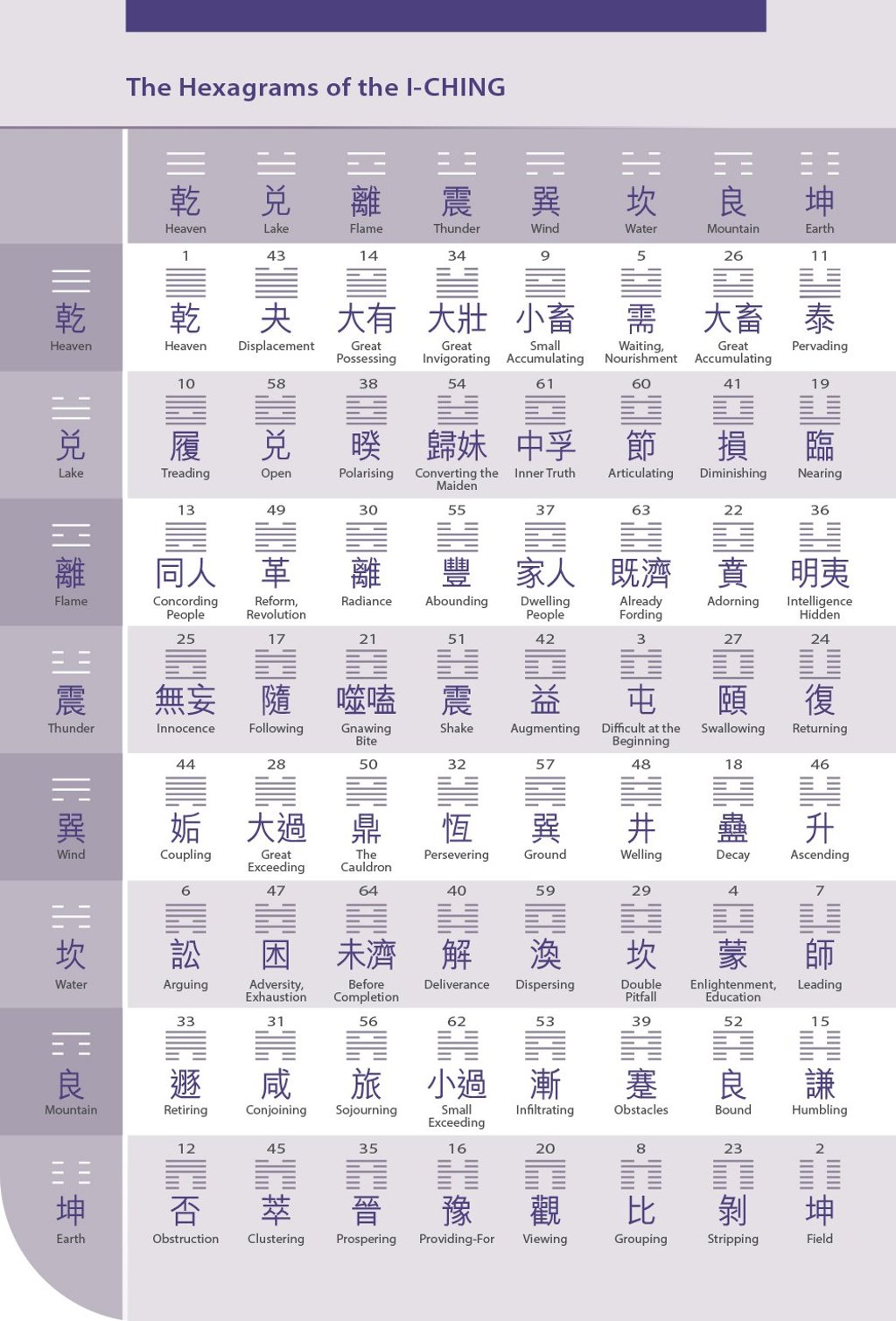
In the I-Ching, each hexagram is composed of six horizontal lines representing the interplay of yin (“⚋”) and yang (“⚊”), which are opposite yet complementary forces. The yin and yang symbol first combine to form eight basic triagrams, which are then further combined in pairs to create 64 complex hexagrams.
To fully grasp a hexagram’s message, one can start by carefully interpreting three basic elements: the name of the hexagram, a general explanation of the hexagram’s significance, and the meanings of each horizontal line within the hexagram.
For example, the first hexagram, qian (乾 or heaven), depicts the vigorous movement of heaven and indicates that individuals should constantly strive to improve themselves. While this hexagram encourages individuals to work hard, its six lines are associated with the journey of a dragon through six stages – also a metaphor for leadership growth.
The first stage, “a dragon hiding in the deep,” symbolises the early stages of a career, where bold actions might be inappropriate due to a lack of authority or experience. By the fifth stage, the dragon soars, representing the pinnacle of success after overcoming challenges. However, the sixth stage warns of “an arrogant dragon,” illustrating a common theme in Chinese culture: excess often leads to downfall.
From collapse to renewal
Hong Kong, like many other economies, is grappling with significant challenges as it manoeuvres the US-China trade tensions, the sluggish property market and the struggling retail sector. Professor Sin identifies two hexagrams that may help people have a better understanding of the current circumstances.
The 23rd hexagram, bo (剝 or stripping), describes the collapse of brightness (yang) due to a victory and invasion of darkness (yin). Due to the rapid and unpredictable change in macro-environment, Hong Kong is losing its competitive edge. “But don’t be too pessimistic, there is always a solution,” he says.
The subsequent hexagram may offer hope. The 24th one, fu (復 or returning), describes “thunder stirring beneath the earth”, depicting the retaining of brightness in total darkness, which signals nascent renewal. However, as the power of the thunder is still very weak, this recovery takes time to gain momentum. “Therefore, Hong Kong should prioritise and concentrate on developing one or two key industries before expanding further, which can help the city regain its competitiveness in the future,” he adds.
Lessons for global relations
Beyond addressing local challenges, the I-Ching also offers valuable insights that can shed light on international relations. For instance, Professor Sin uses the other two hexagrams to dissect the ongoing trade disputes between the US and other countries in recent months.
“A nation can adopt one of two stances in response to such trading tax conflicts: embodying the essence of the sixth hexagram, song (訟 or arguing), or resonating with the seventh hexagram, shi (師 or leading or army),” he says.
More specifically, he underlines that the sixth hexagram represents resolving conflicts through humility and negotiation. This approach reflects diplomatic efforts to ease tensions during trade wars. On the other hand, the seventh hexagram suggests that beneath the surface, tension is building, potentially leading to retaliatory actions such as tariff exchanges.
This wisdom can give us direction on what to anticipate in the global landscape following the trade war. According to the I-Ching principle, following the above two hexagrams is bi (比 or grouping). Professor Sin elaborates that this hints at a scenario where nations may polarise into opposing factions, which could escalate the risk of conflict or even war, although the full implications of these developments remain to be seen.
Empowering decisions with I-Ching
“The I-Ching studies the changes of all things,” Professor Sin adds. “By carefully observing and interpreting current events, individuals can identify and analyse the corresponding hexagrams, paving the way for informed decisions and sound judgments in the face of uncertainty.”
However, he highlights that understanding and applying the I-Ching in real life is not a simple task. “Knowledge and information are easy to access today, but wisdom is not. To truly benefit from the I-Ching, one must be passionate and willing to invest effort in learning and thinking I-Ching.”
While the I-Ching can help individuals and businesses enhance their analytical, predictive and decision-making abilities, Professor Sin stresses that it does not determine destiny. “The book only reveals options, not outcomes,” he says, “Ultimately, we still need to make our own judgements.”
About Professor Sin Yat-ming
Professor Sin Yat-ming received his BBA degree from CUHK in 1979 and obtained his PhD in marketing from the University of British Columbia in 1993. He was the vice-chairman of the Chartered Institute of Marketing (Hong Kong Office). His research and teaching interests include marketing in China, strategic marketing, and cross-cultural marketing. He has extensive consultancy experience in providing training and research services to local and international companies and organisations. He has published ten books and over 40 articles in international journals.