Make your schooling experience work for you

[Sponsored Article]
Ask the average manager what they are looking for in a dream hire and the answer will likely involve traits such as resilience, flexibility, creativity, independence, the ability to collaborate - the list goes on. They want players on their teams who think for themselves, identify and tackle challenges without having to have every step of the process spelled out for them, think strategically about the organization’s needs as well as their own - people who can reflect on their own strengths and weaknesses, set goals for themselves and their work and drive relentlessly toward them.
In short, the best employees are not merely those who have a defined skill set or knowledge base, but those with the vision and motivation to actually do something with them. If you run a team, you understand quite well what it is like to have two direct reports of relatively equal ability but completely different efficacy. You know how valuable it is to have partners in the work versus people you have to manage every step of the way. You know the relief when you can hand off a task and not worry whether it will be completed or accomplished at the level it would be if you did it yourself.
We all know what excellent employees looks like, but we do not concern ourselves all that much about whether or not the training ground for our workforce - our schools - actually cultivates them. We are unperturbed by the fact that the traditional schooling program prioritizes compliance above all else. Often when students probe into the reasoning behind some work product or activity they have been assigned at school, they are given an answer uncannily similar to “theirs not to reason why...”
Questioning one’s course - a skill foundational to learning and success - is discouraged. They march forward exam after exam, class after class, year after year, under the assumption that the certifications they earn along the way will open doors, expand their options, make them better. But what arena are we preparing them for? Very few jobs in the modern workplace come with a formula for success. Infrequently do workers interact with knowledge that has been sectioned off into neat, discrete content areas.
Most work (at least that which is not under immediate threat of automation) takes integrative thinking - it relies on iteration and the ability to make connections, cultivate networks of partners, think ahead. In short, all of the things most primary and secondary curricular programs de-emphasize. Memorize, regurgitate, rinse, repeat. Do not collaborate too much with your peers because at the end of the day the most important thing is that your GPA is higher than theirs. So what if you will forget most of what you learned for that exam five minutes after that exam or if it will give you only marginal gain in a college admissions process? It is what high performers have always done. So do not ask questions! Just do it!
We know that the most effective workers are the ones who can prioritize, make tough calls, evaluate opportunity costs. But in school we say do everything! Be everything! Dabble in it all and master none of it. Every extra activity you can add to your resume, every additional credit you can squeeze into your schedule - take advantage of it. Forget that the most compelling hires - people, even - are often the ones with a differentiated narrative. To have written a meaningful story with your life or career you have had to be thoughtful, selective about investing your energies. Sure, you may have adapted or changed direction, but you had to do so thoughtfully, with intention, according to your values.
Many individuals spend anywhere from fifteen to twenty years of their life on schooling experiences that they see little relevance in at the time and which, in the end, do little to prepare them for future undertakings. For generations the social capital linked to secondary and tertiary degrees has taken the pressure off of educators to make the learning experiences they generate relevant to their pupils. The value in learning to read, write, add, subtract might be self-evident. But we have felt no real pressure to explain the why behind teaching alliteration or quadratic equations beyond “this is how we have always done it.”
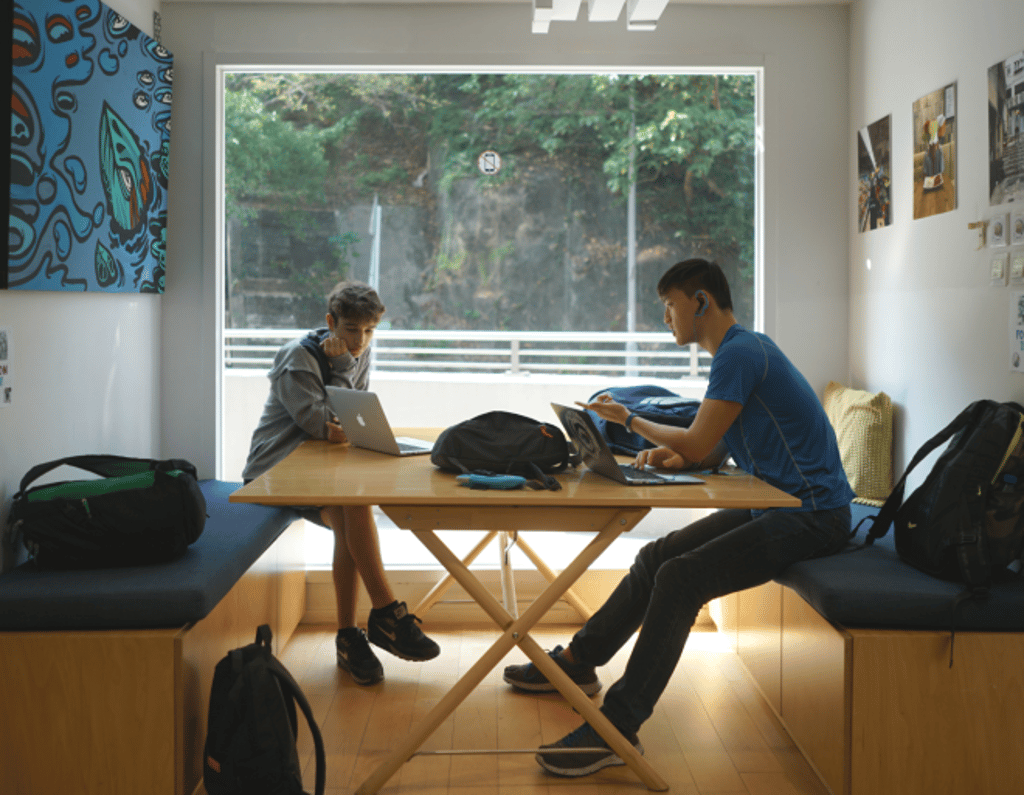
The Harbour School (THS) seeks to generate a learning environment that works for students rather than the other way around. It is intuitive that people learn more when they are invested in the topic in front of them, so teachers ask what content students are interested in before designing courses. The high school day runs from 9 AM - 5 PM to capture teenage minds when they are more alert and engaged and to mirror a typical work day. The campus itself looks more like an office building than a school, with movable walls, tables instead of desks, surfaces you can write and ideate on.
The curriculum is modularized in a way that allows teachers from diverse content areas to plan and teach transdisciplinary courses and encourages students to make choices in selecting classes every term and mapping their curricular program. It is a supported, scaffolded environment for learning real-world skills around making decisions, assessing tradeoffs, planning, adjusting, adapting, seeking advice, reflecting on mistakes.
Students are required every year to produce an independently designed course rooted in their interests whether they be coding, running a jewelry business, or building boats. They are pressed from a young age to articulate their interests, talents, and growth areas, to test those interests through courses, projects, excursions, and internships to see if applying their talents in this way or that will be what they ultimately want to pursue in university or beyond.
It is a program in which it is impossible to fall asleep at the wheel. Students at THS are reminded that it is never too early to try to understand who you are and what you can do. That no one differentiates themselves but trying to be just like everyone else or wins by playing someone else’s game rather than their own. Teachers are not merely a source of knowledge or skills to share but also mentors, curators of experiences, connectors to information and opportunities that might exist outside the boundaries of the traditional classroom.
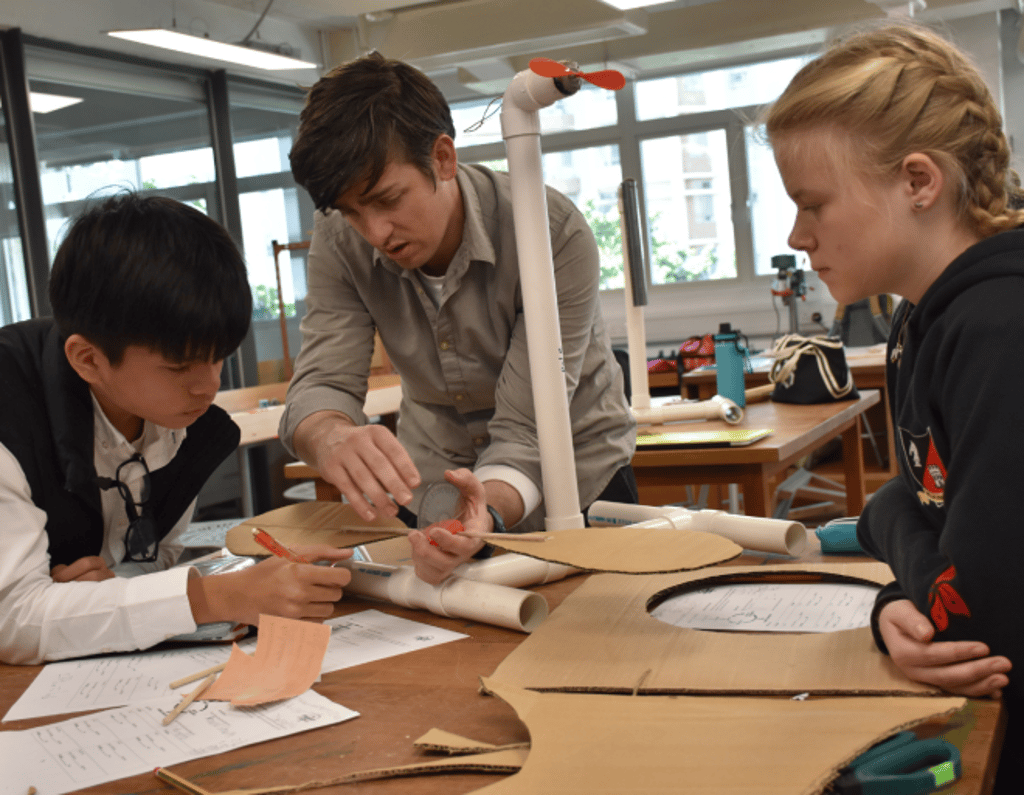
Classes emphasize collaboration, group work, professional skills, and exposure to problems that resist easy solutions. Successful people and organizations have a vision and then relentlessly pursue the knowledge and skills which will help them achieve it. Medical school works because you have committed to being a doctor and that commitment lends meaning to everything you do in your courses- even if you ultimately change professions in the long run.
Most high school programs operate according to a backwards strategy. They pack students full of undifferentiated, unfiltered information (most of which they promptly forget) and then send them on their way hoping that some piece of content or other winds up being useful somewhere along the line. This approach often results in generating highly diligent students who hate learning because rather than seeing educating oneself as a lifelong pursuit, it has become something to get through on your way to pursuing your actual goals.
Worst of all, the experience rarely prepares them to be authentically successful in more independent, personally accountable university environments and often leaves them completely unequipped to be successful in modern workplaces. They have been trained to operate in a manner that is exactly the opposite of the aforementioned dream employee.
The THS program puts the search for vocation first. It asks students to identify the best way they can leverage their learning opportunities toward their future goals rather than setting them up as arbitrary hurdles. It is a model that reflects a changed and changing world where the value proposition of schools must be something more than purveyors of information. It demands that teachers develop the individuals right in front of them rather than march through a preset curriculum for the hypothetical average person.
A favorite book to give graduates of high school and college is Dr. Seuss’ Oh, the Places You’ll Go! One of my favorite lines from the story reads: “You’re on your own and you know what you know and YOU are the guy who’ll decide where to go.” We release our students into a world where their success is ultimately defined by how much ownership they take over their own path. High school students must demand an educational experience that prepares them to make the critical decisions about where to go, what to do, when and how to adjust course, and how to enjoy the journey. There is no time to waste.
About Dr. Elizabeth Micci, THS High School Principal
Dr. Elizabeth Micci joined The Harbour School in 2017 as a researcher and a member of the high school humanities faculty while completing her Doctorate of Education Leadership from the Harvard Graduate School of Education. Upon completion of her program, she became the High School Principal at the Garden Campus. She also holds a Bachelor of Science in Business Administration and English from Washington & Lee University and a Master of Arts in English from Middlebury College. Prior to joining The Harbour School, Dr. Micci was a high school English teacher and administrator of a college prep academy in Houston, TX.