Confronting the Global Fertility Crisis: Five Pillars for Humanity’s Future

[The content of this article has been produced by our advertising partner.]
The world is at a demographic crossroads. Fertility rates have fallen below replacement levels in two-thirds of the global population, threatening economic stability, cultural continuity, and sustainable development. This is no longer a regional challenge—it is a global transformation that demands urgent collective action.
The inaugural Global Fertility Crisis Forum, held in Hong Kong, convened leaders from the United Nations, academia, government, and business to confront the root causes of declining fertility. Discussions ranged from economic pressures and shifting social expectations to the disruptive role of artificial intelligence in reshaping family life.
As Vladimira Kantorova of the United Nations Population Division emphasized, “we must design people-centered interventions to build a viable future and leverage intersections across demographic trends to forge sustainable futures.”
Yuwa Population Research Institute CEO and Chief Researcher Wenzheng Huang added urgency, calling for an immediate return to replacement-level fertility. He reminded participants that “people are not merely labor but consumers, the base for innovation, carriers of culture and language, and sources of emotional meaning.”
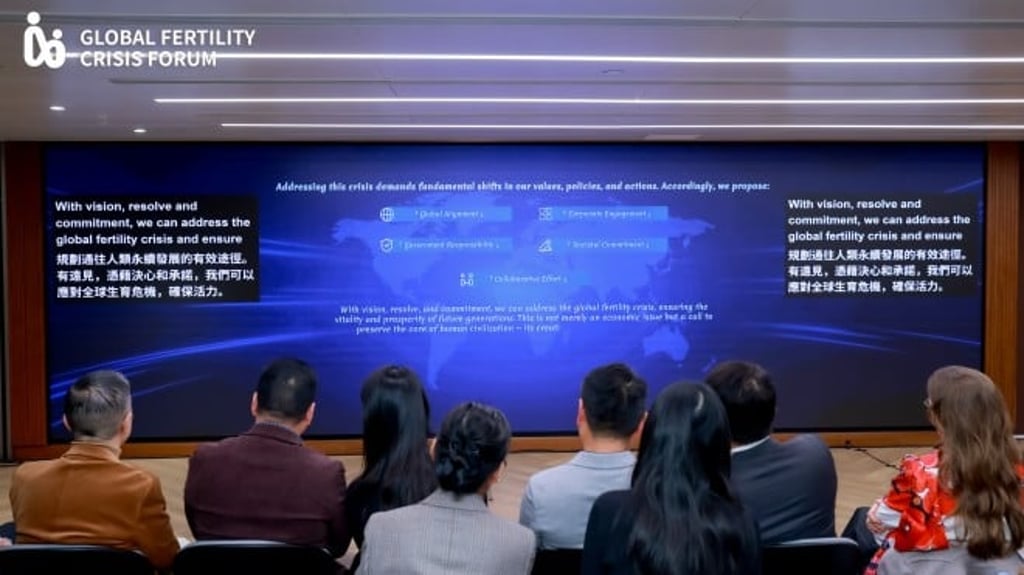
The forum’s most significant outcome was the articulation of five advocacies—a framework for governments, corporations, and societies to act decisively in reversing the fertility crisis.
1. Global Consensus
Call on the global community to recognize that restoring and maintaining replacement-level fertility is the prerequisite for the continuation of human civilization, and to promote international organizations in establishing shared values and integrating them into development frameworks.
2. Government Responsibility
Emphasize that governments in low-fertility countries must genuinely compensate parents for their contributions to childrearing and build systematic fertility support policies.
3. Corporate Engagement
Advocate for enterprises to embrace fertility-friendly principles, eliminate discrimination related to childbearing, reduce employees’ parenting burdens, develop products and services tailored to parenting needs, and support related public welfare initiatives.
4. Social Support
Promote the creation of a fertility-friendly cultural atmosphere, highlight the social value of raising children, and encourage family members to actively participate in childcare responsibilities.
5. Collaborative Action
Propose that addressing the fertility crisis requires the collective strength of humanity, building an international cooperation platform to jointly explore effective and sustainable solutions.
The Role of Technology and Culture
Economist, James Liang posits that AI is exacerbating the global fertility crisis on two key fronts: AI-fueled entertainment offers instant gratification that competes with the long-term commitment to raising children, sparking the question of whether virtual dopamine is supplanting family life, and an AI-driven economy demands hyper-skilled labor, pushing young people into extended education and greater financial instability, which leaves them without the time or money to start and sustain families. Amid these AI-driven fertility challenges, Liang underscores that having children is a meaningful contribution to the continuity of humanity, a critical point he emphasizes in addressing the deepening dilemma.
Masahiro Yamada, Professor of Family Sociology at Chuo University, Japan, pointed to cultural and economic pressures: “Marriage has become a luxury,” he said, highlighting how surging unmarried rates erode workforces and innovation while aging demographics strain healthcare systems.
A Call to Leadership
The fertility crisis is unfolding now, reshaping economies and societies in real time. The five advocacies outlined at the Global Fertility Crisis Forum provide a blueprint for action. What is needed now is leadership—by governments, corporations, communities, and international organizations—to translate these principles into practice.
The future of humanity depends not only on innovation and economic growth, but on the most fundamental act of continuity: the decision to bring new life into the world.