Can AI help businesses weather any storm?
Investing in AI can be the lifeline that helps firms survive calamities, but not every enterprise can find salvation

[The content of this article has been produced by our advertising partner.]
Businesses now operate in an increasingly unpredictable environment. Artificial intelligence (AI) is poised to help navigate turbulence, but its value is more evident in optimising business under stable circumstances. This is not surprising since corporate AI investment, such as from big pharma to tech giants, has historically prioritised building competitive advantage over resilience.
“AI undoubtedly helps productivity in normal times. However, given the current high-velocity environment characterised by disruptive upheavals, a better understanding of how to deal with such unrest becomes more urgent,” says Wu Jing, Professor in the Department of Decisions, Operations and Technology at the Chinese University of Hong Kong (CUHK) Business School.
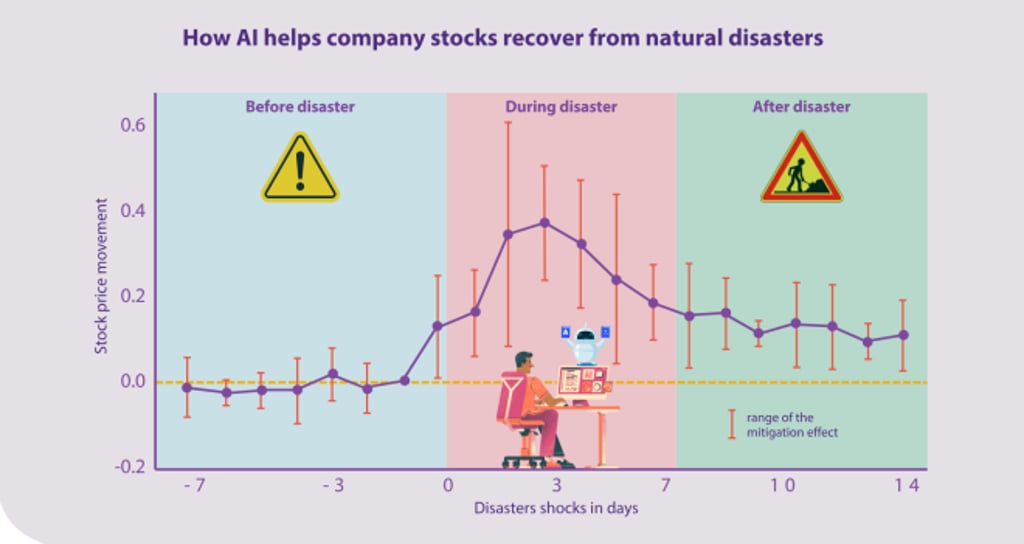
Disruptions brought by natural disasters impair business operations and erode investor confidence, leading to lower stock prices for affected companies. Professor Wu’s study reveals that companies that hire more AI talent see a smaller drop in stock value and recover more quickly after disasters as opposed to companies with less AI investment.
The interesting part is that companies with limited budgets are found to benefit more from AI investment during crises. However, their productivity gains still couldn’t match their wealthier peers in normal times due to a lack of organisational systems and infrastructure to fully reap AI potentials. “Resilience becomes more and more important in today’s ever-changing environment. If crisis is the new norm, infusing AI into firm productions is no longer a luxury,” he adds.
How much AI investment is enough?
Along with Michael Zhang, the Wei Lun Professor of Business AI at the same department, as well as Han Miaozhe at the Hong Kong University of Science and Technology and Shen Hongchuan at the University of Macau, Professor Wu’s latest study, Artificial intelligence and firm resilience: Empirical evidence from natural disaster shocks, assesses AI’s impact on firm resilience during challenging periods.
The study focuses on 3,137 firms in the US across agriculture, mining, utilities, construction, manufacturing, trade, transportation, and warehousing sectors.
Stock returns represent adjustments in the general expectation of a firm’s performance, reflecting the firm’s ability to mitigate the damage amid catastrophes. Firms that hire more AI-related positions see moderate losses and higher stock returns during and after the disaster. They can fully recover quickly if at least 2.4 per cent of their job postings require AI-related skills, such as deep learning, image processing, AI tool operation, and the like.
This positive impact is greatest at the peak of the disaster, with the most effective AI-empowered roles focused on cognitive tasks, decision-making, and supply chain coordination. “AI generates significant resilience for firms facing natural disaster shocks primarily by optimising supply chains and production inputs,” says Professor Wu.
However, Professor Wu notes that such resilience may not persist in the face of human-induced shocks, such as cyberattacks, labour strikes, or industrial accidents. The damage in human-caused disasters is often reputational or contractual, and AI-driven operations cannot fully offset it. In this case, AI can only serve as a risk detector, providing data to support human operators rather than mitigating the damage.
“AI serves as complementary support for tangible operations and works more efficiently if it targets physical assets, such as factories,” he adds. “When AI is used on financial assets, intellectual property, or market access, its effects are limited.”
Many may conflate AI with information technology (IT), as both often go hand in hand, so the researchers seek to examine them more deeply. IT is meant to improve efficiency by coordinating, communicating, and monitoring a wide range of activities, whereas AI focuses on applications where data and algorithms generate predictions to assist decision-making.
The team then measures investments in non-AI technologies by weighing job postings with general IT skills, such as robotics, data analytics, or cloud-related skills. The analysis finds that while IT is great for enhancing day-to-day operations and cutting costs, AI plays a distinct role in helping firms to be more resilient during crises.
Professor Wu suggests that AI investment should not be spread evenly across all technical functions. Instead, focus on encouraging managers who can maximise output with AI when resources are scarce. By concentrating AI capabilities in high-level cognitive and operational roles, firms can improve their resilience.
“Therefore, roles like supply chain coordinators should be prioritised to be empowered with AI skills for better predicting materials arrivals and planning alternative routes to address the disruptions directly,” says Professor Wu. “Strategic decision-makers and production operations managers should also be equipped with AI tools to make quicker, better decisions in resource allocation.”
For financially constrained firms, rather than investing solely in AI tools, the most critical takeaway is to prioritise organisational design, such as training manpower and setting up procedures to ensure AI can make a real difference. “These firms should view AI investment as an insurance premium for resilience instead of an immediate profit engine, ensuring they have the IT backbone to support it,” he adds.
“They should also focus on deploying AI in areas that immediately reduce operational costs or mitigate certain risks, such as vendor monitoring or financial planning. This will allow them to generate the savings needed to fund further resilience tools while avoiding the trap of investing in technology they cannot utilise efficiently.”
About Professor Michael Zhang
Professor Michael Zhang is the Wei Lun Professor of Business AI at the Department of Decisions, Operations and Technology at CUHK Business School. He holds a PhD in Management from MIT Sloan School of Management, as well as an MSc in Management, a BE in Computer Science and a BA in English from Tsinghua University. He researches the creation, sharing, and processing of business information. His work specifically focuses on the pricing of information goods, online advertising, innovation incentives, and the application of AI in financial markets.
About Professor Wu Jing
Professor Wu Jing is a Professor in the Department of Decisions, Operations and Technology at CUHK Business School. He is the Director of the MSc Programme in Business Analytics, the Director of the Centre of Cyber Logistics, and the Associate Director of the Asian Institute of Supply Chains and Logistics. He holds a PhD in Operations Management (minoring in Economics and Finance) and an MBA from the University of Chicago Booth School of Business and a Bachelor’s in Electronic Engineering from Tsinghua University. His research focuses on global supply chain management, the operations-finance interface, sustainable operations, and business intelligence.