HKSTP supercharges Hong Kong’s new-industrialisation mission with key microelectronics partnerships
- Microelectronics enterprise J2 Semiconductor and new-energy vehicle maker Neta Auto choose Hong Kong Science Park for their R&D centres
- Deals highlight Hong Kong’s edge in microelectronics and boost its status as an international innovation and technology hub

[The content of this article has been produced by our advertising partner.]
Hong Kong Science and Technology Parks Corporation (HKSTP) has recently formed two landmark partnerships. One is with mainland China’s microelectronics enterprise J2 Semiconductor, and the other with leading new-energy vehicle (NEV) maker Neta Auto. Together they further strengthen the global status of Hong Kong’s microelectronics and NEV sector.
With support from Hong Kong’s Innovation, Technology and Industry Bureau (ITIB) and the Office for Attracting Strategic Enterprises (OASES), HKSTP has sealed deals with these two partners, fully establishing Hong Kong as an innovation and technology (I&T) hub in the region.
According to J2 Semiconductor, the company has agreed to set up a global research and development (R&D) centre focusing on third-generation semiconductors at Hong Kong Science Park, and to establish Hong Kong’s first facility to develop silicon carbide (SiC) 8-inch advanced wafer fabrication – a material used in power semiconductor devices.
Dr Robert Tsu, chairman of J2 Semiconductor, says an estimated HK$6.9 billion (US$882 million) will be invested in the project, with plans to start volume production within the next two years, reaching an annual production capacity of 240,000 SiC wafers by 2028. This is expected to generate an annual production value of more than HK$11 billion (US$1.4 billion) and create over 700 jobs in Hong Kong.
“The project will assist in the early completion of the localisation of the new-energy vehicle supply chain and drive the long-term development of the semiconductor industry in Hong Kong,” Tsu says.
This further promotes new-industrialisation, which is a core area for ITIB. The bureau published its Hong Kong Innovation and Technology Development Blueprint last December, with a mission to develop strategically advanced manufacturing industries such as microelectronics and semiconductors.
Vital hub in global semiconductor value chain
Hong Kong is at the heart of the Greater Bay Area, with huge potential to become a key hub in the global semiconductor supply and value chain. According to data from the Observatory of Economic Complexity, Hong Kong was the world’s largest importer of semiconductor devices in 2021 (by value), while in the same year integrated circuits were the second-most exported product in Hong Kong, the first being gold.
The Hong Kong Chief Executive’s 2023 Policy Address laid down plans to establish the Hong Kong Microelectronics Research and Development Institute next year. Its purpose will be to guide and promote collaboration among universities, R&D centres and the industry in exploring core technology for third-generation semiconductors and strengthening the local microelectronics ecosystem.
Professor Sun Dong, Hong Kong’s Secretary for Innovation, Technology and Industry, says the collaboration between HKSTP and J2 Semiconductor to set up Hong Kong’s first large-scale semiconductor wafer fabrication facility demonstrates the commitment of the Hong Kong government’s initiative to turn its new-industrialisation vision into action.
“J2 Semiconductor is proactively building up the capacity, quality and competitiveness of Hong Kong’s tech talent pool,” he says. “The project will also drive the development of related industries – including semiconductor equipment manufacturers, material suppliers and testing service providers – to develop a complete ecosystem to reinforce Hong Kong’s position in the global semiconductor industry value chain.”
Hong Kong at centre of new-energy vehicle ecosystem
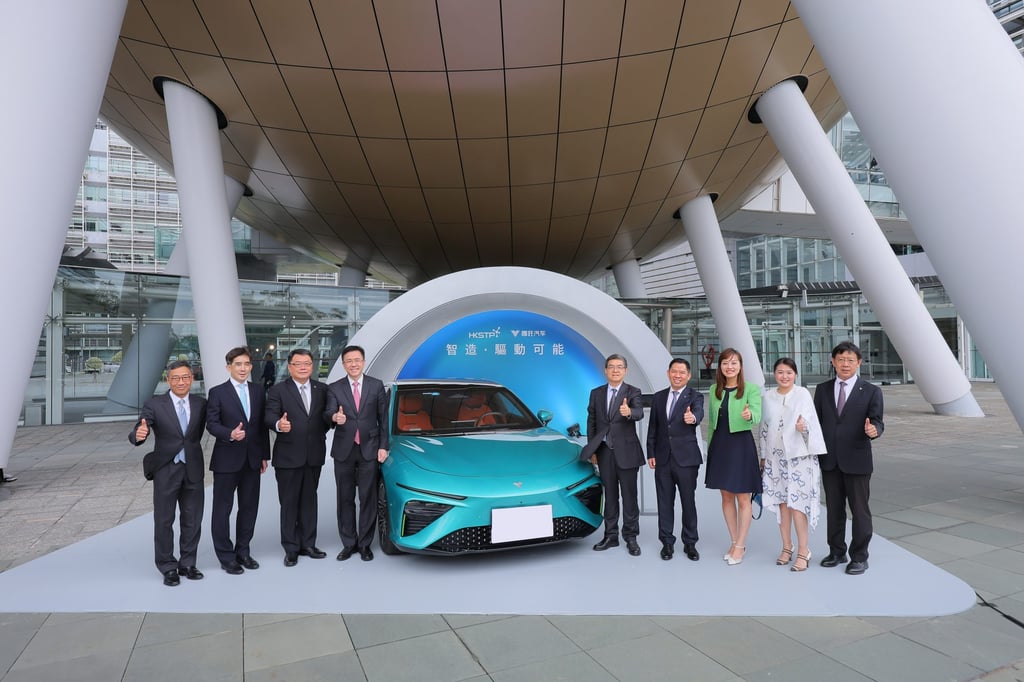
The second landmark deal features one of mainland China’s emerging leaders in NEVs, Neta Auto, which will establish its international headquarters and new R&D centre at Hong Kong Science Park as part of its plans for global expansion. The NEV maker will recruit nearly 600 research talents over the next five years, and establish a smart R&D centre of more than 40,000 square feet. It is expected to invest hundreds of millions of yuan in establishing its international headquarters in Hong Kong by the end of this year.
Neta Auto will bring its NEV success to Hong Kong’s innovation ecosystem, and is an example of how the city intends to realise its vision for the next phase in new-industrialisation.
Many countries around the globe are seeking to diversify their economies for new growth and greater resilience. Advanced manufacturing sectors will create high-value, high-tech industries, leading to new opportunities for talent in I&T while attracting global investment.
“New-energy vehicles are now in the spotlight as an emerging world-leading technology industry,” Sun says. “By integrating the upstream, midstream and downstream sectors, new-energy vehicles will spur economic development and provide employment opportunities.”
Hong Kong’s ITIB and OASES teams are tasked with attracting representative companies that can advance strategic sectors such as advanced manufacturing, and Neta Auto is identified as a strategic representative I&T company with high potential. Its establishment in Hong Kong is a significant marker in the city’s new-industrialisation mission.
Such partnerships enhance HKSTP’s thriving I&T ecosystem, with more than 13,000 R&D professionals, over 1,400 technology companies and more than 300 partner networks. HKSTP will provide comprehensive support and infrastructure to drive collaboration among stakeholders across the industrial, academic and research sectors.
The comprehensive integrated innovation ecosystem at Hong Kong Science Park has supported 12 unicorn companies. This unique capability to help start-ups to scale-up to potential IPOs will help Neta Auto and many other tech ventures, such as J2 Semiconductor, on their journey to innovation and success.