Advertisement
Art Basel
Special Reports

Art Basel Hong Kong’s director on the fair’s role in the city’s cultural scene

Angelle Siyang-Le talks to us about her commitment to the show – and why her dad initially thought the company didn’t exist

4-MIN READ4-MIN
Angelle Siyang-Le, director of Art Basel Hong Kong. Photo: Vivien Liu, courtesy of Art Basel
Douglas Parkes
In 2012, when Angelle Siyang-Le told her father she had taken a job with a company called Art Basel, his initial reaction wasn’t one of pride, but one of concern. “My dad was like, ‘OK, never heard of it,’” she recalls. The inquisitive parent researched the company address in Wan Chai and set off to find its office, only to come up empty, not realising the different company he found at that address was a co-working space. Perturbed, he promptly texted his daughter to warn her she’d been conned and that “Art Basel” didn’t exist.
Now director of Art Basel Hong Kong, Siyang-Le laughs when she tells this story, adding that these days her father is the first person to ask her what’s new each March.

It is her way of illustrating just how much has changed since she joined Art Basel nearly 14 years ago, both for herself and for the city she now calls home.
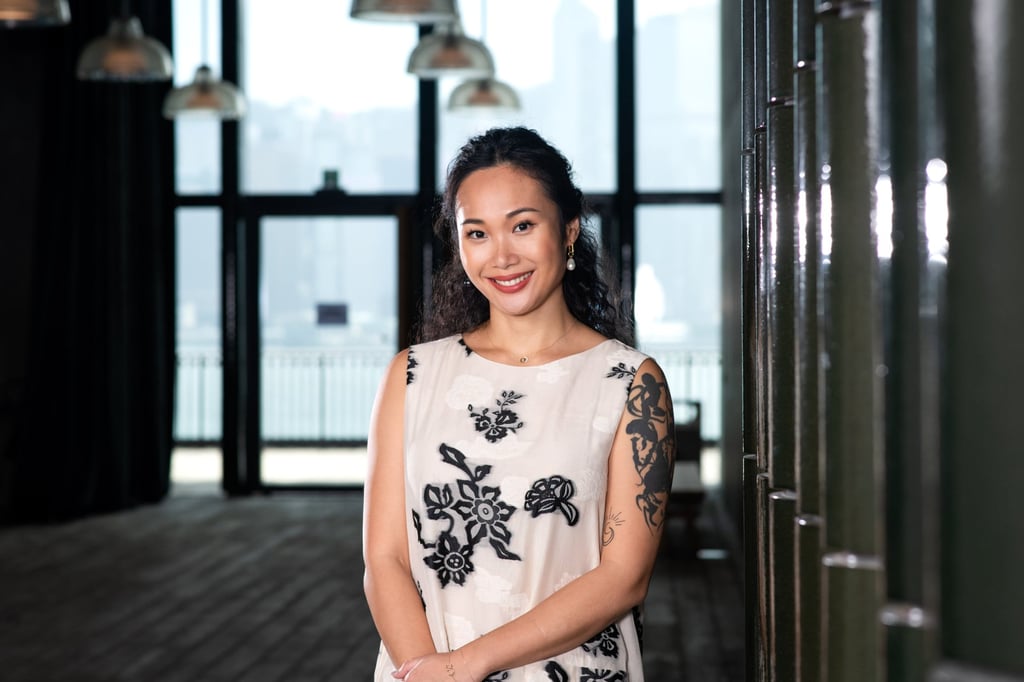
Angelle Siyang-Le’s career has spanned Europe, the Middle East and Asia. Photo: Art Basel

Born in Shanghai and raised in London, with a career that has spanned Europe, the Middle East and Asia, Siyang-Le describes herself as “half a local” in Hong Kong. This cross-cultural upbringing deeply informs her world view and her eye for art.

Advertisement

“There are so many artists in my generation sharing the same upbringing, the same themes. I resonate with the topics that they explore, having that background.”

Siyang-Le’s connection to art is deeply personal. “I still want to be an artist,” she admits, revealing a youth spent training “like a photographer and more towards painting”. These days she lacks the time to devote herself to her own art. Aside from her duties as fair director, she is a mother of two and credits the two fairs she spent heavily pregnant, waddling through stalls with a “seven-month belly”, for helping deepen her relationships with galleries and clients who assisted her.

Advertisement
The sense of community this created is what ultimately anchored her to Hong Kong – a city whose creative pulse she perceived long before many others did. Such optimism was once unusual when it came to Hong Kong’s artistic potential. A South China Morning Post column from 1951 noted that “old residents are familiar with the criticism that the colony is a cultural desert”, indicating that even 75 years ago, it was an established notion that the city was lacking when it came to the arts. In 2012, however, Siyang-Le saw a landscape brimming with latent potential.

“Hong Kong was already a kind of hub for antiques,” she explains, “and there’s an open mindset in Hong Kong. People want to understand things that they don’t understand. They have that high level of curiosity … That is the best basic condition for building a contemporary arts scene. Even in the biggest megacity in the world, you might not find this.”

Advertisement
Select Voice
Select Speed
1.00x