Advertisement
Advertisement
Artificial intelligence
Get more with myNEWS
A personalised news feed of stories that matter to you
Learn more
Even in China, where ChatGPT is not available, users have been finding ways to access it and businesses are trying to profit from the concept. Photo: Dreamstime/TNS

Chinese firms scramble to take advantage of ChatGPT concept, even though the service is not officially available

  • Baidu’s AI chatbot ‘Wenxin Yiyan’, or ‘Ernie Bot’ in English, will undergo internal testing in March before being made available to the public
  • On Alibaba’s Taobao Marketplace, hundreds of listings offer ChatGPT accounts, or help to conduct bot conversations on behalf of customers

Chinese companies from search engine provider Baidu to e-commerce giant Alibaba Group Holding are jumping on the ChatGPT bandwagon, rolling out their own versions of the technology or linking their applications to the OpenAI service.

Baidu has named its artificial intelligence (AI) chatbot project “Wenxin Yiyan”, or “Ernie Bot” in English, and it “aims to complete internal testing in March before making the chatbot available to the public”, a Baidu representative said on Tuesday. The company’s Hong Kong-listed shares surged 15 per cent on Tuesday.

On Monday, Alibaba’s enterprise collaboration tool DingTalk published a user guide for adding ChatGPT to group chats via a valid token generated by the service, but emphasised that users “shall comply with the nation’s laws and regulations” when using it. Alibaba owns the South China Morning Post.

ChatGPT hype pushes up stock volume for BuzzFeed and other connected firms

Chinese online luxury retailer Secoo Group said in a statement on Monday that it would conduct “in-depth research and expansion” on artificial intelligence-generated content (AIGC) and ChatGPT-related technologies to “realise interactive conversations similar to real people”. The platform has received complaints about its slow response to customer service inquiries.

Chinese printer and lottery technology developer Hongbo Co told investors on Tuesday that it was “developing and testing” relevant ChatGPT products. Separately, shares of Shanghai-listed 360 Security Technology rose by the daily limit of 10 per cent on Tuesday after it told investors it has been investing in technologies “similar to ChatGPT” since 2020.
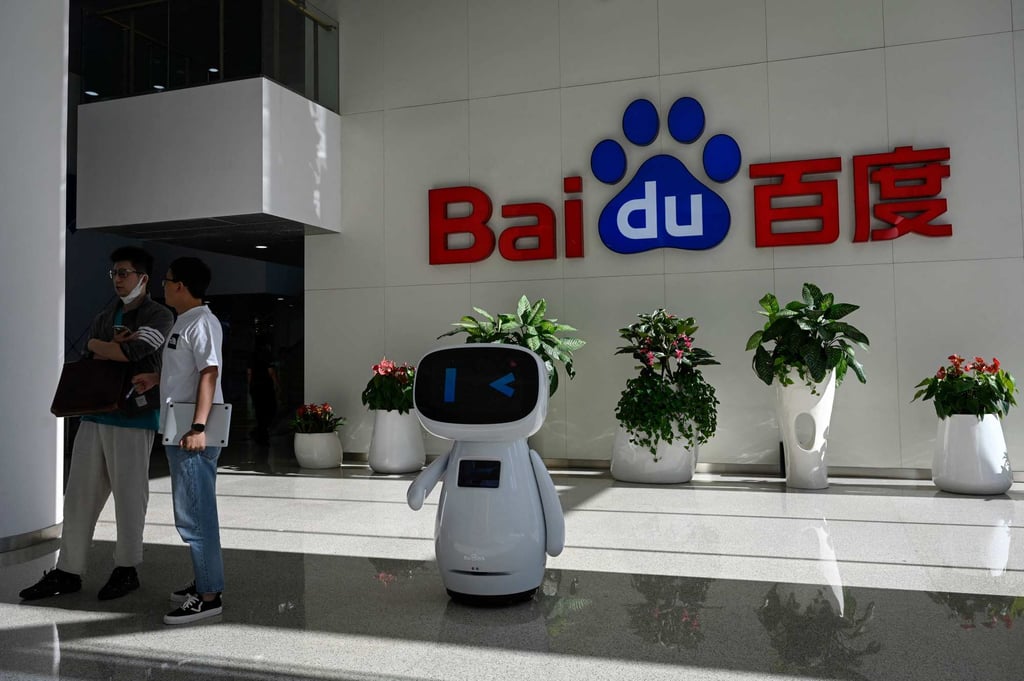
This file photo taken on September 6, 2022 shows Baidu’s headquarters in Beijing. Photo: AFP

On popular Chinese microblogging site Weibo, the hashtag “when will home-made ChatGPT alternatives be available” was trending among the top 10 topics on Monday evening.

The widely-discussed language generation model has reached 100 million users globally two months after its launch, according to UBS. Even in China, where the service is not available, users have been finding ways to access it and businesses are trying to profit from the concept.

On Alibaba’s Taobao Marketplace, hundreds of listings are offering ChatGPT accounts, or help to conduct conversations with the bot on behalf of customers. However, it is difficult for China-based users to access the service even with a virtual private network to bypass the Great Firewall, because opening an account requires a foreign phone number.

Shenzhen aims to be China’s artificial intelligence hub with new guidelines

On Tencent Holdings’ WeChat app, multiple start-ups are offering ChatGPT alternatives. Shanghai-based Entropy Cloud Network Technology Co and Chengdu Yibai Technology Co from southwestern Sichuan province have launched chat bots that offer four free conversations for each user, with an annual subscription fee of nearly 1,000 yuan (US$147).

When asked about its relationship with OpenAI, Entropy Cloud said that its bot, called ChatGPT Online, was “an AI system built on technologies similar to ChatGPT’s”. Yibai, whose service is called ChatGPT AI, said it was not able to answer the question.

Charles Li, a Beijing-based cybersecurity consultant who has tried both versions, said it was a case of “companies trying to make money from the buzzword”.

Li said he asked ChatGPT several technical questions and got “very basic answers”. He added that the technology “doesn’t have its own opinion and judgment”.

Pan Helin, a Zhejiang University researcher and adviser to the Ministry of Industry and Information Technology, said it was necessary for China to both “bring in ChatGPT” and “develop its own alternatives” if the country wants to keep up with the trend, according to an article published Monday in local media National Business Daily.

Pan said the government would regulate AIGC, especially from copyright and ethical perspectives. “If AI generates content that goes against public order and morality, who should be responsible?” he asked.

To fight plagiarism, OpenAI earlier this month released a tool to detect when written works were being authored by AI.
1