Advertisement
US-China tech war: Huawei counts on 5G-powered Tianjin Port to redefine its enterprise business to survive crushing trade sanctions
- At Tianjin Port’s ‘Smart Hub’, quay cranes, gantry cranes, stackers and forklifts are all controlled by a command centre miles away
- The smart port can move 36 20-foot boxes an hour, faster than human-controlled movers, needing only a quarter of the pre-digital staffing level
6-MIN READ6-MIN
18

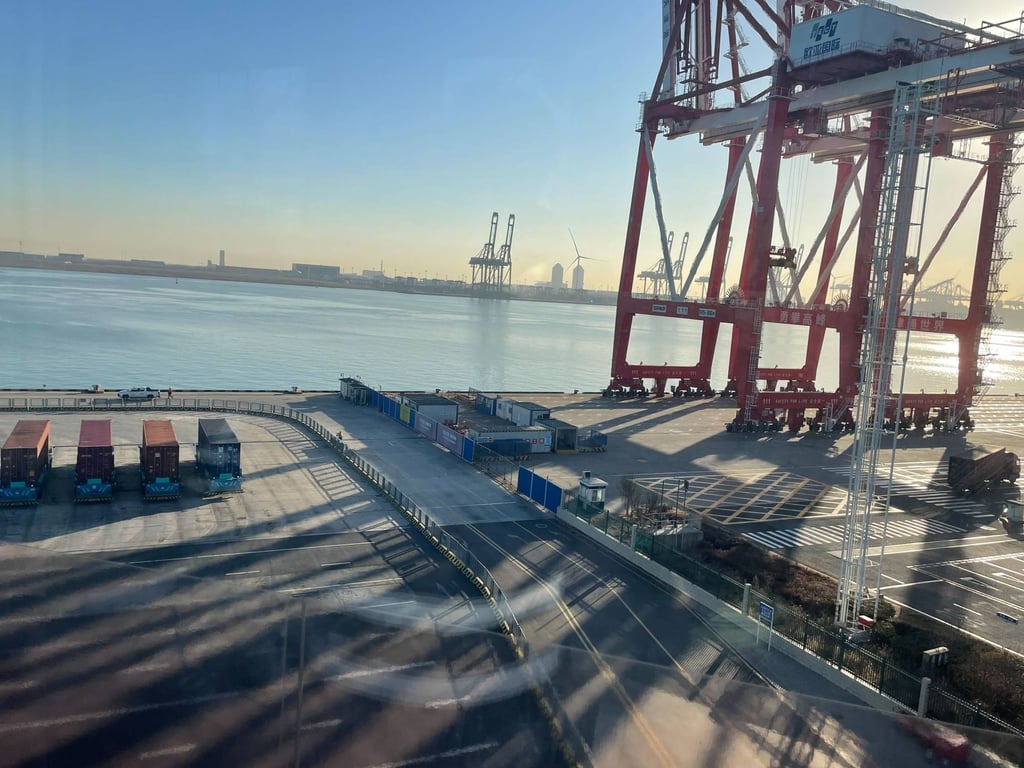
The road through northern China’s biggest seaport in Tianjin cuts through two worlds. At the berths on the road’s right, quay crane operators sit in cockpits 50 metres (160 feet) above ground, deftly manoeuvring cargo containers between trucks and ocean-going vessels, moving between 28 and 30 boxes an hour.
At Terminal C on the left of the road sits Tianjin Port’s “Smart Hub”, a fully digitalised and automated wharf where quay cranes, gantry cranes, stackers and forklifts are all controlled by a command centre miles away. Powered by Huawei Technologies’ 5G telecommunications infrastructure, the smart port can move 36 20-foot boxes (TEUs) per hour, much faster than humans.
Digitalisation “is the industry trend, a direction not just for Chinese ports, but for all global ports”, said Tianjin Port Group’s vice-president Yang Jiemin during a recent visit by the South China Morning Post. “Our goal is to build a digital twin to Tianjin Port in the next three to five years”.
Advertisement
Tianjin Port is the latest technological showpiece of Huawei, as the world’s largest provider of phone network equipment reinvents itself after nearly four years of crushing US sanctions, which have eviscerated its once-successful smartphone business and driven almost all its network gear out of North America, Europe and Australia.
The Shenzhen-based behemoth – with 195,000 employees on staff in 2021 and one of the world’s largest research budgets, surpassing even Google and Microsoft – is now promoting the advantages of 5G-enabled digitalised services to modernise the backbone of China’s industrial production in coal mines, ports and even hospitals.
Advertisement
The benefits of automation are clear. A staff of 200 operators and engineers can manage 1 million TEUs in annual throughput at Tianjin Port’s Terminal C, about 25 per cent of the employees needed in a typical year during its pre-digital age. The future has more in store: artificial intelligence (AI) for predicting congestion, big data analysis for parsing traffic trends and driverless trucks – all made possible by the ultra-fast exchange of data in 5G networks.
Advertisement
Select Voice
Select Speed
1.00x