Advertisement
Artificial intelligence
TechBig Tech

China launches space computing hub as SpaceX gears up for historic IPO

New institute highlights Beijing’s bid to leapfrog energy bottlenecks and underscores how tech race with US is moving off-planet

2-MIN READ2-MIN
1
Listen
The establishment of the institute marks a major step in the China-US AI rivalry, which is increasingly extending beyond Earth. Photo: Shutterstock
Ben Jiangin Beijing
China is ramping up its bets on space-based artificial intelligence computing with the launch of a state-backed research institute in Beijing, accelerating a frontier tech race with the US just as Elon Musk’s SpaceX eyes a record-shattering US$75 billion market debut to fund its own orbital AI ambitions.
The establishment of the Beijing Space Intelligent Computing Research Institute marks a major step in the superpowers’ AI rivalry, which is increasingly extending beyond Earth as terrestrial AI data centres face energy bottlenecks.

The facility was established in late May in the Beijing Economic-Technological Development Area, a hi-tech hub known as E-Town that hosts many Chinese robotics and AI firms.

Advertisement

It was launched by a consortium of backers led by the National Information Technology Application Innovation Park – a joint initiative established in 2019 by the Ministry of Industry and Information Technology and the Beijing municipal government.
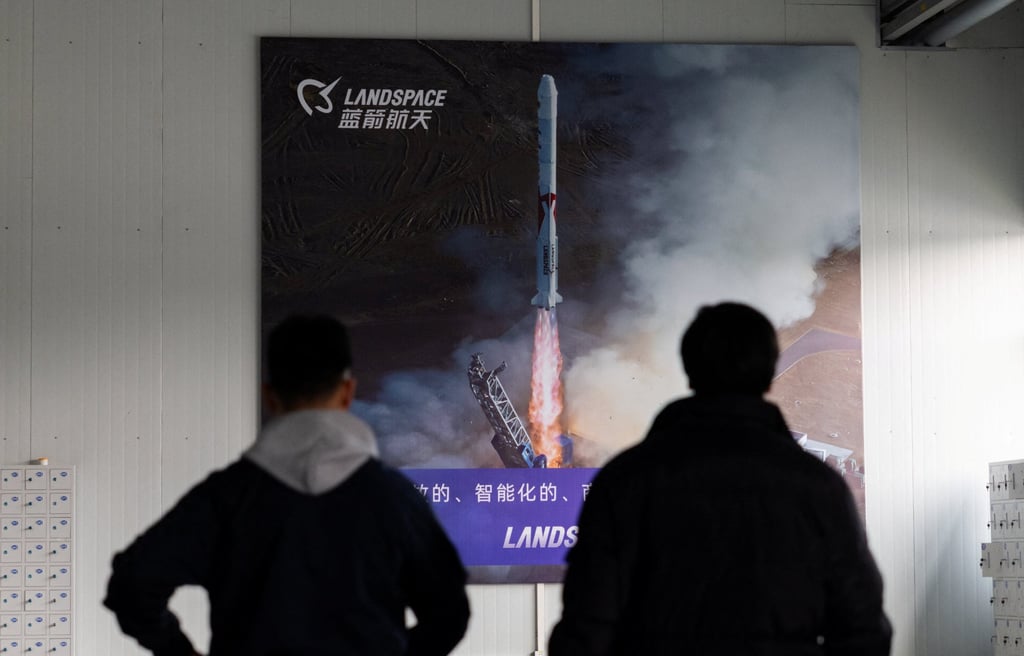
A banner from China’s private rocket company LandSpace, which is one of the backers of the Beijing Space Intelligent Computing Research Institute. Photo: Reuters

The institute would focus on cutting-edge research across space-computing chips, inter-satellite laser communication, space energy and space safety standards, according to a notice published on Friday by the Beijing Association for Science and Technology (BAST).

Advertisement

It aims to develop and launch a pilot satellite by the end of 2028.

Advertisement
Select Voice
Select Speed
1.00x