China’s Baidu plans to start production of self-driving bus next year
The internet giant is pushing ahead with its move into autonomous vehicles as it looks to reinvent itself as an artificial intelligence company

Chinese internet giant Baidu Inc plans to start production of self-driving buses by the middle of next year, as it pushes ahead with efforts to get ahead of the pack in the race to develop autonomous vehicles.
The Nasdaq-listed company, which operates China’s largest online search business, said it has agreed with Chinese bus maker King Long United Automotive Industry Co to develop and manufacture China’s first fully autonomous bus model.
Initial production and trials are expected to start in July next year, Baidu said. It did not give any technical details of the bus or its seating capacity. It has previously vowed to release a driverless car by 2018, with mass production to begin by 2021.
Autonomous vehicles are a key part of Baidu’s future as it seeks to reshape itself as an artificial intelligence company after retreating from online-to-offline (O2O) businesses, where platforms and delivery networks are built to link consumers with brick-and-mortar merchants and service providers.
In September, Baidu released Apollo 1.5, the latest iteration of its Apollo open-source unmanned vehicle software, and announced a 10 billion yuan (US$1.5 billion) fund to invest in more than 100 autonomous driving projects.
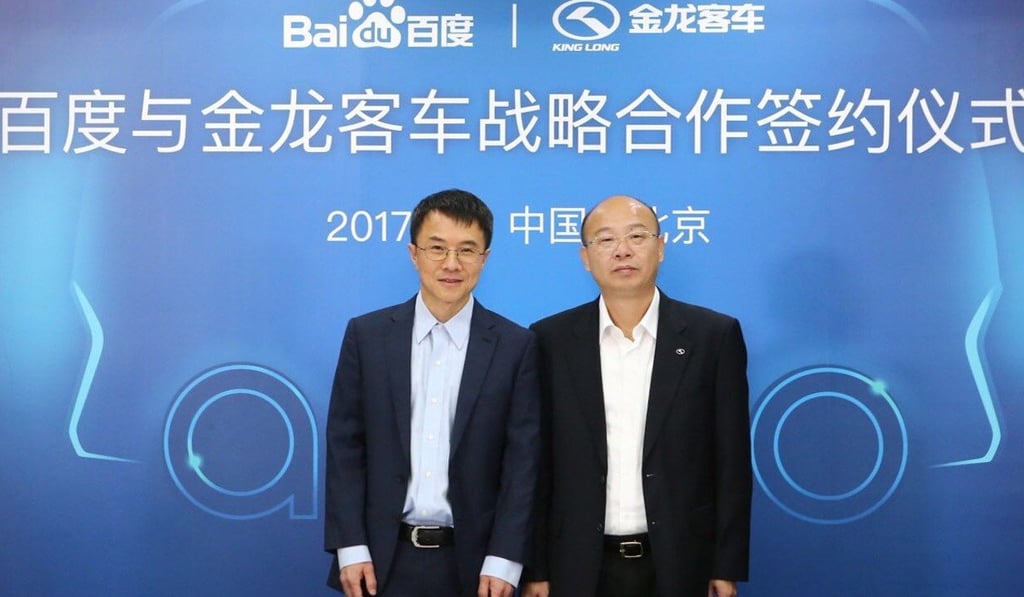
“Apollo will help drive China’s auto industry to grow by leaps and bounds,” said Lu Qi, Baidu’s chief operating officer and head of its intelligent car unit, at the signing ceremony with King Long.