Advertisement
Robotics
TechScience & Research

Praying mantises wear miniature 3D glasses to improve robot vision

3-MIN READ3-MIN
A praying mantis sports miniature 3D glasses fixed on with a blob of beeswax in an experiment at Newcastle University, Britain, that could be used to help miniature robots navigate the world. Photo: Newcastle University via AFP
Associated Press

If you thought praying mantises already look pretty cool, wait till you see them in these stunning shades.

Scientists who put tiny 3D glasses on these petite hunters have found that their stereoscopic vision system is unlike that of any other known animal.

The findings, described this week in the journal Current Biology, reveal how these remarkable insects have developed a sophisticated ability with such a tiny brain – and could prove useful in designing visual systems for future robots.

Advertisement

Vertebrate animals use their stereoscopic vision to perceive depth. Each eye sees a slightly different image because of its slightly different vantage point.

The brain then slides those two images together and calculates how far objects are based on the amount of sliding needed to match them up.
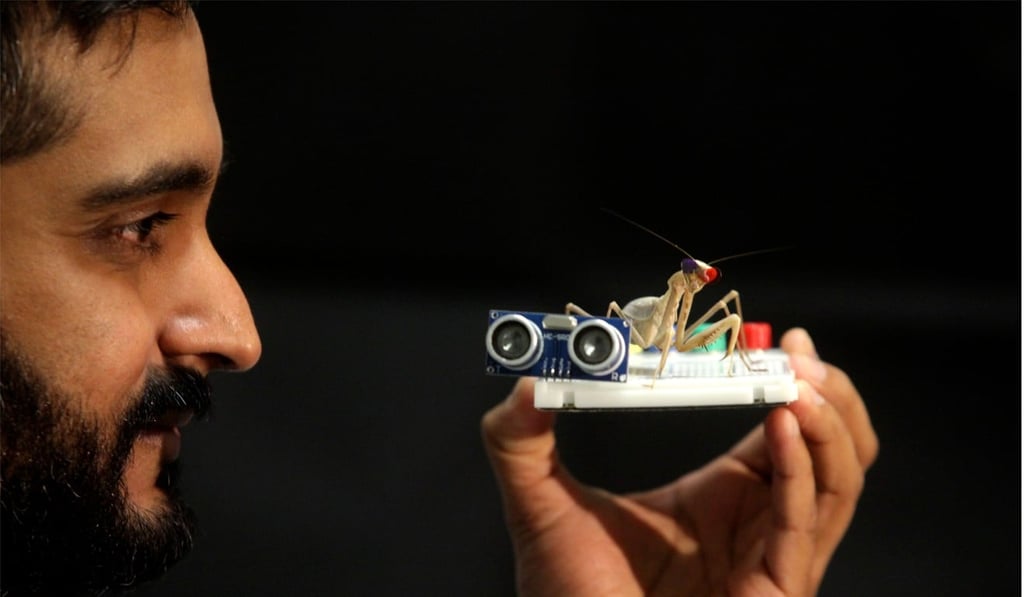
Advertisement
Dr Vivek Nityananda of Newcastle University inspects a praying mantis fitted with miniature 3D glasses. With two teardrop-shaped, light-filtering lenses perched on their heads, the insects lashed out in lab experiments at images of tempting prey in a special 3D film. Photo: Newcastle University via AFP
Advertisement
Select Voice
Select Speed
1.00x