Chinese men’s fashion brand popular with celebrities closes shop amid weak consumer demand, tough competition
- The brand, which has 735,000 followers on Alibaba’s Tmall e-commerce platform, is conducting a final sales clearance until Saturday
- China’s e-commerce ecosystem gave rise to a crop of digitally native brands which banked on the low costs of running an online store

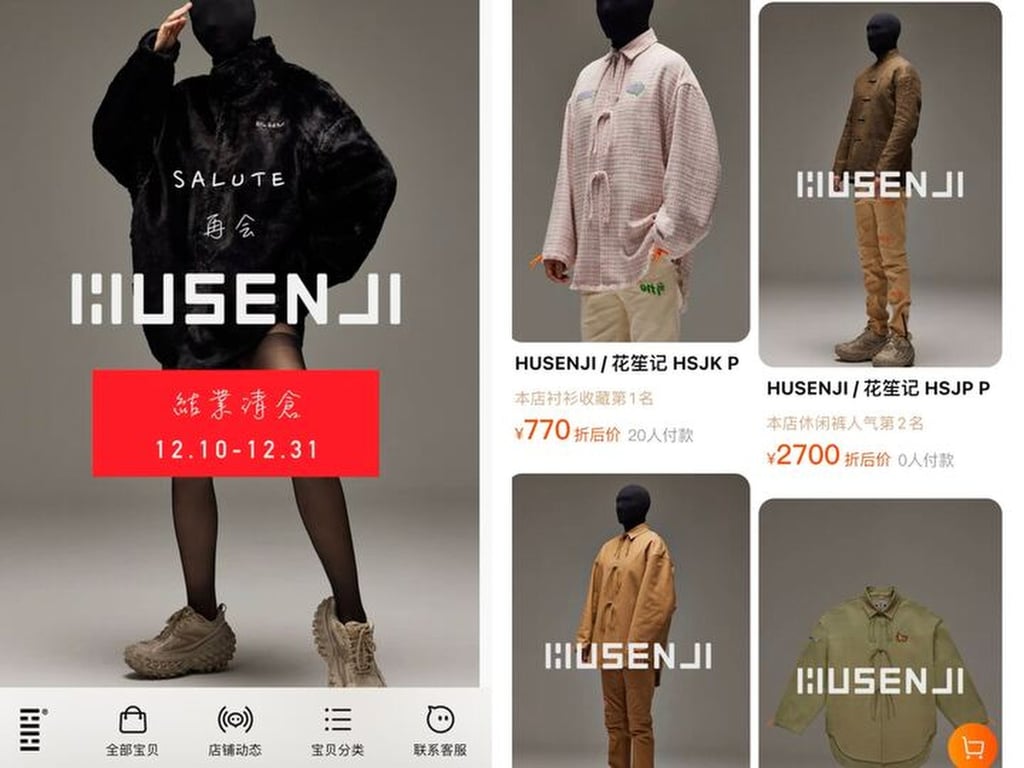
Huashengji, a traditional Chinese fashion brand for men that wooed high-profile customers like billionaire Jack Ma, will close its shop on Alibaba Group Holding’s Tmall e-commerce platform, in a cautionary tale of retailing in China where consumption is weak and competition ruthless.
The Shanghai-based company, which promotes traditional Chinese-style clothing for men, said in a statement that it is “ending” its operations. The brand, which has 735,000 followers on Tmall, is conducting a final sales clearance until December 31, offering a 50 per cent discount for some products. One popular item, a black down jacket, was priced at 2,500 yuan (US$358) after the discount.
The brand, which is marketed as Husenji in English, was popular with celebrities and the wealthy. Ma, the founder of Alibaba, was seen wearing the brand, according to social media screenshots in 2014. Alibaba owns the South China Morning Post.
Huashengji’s goal of introducing traditional Chinese costumes into modern-day wardrobes was initially a success, driven by a movement to embrace local cultural elements such as hanfu in fashion, but it proved to be spontaneous and ultimately unsustainable without the huge push needed to commercialise the trend, analysts said.
Tong Wenhao, an analyst at research firm Leadleo, said brands like Huashengji caught the early wave of Taobao’s growing traffic, but failed to keep it up. “These kinds of ‘Tao brands’ grew quickly on platform traffic, but quality, inventory management and operating ability can’t match. Their room for growth was also very limited as they only sold on Taobao,” Tong said.
“The young generation are willing to pay for these kinds of Chinese fashion brands,” Tong added. “Still, Chinese characteristic brands also have certain disadvantages. For example, the design and aesthetics of Chinese fashion brands are still difficult to compare with global front-end fashion brands.”
Huashengji was created in 2008 by Zhang Yi, but there is little public information available on the individual – not even their gender. According to a May 2020 article posted on the company’s official WeChat account, Zhang said the brand would go into “hibernation”, ceasing new design releases.