Chinese researchers claim breakthrough in training household robots with AI-generated homes
The framework breaks the constraints of conventional indoor scene generation, which has long been confined to single-room layouts

A team of Chinese researchers has claimed a breakthrough in training robots in real-world home environments, tackling a long-standing data bottleneck in the field and potentially accelerating the adoption of robots at home.
Kairos-HomeWorld was the world’s first unified framework capable of generating coherent, accurate and simulation-ready home environments using simple text prompts, according to researchers from Ace Robotics, a start-up backed by Hong Kong-listed artificial intelligence company SenseTime, the Multimedia Laboratory at Chinese University of Hong Kong and Shenzhen Loop Area Institute.
The framework is designed to break the constraints of conventional indoor scene generation, which has long been confined to single-room layouts and limited interactivity.
Instead, Kairos-HomeWorld generates whole home-scale and object-level residential scenes on a scale that can be used to train domestic robots as well as humanoids.
“These high-fidelity, large-scale simulations provide a robust foundation for advancing embodied intelligence applications and accelerating real-world robot training,” Ace Robotics said in an announcement on Friday.
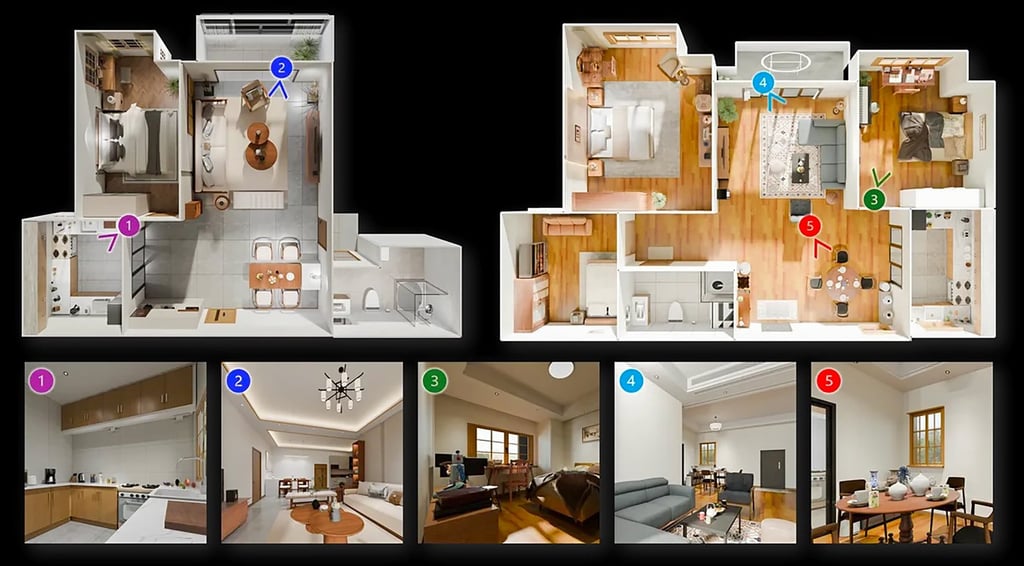
The Kairos-HomeWorld framework works on a four-stage process that starts from floor plan construction and progresses through two-dimensions-to-three-dimensions and furniture layout generation. It then moves to the refinement stage before final object-level generation, with each generated scene incorporating an average of more than 15 manipulable objects.