Tech war: China chip industry event woos fewer exhibitors amid market headwinds, US export restrictions
- China’s chip sales dropped 14 per cent year on year in 2023, the steepest decline of all markets in the world, according to the SIA

A key semiconductor industry event in China attracted a smaller number of exhibitors this year, reflecting local market challenges and a desire to stay out of the limelight amid intensified US export restrictions.
The sixth edition of the World Semiconductor Conference (WSC), which kicked off Wednesday in Nanjing, the capital of China’s eastern Jiangsu province, drew more than 200 exhibitors from a wide range of chip-related applications such as artificial intelligence (AI), automotive, and electronic design automation (EDA) software, as well as global foundry leader Taiwan Semiconductor Manufacturing Co (TSMC), Huawei Technologies and Tencent Cloud.
Last year, the show attracted 300 exhibitors. Chen Gen, one of the organisers, attributed the decline to “market-driven” practices, whereas in the past many exhibitors were “invited” to attend by the local government.
Visitor numbers also appeared to be down this year, reflecting a decline in the local market. China’s semiconductor sales dropped 14 per cent year on year in 2023, the steepest decline of all markets in the world, according to the US-based Semiconductor Industry Association (SIA). The current market situation is still uncertain, with the industry still facing challenges, according to speakers who addressed a forum on high-quality growth in the chip sector.
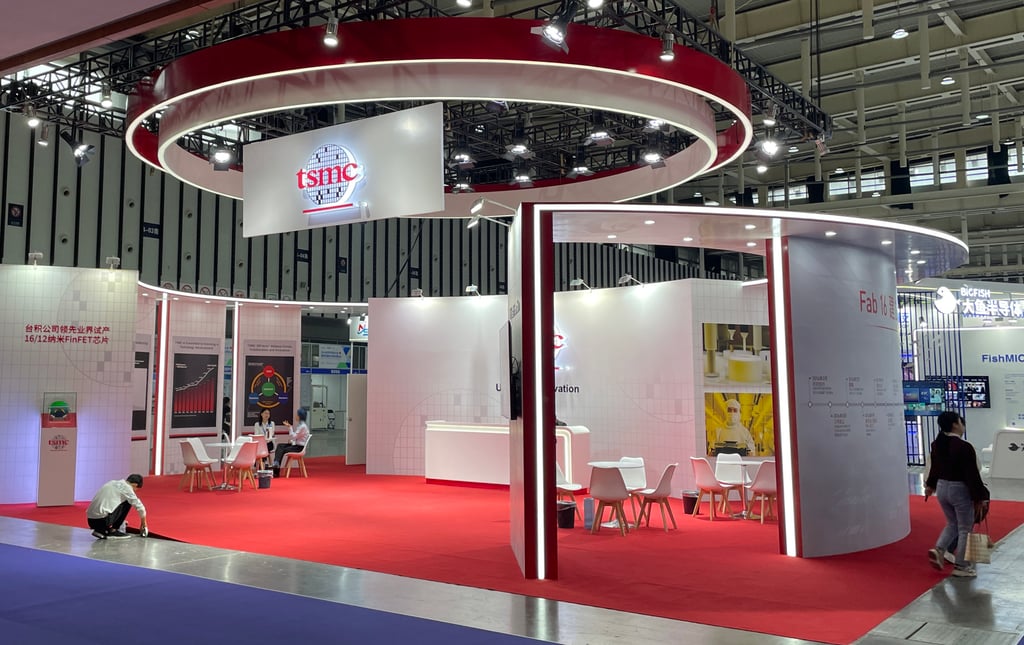
TSMC, which has operated a foundry capable of making 16-nanometre grade logic chips in Nanjing since 2016, declined to participate in the forums or comment on the sidelines of the event amid geopolitical tensions across the Taiwan Strait. Last year, Chen Fang, a TSMC China manager, gave a presentation on the company’s road map to 2-nm advanced technology through to 2026.
Only a few foreign firms are participating in forums on the sidelines of this year’s exhibition, including Samsung Electronics, British chip IP provider Arm, US engineering simulation software firm Ansys, STMicroelectronics, and Ericsson China.