Advertisement
Advertisement
Japan
Get more with myNEWS
A personalised news feed of stories that matter to you
Learn more
US President Joe Biden welcomes Japanese Prime Minister Fumio Kishida to the White House on Friday. Photo: AFP

Japan really wants the US to join the CPTPP. But ‘politically weak’ Biden isn’t interested

  • Washington says it will focus on its own Indo-Pacific Economic Framework instead of the massive multilateral trade agreement that China wants to join
  • Japanese PM Fumio Kishida’s repeated calls for the US to reconsider and join the CPTPP make it look like he’s grasping at straws, an analyst said
Japan
Japanese Prime Minister Fumio Kishida’s push for the United States to join one of the world’s biggest multilateral trade agreements looks doomed to fail under the “politically weak” President Joe Biden, analysts say, as the focus now shifts to China’s application for membership.
Kishida met Biden in Washington on Friday at the tail-end of a whistle-stop week-long tour of fellow G7 members, with the two leaders agreeing to deepen security ties and cooperate on semiconductor-related exports controls to China.
In a joint news conference after their meeting, Kishida again urged the US to join the Comprehensive and Progressive Agreement for Trans-Pacific Partnership (CPTPP) – the successor to an earlier trade pact torpedoed in 2017 by the US’ withdrawal under Biden’s predecessor Donald Trump.
But White House Press Secretary Karine Jean-Pierre later told reporters “this is not an option we’re exploring” as Washington was focused on its own Indo-Pacific Economic Framework (IPEF) instead.
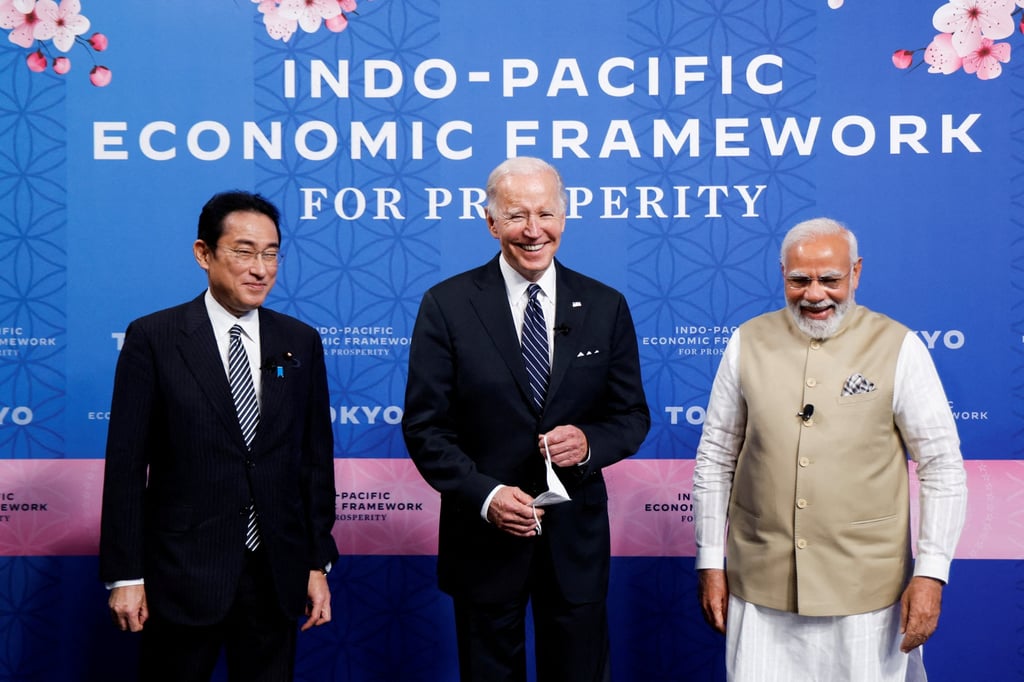
Biden and Kishida stand with India’s Prime Minister Narendra Modi at the launch of the Indo-Pacific Economic Framework for Prosperity (IPEF) in Tokyo last year. Photo: Reuters

The IPEF is not a free-trade arrangement but instead aims to deliver fair and resilient trade rules in sectors including digital trade, labour and the environment, as well as promoting resilience in supply chains, encouraging the development of infrastructure and green technology, and harmonising tax and anti-corruption efforts.

Being part of CPTPP would unquestionably benefit many companies in the world’s biggest economy thanks to easier access and reduced tariffs. But Japan and the 10 other CPTPP members “want the US to be part of the agreement simply because of the economic gravitas that the US brings to bear,” said Ryo Hinata-Yamaguchi, an assistant professor at the Research Centre for Advanced Science and Technology at the University of Tokyo.
“They also point out that the CPTPP is growing – Great Britain wants to join and Taiwan has expressed an interest – so there is a sense that why would the US not join as part of its competition with China.”
Beijing submitted its formal application for membership in September 2021 – pre-empting Taipei’s application by just six days – though a decision has yet to be made on either submission.

What is the CPTPP and why is China eager to join?

“Japan has much less reluctance supporting Taiwan’s application and that means it is likely to become an interesting test case that reveals Kishida’s resolve vis-à-vis Taiwan,” said Jeff Kingston, director of Asian studies at Temple University in Tokyo.

“If Taiwan is welcomed into the group, that would be a significant boost for Taipei, but it would certainly be viewed by Beijing as a provocation – even more so if [mainland] China is not permitted to join.”

Kishida likely repeated his call for the US to join the CPTPP during his Washington visit because he had little to lose politically – his approval ratings slipped to a new low last year amid a raft of ministerial replacements – and it looked like he was grasping at straws, Kingston said.
But even if Biden was interested in joining the trade agreement, Kingston said it was extremely unlikely that he would be able to push through what was essentially a reversal of Trump’s 2017 decision to abandon the CPTPP’s forerunner – known as the Trans-Pacific Partnership – as the current US president is “politically weak” and Congress is highly polarised.
When it comes to security and politics, the two sides are in agreement, but on economics and trade, they are not always singing from the same sheet
Japanese academic Ryo Hinata-Yamaguchi on US-Japan ties
In addition to Washington’s preference for the IPEF, Hinata-Yamaguchi told This Week in Asia there was still a lingering disconnect in some areas of US-Japan relations.

“When it comes to security and politics, the two sides are in agreement, but on economics and trade, they are not always singing from the same sheet,” he said, pointing to the legacy of trade rivalries dating back to the 1980s and lingering distrust on the US’ part.

Given how remote a Biden-led initiative to join the CPTPP now appears – even if doing so would benefit constituents in agricultural regions of the US who have expressed concern at losing market share in Japan to members of the trade pact such as Canada and Australia – the focus has shifted to whether mainland China or Taiwan will be allowed to join.

China renews pledge of reform in bid to join Pacific Rim trade pact

Beijing’s biggest stumbling block appears to be membership requirements related to corporate social responsibility, “indigenous rights”, “inclusive trade” and “traditional knowledge”. But if it keeps its commitment to “deepening reform” in its bid to join the CPTPP then Hinata-Yamaguchi said “it might be hard to keep Beijing out” – particularly if a majority of other members are convinced.

The academic further dismissed suggestions that the trade pact would be used by member states to limit China’s rise, saying: “I do not see the trade deal being securitised that much as trade is a very different thing to security arrangements.”

“Every country has to deal with other governments that they do not necessarily like or agree with and it is simply because there is an economic benefit to be had,” he said.

26