Advertisement
North Korea nuclear crisis
This Week in AsiaGeopolitics

When Trump opens his arms to Kim again, could they close the door on the Korean war?

  • Expectations are growing that the US president and North Korean leader may use a second meeting on denuclearisation to declare a formal end to the 70-year conflict
  • Despite the signing of an armistice in 1953, the war officially continues to this day

Reading Time:4 minutes
Why you can trust SCMP
Almost eight in 10 South Koreans support the signing of a peace agreement with the North, according to an opinion poll carried out last year. Photo: AP
John Power
When military leaders from the United States, North Korea and China signed an armistice in 1953 after three years of bloody conflict, they agreed to reach a “peaceful settlement” to the war within months. The settlement never came, and the Korean war never ended – officially, it continues to this day.
But that could change as expectations grow that US President Donald Trump and North Korean leader Kim Jong-un may use a second meeting on denuclearisation later this month to declare a formal end to the conflict.

Christine Ahn, founder of peace activist group Women Cross DMZ, said ending the Korean war could be the US president’s “Nixon moment” – referring to the normalisation of relations with China in 1979 after a historic visit by then-president Richard Nixon seven years earlier.

“We know that basically a state of war defines the US-DPRK relationship,” said Ahn, using North Korea’s official name, the Democratic People’s Republic of Korea. “And so without there being a final, permanent settlement of that war, there is obviously the possibility of a nuclear war, there’s the possibility of a conventional war. It just creates so much uncertainty.”
President Trump is ready to end this war ... We’re not going to invade North Korea
US Special Envoy for North Korea Stephen Biegun

Stephen Biegun, US special envoy for North Korea, last week said Trump was more deeply committed to ending the hostility on the Korean peninsula than any president before him.

Advertisement

“President Trump is ready to end this war,” said Biegun during a speech at Stanford University. “It is over. It is done. We’re not going to invade North Korea. We are not seeking to topple the regime.”
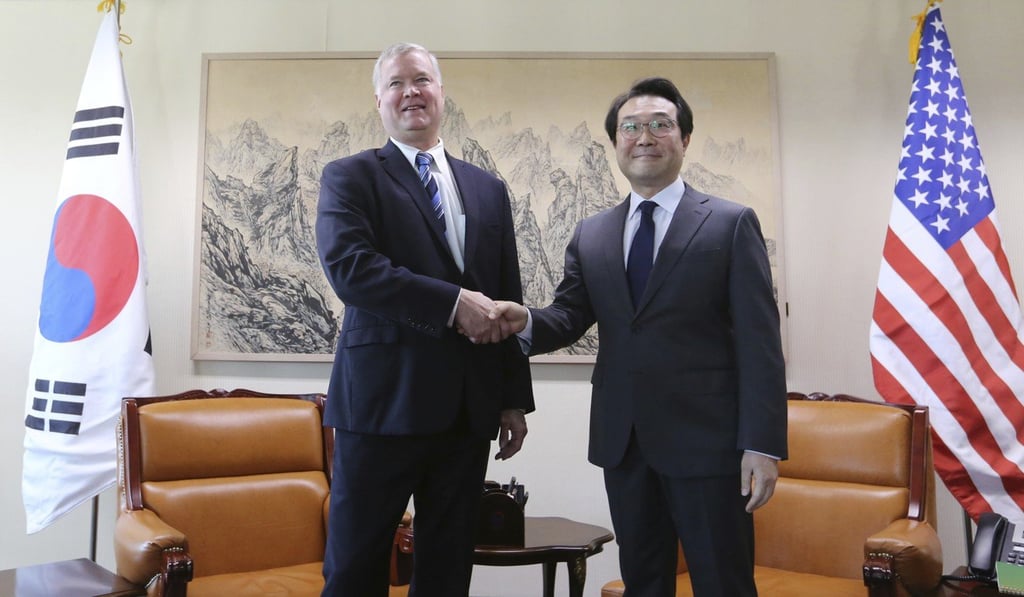
US special representative for North Korea Stephen Biegun with South Korea’s Special Representative for Korean Peninsula Peace and Security Affairs Lee Do-hoon. Photo: AP
Advertisement
On Monday, Biegun met South Korean officials in Seoul to discuss details of the upcoming summit, which is expected to take place in Vietnam, ahead of talks with North Korean negotiators later this week. During the first summit in Singapore last summer, Kim signed a vaguely worded agreement promising to work toward the “complete denuclearisation of the Korean peninsula”, but progress stalled as Pyongyang accused Washington of not taking “corresponding measures”.

While rich in symbolism, the practical implications of ending the Korean war are open to interpretation. One common expectation of normalising relations is that Washington would open an embassy or liaison office in Pyongyang, and vice versa. An end-of-war declaration could also be accompanied by relief from US sanctions and the easing of a travel ban for US nationals.

Advertisement
Select Voice
Choose your listening speed
Get through articles 2x faster
1.25x
250 WPM
Slow
Average
Fast
1.25x