Advertisement
Coronavirus pandemic
This Week in AsiaHealth & Environment

Coronavirus: Japan’s employees are working from home, but stress has followed them

  • Prime Minister Shinzo Abe has called on companies to find ways to let employees work remotely and set a target of 70 per cent fewer commuters
  • Firms can cut costs and employees don’t need to commute, but 40 per cent of people said their mental health had been affected by teleworking

Reading Time:3 minutes
Why you can trust SCMP
Masked commuters head to work near Tokyo Station on Monday, after the city and other parts of the country were placed under a state of emergency last week to halt the spread of coronavirus infections. Photo: Kyodo
Julian Ryall
With more Japanese people working from home during the state of emergency implemented to stem the spread of coronavirus infections, the social and economic benefits as well as the downsides are becoming clearer, with an analyst suggesting there are already signs of a shift in the way in which people are working.
Japanese Prime Minister Shinzo Abe called on companies across the nation to find ways to let more employees work remotely, after he declared a state of emergency in Tokyo, Osaka and six neighbouring prefectures on April 7, and set a target of 70 per cent fewer commuters.

While there was a clear decline in the number of people using public transport late last week, it fell far short of the 70 per cent reduction. Numbers were down around 40 per cent in Yokohama and parts of Osaka, but only down 15 per cent in central Kobe and a mere 7.7 per cent in the Urawa district of Saitama Prefecture, north of Tokyo.
Advertisement
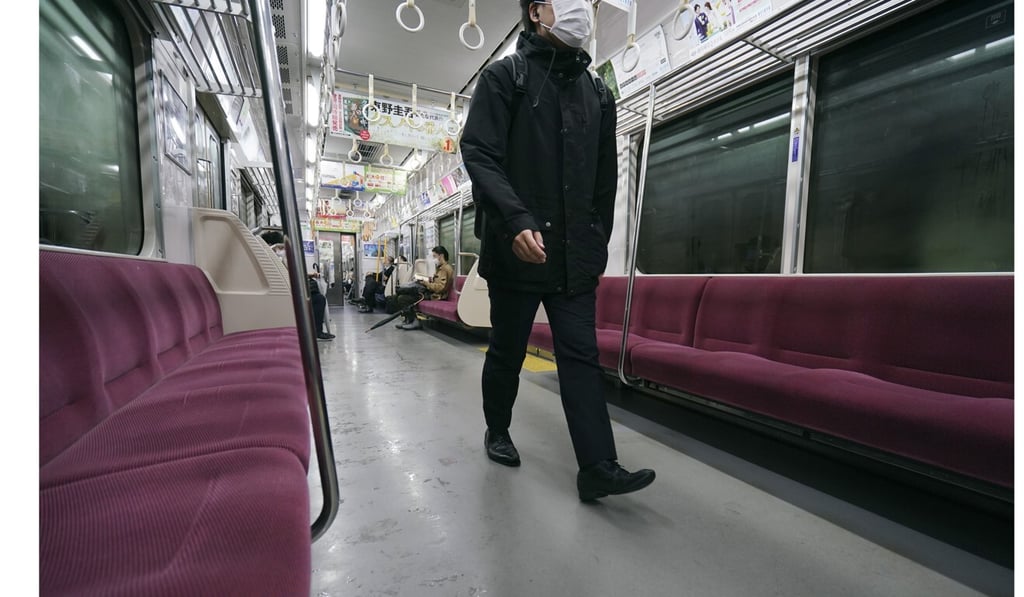
A passenger wearing a protective face mask walks on an empty train car in Tokyo, as the government set a target for a reduction in the number of commuters. Photo: AP

Abe made his disappointment clear. “Even it is absolutely necessary to go to work, the number of workers should be reduced by at least 70 per cent,” he told the coronavirus task force meeting over the weekend.

Advertisement

Shino Naito, a senior researcher at the Japan Institute for Labour Policy, said it may take a little time for companies to get to grips with the concept of letting staff work remotely, but they are likely to embrace the idea once they see the positives.

Advertisement
Select Voice
Choose your listening speed
Get through articles 2x faster
1.25x
250 WPM
Slow
Average
Fast
1.25x