-
Advertisement
Coronavirus pandemic: All stories
This Week in AsiaHealth & Environment

Coronavirus: when will Singapore’s recovery rate of 15 per cent pick up?

  • Singapore has nearly 25,000 infections and only 15 per cent of patients are deemed to have recovered
  • Experts say the city state has strict criteria for defining recovery and they expect this figure to rise as more migrant workers are discharged from medical care facilities

Reading Time:5 minutes
Why you can trust SCMP
A man walks past partitioned rooms at Changi Exhibition Centre in Singapore, which has been repurposed into a community isolation facility for Covid-19 patients. Photo: Reuters
Kok XinghuiandDewey Sim
With just 21 deaths among its nearly 25,000 coronavirus infections, Singapore has so far succeeded in limiting the toll from Covid-19. But there is another statistic that has also remained low: its recovery rate.

Almost nine in 10 of Singapore’s Covid-19 patients are still being kept in isolation at hospitals or care facilities, equating to a recovery rate of just 15 per cent.

In neighbouring Thailand, which has just over 3,000 cases, and Malaysia, with more than 6,700 cases, the recovery rates stand at 92 and 76 per cent respectively. In Italy, which has 221,216 infections, the recovery rate is 48 per cent.
Advertisement

So why the disparity? The answer, medical experts say, lies in the stricter definition of recovery in Singapore. It is also about timing, as Singapore’s surge in cases has happened recently. When it had 100-odd cases in March, the recovery rate was 70 per cent.
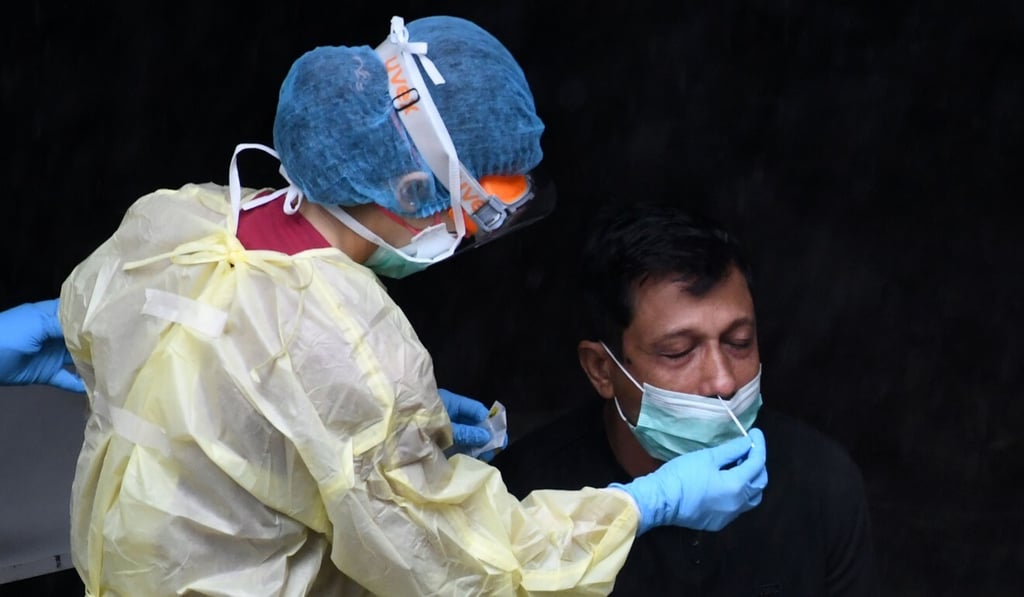
In Singapore, Covid-19 patients must twice test negative for the disease to be considered ‘recovered’. Photo: AFP
Advertisement

In the city state of 5.7 million people, anyone who tests positive for Covid-19 is hospitalised or placed in an isolation facility with medical teams. They are discharged only when they stop exhibiting symptoms, when it has been more than six days since the onset of their symptoms and when they test negative for the coronavirus twice more than 24 hours apart.

Advertisement
Select Voice
Choose your listening speed
Get through articles 2x faster
1.25x
250 WPM
Slow
Average
Fast
1.25x