On ReflectionWith China no longer aboard, Mahathir opens new chapter in Saga of the Malaysian People’s Car
The prime minister’s plans to revive Malaysia’s national car project is about more than just an automobile: it is about face, and one man’s enduring obsession with legacy

“We need to go back to the idea of a national car,” he announced at the 24th Nikkei Conference in Tokyo on his first foreign trip since his election last month. “Our ambition is to start another national car, perhaps with some help from our partners in Southeast Asia … we want to access the world market.”
His announcement that Malaysia was seeking new automotive partners and that Proton with its 49.9 per cent Chinese holding was no longer the Malaysian national car, made so soon after his election, suggest he is wasting no time in writing a new chapter in Malaysia’s automotive history – a history largely down to him.
Malaysia, he said, has “most of the skills and technologies in regard to the design and production of a new car” thanks to two decades of cooperation with Japan’s Mitsubishi Motors. “There are certain parts of a car which are extremely expensive to develop. We will want to source some of those expensive parts from other countries, including of course from Japan.” China was pointedly not mentioned.
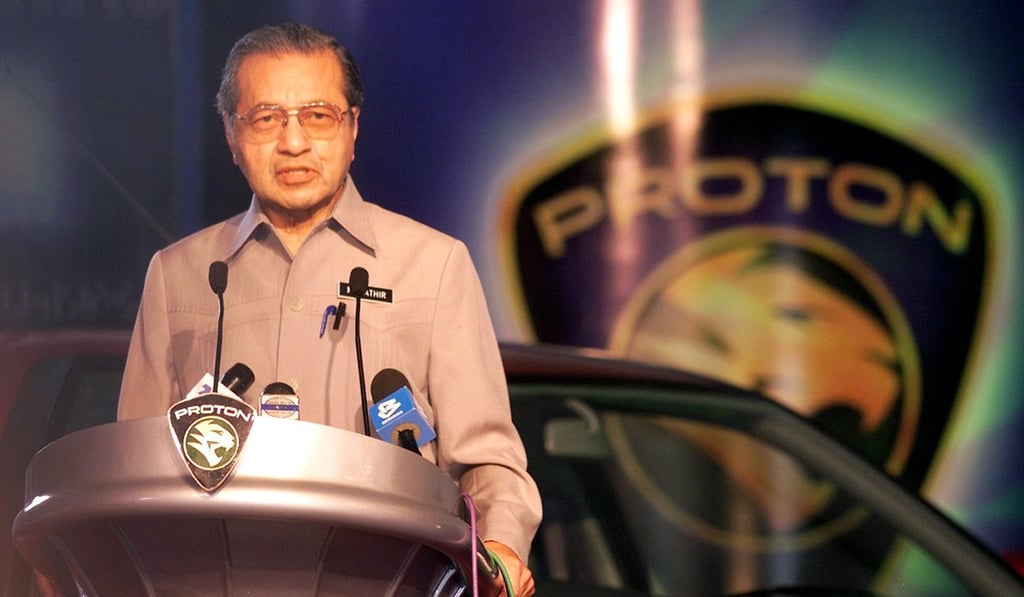
Mahathir hopes to produce a car which will conform to the Euro-5 or Euro-6 emission standards to access the world market. “We see in Silicon Valley there are a lot of new ideas that have come up, making use of IT and sensors used in building driverless cars.”