Advertisement
OpinionIndia must quit playing politics and change its approach to Kashmir if it wants to end deadly decades-old insurgency
- Arnab Neil Sengupta says New Delhi needs to face facts and stop throwing soldiers at a problem that a considered and coherent strategy could solve
4-MIN READ4-MIN

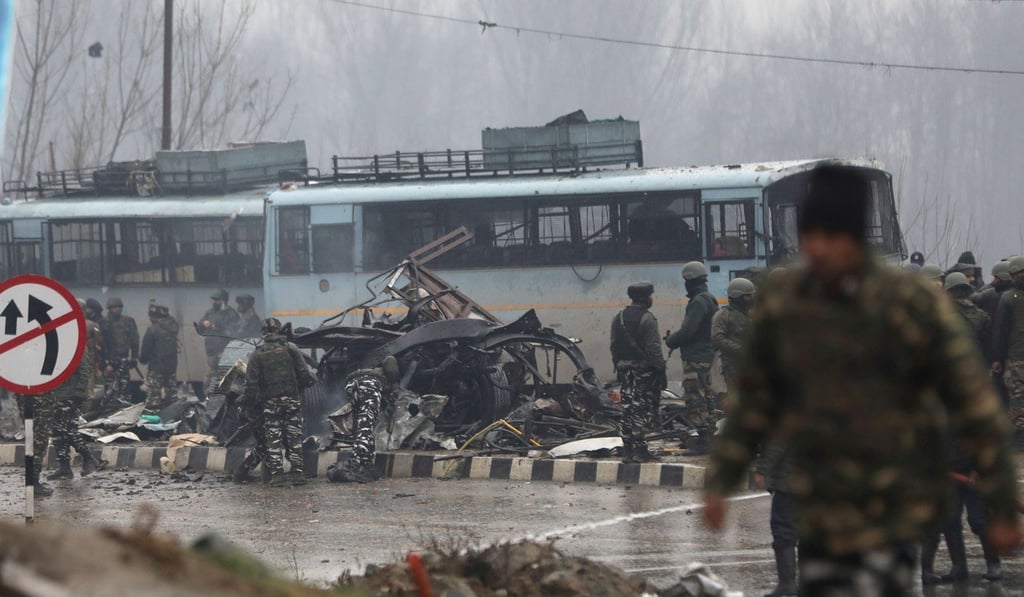
A week after the deadliest attack on Indian security forces in the annals of the Kashmiri insurgency, an informed geopolitical perspective is still missing from the national conversation about what hit the country on February 14.
The collective outpouring of grief and anger over the deaths of 40 paramilitary police officers in one fell swoop was only to be expected. What is on display, though, is more than just emotional catharsis. A subconscious feeling of guilt is also weighing down on India, which does not have compulsory military service, is increasingly addicted to economic populism, and had a score of just 41 out of 100 in Transparency International’s Corruption Perceptions Index 2018.
Advertisement
Besides guilt, there is a cacophony of confusing views on the bloodshed in Kashmir, emblematic perhaps of a political discourse that assumes only two countries in the whole wide world matter: Pakistan and China. But the truth is, Kashmir is a predominantly Muslim region with religious and political ties to the Islamic world, especially to the country just across the Line of Control that controls one-third of it. As such, the attitude that the blast in Pulwama was an unprovoked attack by a Pakistan-backed jihadi group is simple-minded and potentially counterproductive.
Suicide bombings are a classic example of asymmetric warfare used by underdogs who cannot defeat an army in conventional combat but are able to capitalise on local discontent to inflict heavy casualties at a minimal loss to themselves. The responsibility for the Pulwama attack may have been claimed by the Pakistan-based Jaish-e-Mohammad, but it was carried out by a Kashmiri youth. Violence-torn Kashmir is today a veritable breeding ground for home-grown militants.
As with so many other flashpoints, the turbulence in Kashmir is partly a by-product of the upheavals of 1979 in the Middle East, notably in Iran and Saudi Arabia, which gave rise to an antagonistic but mutually reinforcing relationship between Shia radicalism and Sunni/Salafi jihadism. Forty years on, there is no dearth of state and non-state actors who use armed Sunni and Shia groups to wage proxy wars against their strategic rivals. Pakistan’s spy agency, Inter-Services Intelligence (ISI), is not the only player in this geopolitical game, but it is possibly among the most ideologically motivated ones.
Advertisement
Select Voice
Select Speed
1.00x