
Advertisement
India
This Week in AsiaOpinion
Nisha Mathew

Opinion | Hong Kong was the protest story of 2019. This year it’s Modi’s India

  • Thousands have taken to the streets to defend the world’s largest democracy from the premier’s Bharatiya Janata Party, and the world is taking notice
  • Modi has energised his support base, but last December’s Citizenship Amendment Act has sparked a resistance from across the political spectrum

Reading Time:5 minutes
Why you can trust SCMP
A protest against the Citizenship Amendment Act in Mumbai, India, in December 2019. Photo: AP
As winter bites and temperatures plummet to levels not seen in more than a century, the political wildfire ravaging India shows no signs of abating. If Hong Kong was the protest story that dominated the headlines for much of 2019, expect Indians who are pouring into the streets of major cities and small towns by the thousands each day to take up the mantle in 2020.
Erupting in the wake of last December’s Citizenship Amendment Act (CAA) – which grants Indian citizenship to undocumented migrants from the “Hindu, Sikh, Buddhist, Jain, Parsi or Christian community from Afghanistan, Bangladesh or Pakistan”, but not Muslims – the current protests showcase the resolve of Indians to defend the world’s largest democracy from a ruthless assault by Prime Minister Narendra Modi’s Bharatiya Janata Party (BJP).
The mass protests first began in the northeastern state of Assam, where the National Registry of Citizens (NRC) – supposedly intended to “curb illegal migration” from Bangladesh – rendered nearly 2 million people, both Hindu and Muslim, stateless overnight. At least a thousand were packed off to detention facilities as illegal migrants, but the government trivialised the debacle as a bureaucratic oversight that could be easily corrected once the nationwide CAA kicked in.

A statement from Amit Shah, India’s home minister and a close Modi ally, promised the restoration of citizenship to Hindus – but his deafening silence on Muslims exposed the true colours of a regime that was willing to take its anti-Muslim policy to extremes, no matter how many critics, journalists and students were shot at, no matter how it upended the everyday lives of millions of citizens, and no matter how it battered the country’s already flailing domestic economy.
Advertisement

Protests against the Modi government are nothing new. Farmers, factory workers, university students and caste groups have all agitated against specific policies since the prime minister took power in 2014. None of them, however, could draw crowds in the numbers seen since the CAA was signed into law, let alone sustain their political momentum on a pan-Indian scale.
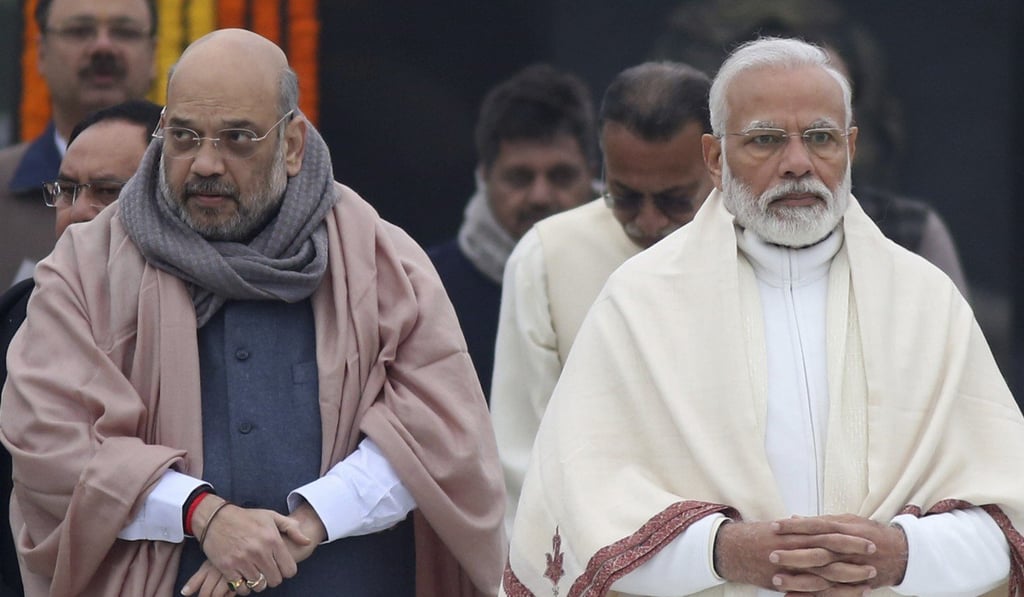
Indian Prime Minister Narendra Modi, right, with Home Minister Amit Shah. Photo: AP
Advertisement

Try as it might to the paint the current unrest as a feckless move by Muslims with a smattering of liberals in their midst, the government cannot refute overwhelming evidence to the contrary. At the helm of the growing nationwide network of protests are students, academics, media professionals, filmmakers, celebrities, opposition party figures and activists – behind whom are ordinary citizens of all religions, with the Indian constitution as their rallying point.

Advertisement
Select Voice
Choose your listening speed
Get through articles 2x faster
1.25x
250 WPM
Slow
Average
Fast
1.25x