Advertisement
Asian AngleIndonesia’s divided Muslims unite around a common cause: the Israel-Gaza war
- Israel’s months-long assault on the Palestinian enclave has galvanised opinion in Southeast Asia’s most populous Muslim-majority nation
- But the politicisation of the issue, and its framing in religious terms, has also spawned unintended consequences in Indonesia
4-MIN READ4-MIN
2

The escalation of the Israel-Gaza conflict since Hamas’ October 7 attack has elicited a significant response from Muslims in Indonesia, a country that hosts the world’s largest population of adherents to Islam but is itself fragmented along ideological and political lines, as well as by affiliation.
Major cleavages include the century-long rivalry between the more traditionalist Nahdlatul Ulama (NU) and the more modernist Muhammadiyah, competition among Islamic political parties, and theological differences between Sunnis and Shiites.
Differences of opinion are exemplified by disagreements over the date Eid falls on, for instance. More recently, Indonesian Muslims’ behaviour has been characterised by distinctions in social class.
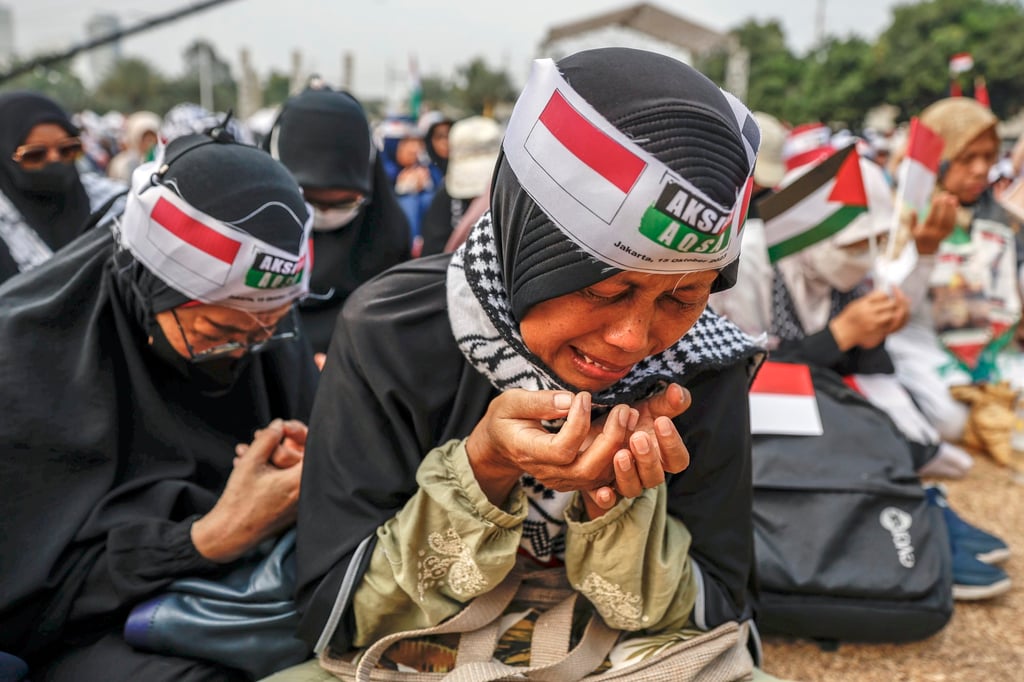
It has taken a conflict thousands of miles away in the Middle East to unite them all.
Advertisement
Indonesia’s dealings with Israel have historically been a sensitive issue. Political leaders, as well as presidential hopefuls in the recent election, have tiptoed around the subject so as not to upset Muslim voters who harbour strong emotions about the Palestinians’ plight and Israel’s occupation of Jerusalem, Islam’s third-holiest site.
In March last year, Central Java’s then-governor Ganjar Pranowo expressed his opposition to the planned participation of Israel’s youth football team in the Fifa Under-20 World Cup, originally scheduled to take place in Indonesia from May to June. With the governor of Bali doing the same, purportedly on the instruction of their Indonesian Democratic Party of Struggle, Ganjar framed his rejection as a collective effort to support the independence of Palestine, aligning with the stance of Indonesia’s first president, Sukarno.
Indonesia’s Muslim groups have maintained their support for Palestinians in the wake of Hamas’ October 7 attack and continue to condemn Israel while calling for a ceasefire. NU and Muhammadiyah are wholeheartedly committed to endorsing the Palestinian independence movement. In October, both Islamic civil society organisations – the two most influential and moderate in Indonesia – released official statements calling for a peaceful and just resolution to the war.
Advertisement
Advertisement
Select Voice
Select Speed
1.00x