-
Advertisement
Asean
This Week in AsiaOpinion
Maria Siow

My Take | Southeast Asians are warming to the Quad – but they need to see more tangible benefits

  • A new survey shows rising regional acceptance of the US-Japan-Australia-India security grouping that’s been derided by Beijing as an anti-China ‘tool’
  • To strengthen ties with Asean, however, more tangible, visible projects for the public good will be needed, especially in health and infrastructure

Reading Time:3 minutes
Why you can trust SCMP
12
Australian Prime Minister Anthony Albanese, US President Joe Biden, Japanese Prime Minister Fumio Kishida, and Indian Prime Minister Narendra Modi wave before their Quad leaders’ meeting in Tokyo in May 2022. Photo: AFP
Despite earlier reservations, there appears to be a greater acceptance of the Quadrilateral Security Dialogue, or Quad, in Southeast Asia.
This is an opportunity for the bloc – comprising the United States, Japan, Australia and India – to seize on the current geopolitical momentum and roll out more tangible, visible projects to strengthen ties with the Association of Southeast Asian Nations.

According to a new survey released this week by the Singapore-based ISEAS-Yusof Ishak Institute, an overwhelming number of Southeast Asians expressed confidence in the Quad, which was established decades ago but revived in recent years as a counter to Chinese influence.

Of the close to 2,000 Southeast Asians surveyed for the sixth “State of Southeast Asia” study, 73.1 per cent agreed that cooperation between Asean and the Quad would either “be beneficial to the region” or “complementary to Asean efforts”.

Advertisement

This stood in stark contrast to the 2020 survey, which found that 54.2 per cent thought the Quad had a “very negative” or “negative” effect on Southeast Asian security, or had “no impact”.

It also marked an increase compared to 2022, when 58.5 per cent of respondents said they either “agreed” or “strongly agreed” that strengthening the Quad would be constructive for the region.
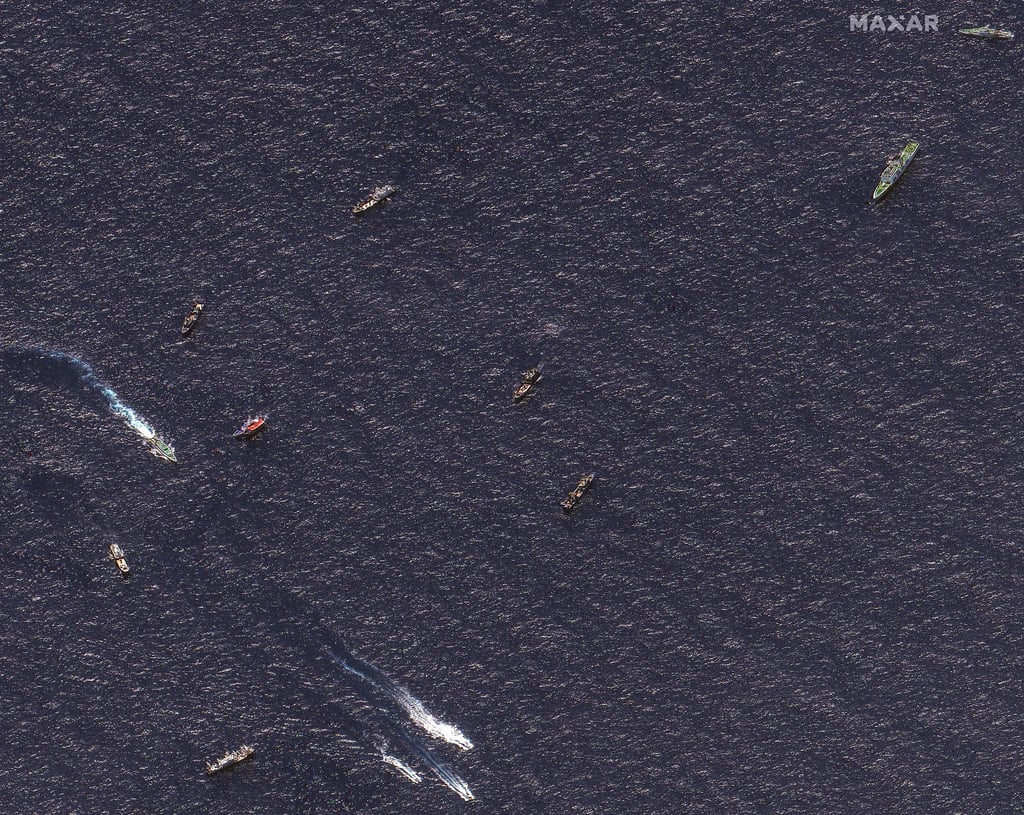
A satellite image taken on March 23 shows Chinese and Philippine ships in the South China Sea. Ongoing maritime tensions have likely contributed to rising acceptance of the Quad in Southeast Asia. Photo: Maxar Technologies satellite image / Handout via AFP
This year’s survey found, for the first time, that more people in Southeast Asia – if forced to choose between the two major powers – favoured alignment with China over the US, albeit by a narrow margin.
Advertisement
Advertisement
Select Voice
Choose your listening speed
Get through articles 2x faster
1.25x
250 WPM
Slow
Average
Fast
1.25x