-
Advertisement
Asean
This Week in AsiaOpinion
William Choong
Joanne Lin
William ChoongandJoanne Lin

Asian Angle | What a US-China ‘grand bargain’ would mean for Southeast Asia

Washington’s Venezuela raid has resurrected old fears about ‘spheres of influence’, sounding alarm bells for Southeast Asian autonomy

Reading Time:4 minutes
Why you can trust SCMP
US President Donald Trump and China’s President Xi Jinping after their talks at the Gimhae Air Base in Busan on October 30, 2025. Photo: TNS
The United States’ military operation in Venezuela, culminating in the capture and removal of President Nicolas Maduro, might at first have appeared distant to Southeast Asia. What should concern the region, however, is not geography but the logic underpinning Washington’s action: a growing willingness to act unilaterally, in this case undermining sovereignty and invoking presidential powers to justify the use of force against a perceived threat.

More troubling still, it dusts off the old geopolitical idea of “spheres of influence”. This notion harks back to a time when major powers “staked out” zones of control, constraining the autonomy of weaker states. Indeed, the latest US National Security Strategy (NSS) explicitly commits Washington to “reassert and enforce the Monroe Doctrine” – a foreign policy position from 1823 associated with US military dominance that frames the western hemisphere as a privileged security space – through what it terms a “Trump Corollary”.

Spheres of influence are established when major powers carve up areas according to their interests, sometimes respecting each other’s spheres so as to reduce the chance of disputes or conflict. In the Venezuela episode, no other power directly challenged Washington’s assertion of a sphere of influence in the western hemisphere, where US military power is unparalleled. China has publicly voiced its opposition, but it is unlikely to actively challenge US President Donald Trump in this instance.
Advertisement

Such an uncontested declaration of a sphere of influence is rare in modern history. When it does occur, other powers must decide whether to cede ground. Historically, many of these arrangements were codified through negotiation. In 1869, for instance, Russia assured Britain that Afghanistan lay outside its sphere of influence, an understanding later formalised in the Anglo-Russian Convention of 1907, which effectively divided Persia into British and Russian zones.
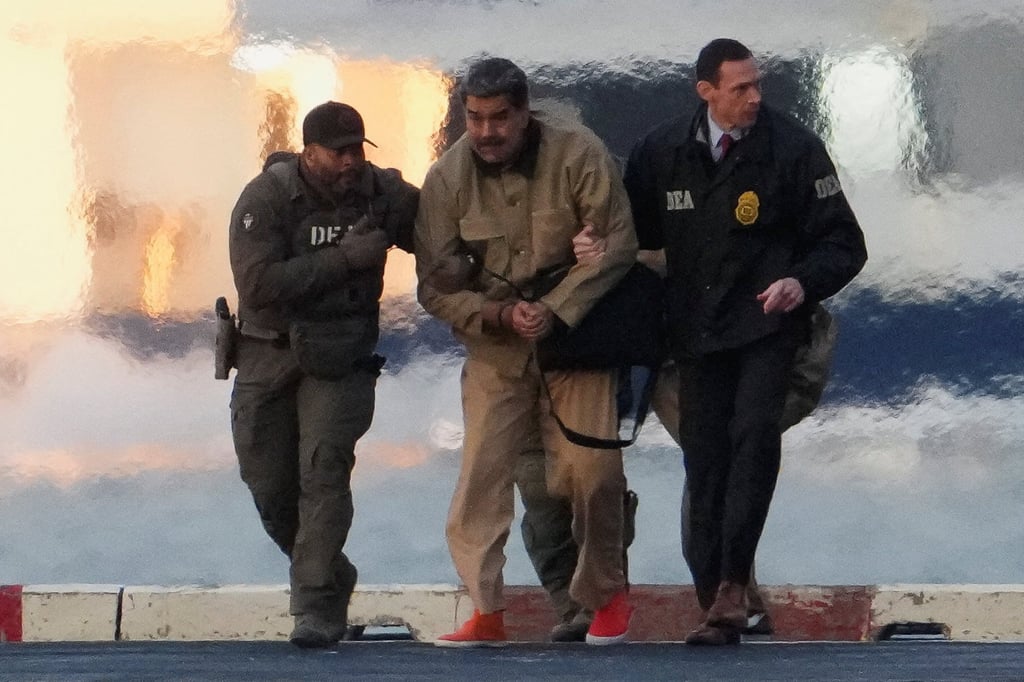
Captured Venezuelan President Nicolas Maduro is escorted to a New York City courthouse for an initial appearance to face US federal charges including narcoterrorism, conspiracy and drug trafficking on January 5. Photo: Reuters

Washington’s action in Venezuela has therefore resurrected Southeast Asia’s fears about spheres of influence closer to home. But it is unlikely that the US could unilaterally establish such a sphere anywhere in Asia without China challenging the move. In any case, the latest NSS was more equivocal about Asia than it was the Americas, stating only that the US sought to “successfully compete” against China in the Indo-Pacific.

Advertisement
Advertisement
Select Voice
Choose your listening speed
Get through articles 2x faster
1.25x
250 WPM
Slow
Average
Fast
1.25x