-
Advertisement
The Philippines
This Week in AsiaPeople

Allies of Philippines’ Duterte step up online attacks as drug war trial looms

The efforts have focused on undermining the ICC itself, targeting victims and witnesses and normalising mockery of the dead

3-MIN READ3-MIN
1
Listen
Philippine President Rodrigo Duterte (centre) holds a Galil sniper rifle during the national police chief change of command ceremony inside Camp Crame in Quezon City in April 2018. Duterte is accused of overseeing a campaign of extrajudicial killings linked to his signature “war on drugs”. Photo: EPA-EFE
Alan Robles
As judges in The Hague consider whether former Philippine president Rodrigo Duterte’s crimes against humanity case should proceed to trial, a parallel battle over the narrative has taken hold online.
Prosecutors at the International Criminal Court (ICC) have accused Duterte of overseeing a campaign of extrajudicial killings linked to his signature “war on drugs”. Rights groups say the campaign left thousands dead during his 2016-2022 presidency, allegations he has repeatedly denied.

Analysts warn that a coordinated network of supporters is working to reshape public perception and portray Duterte as a victim. Over the past 10 days, that effort has crystallised around three strands: undermining the ICC itself, targeting victims and witnesses, and normalising mockery of the dead.
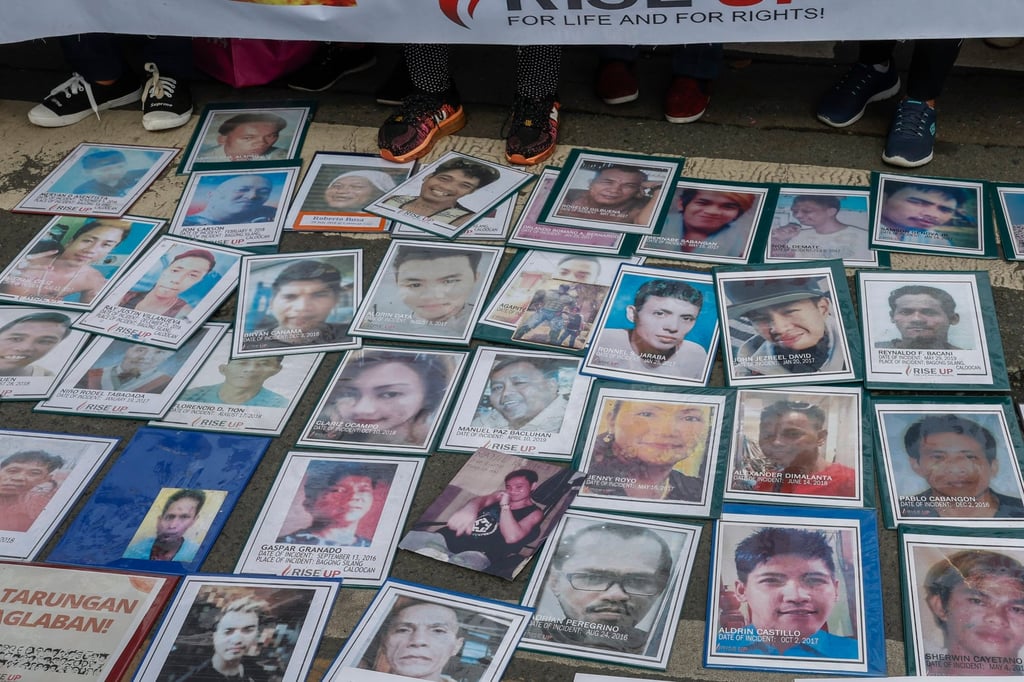
Images of victims of alleged extrajudicial killings during the term of former Philippine president Rodrigo Duterte are laid out during a rally in Quezon City in November 2024. Photo: EPA-EFE

Delegitimising the court

The most dramatic allegation surfaced on February 24, when 18 men presenting themselves as former Philippine Marines held a press conference alleging that from 2022 to 2025 they had delivered suitcases, boxes and bags filled with cash – amounting to 805 billion pesos (US$13.8 billion) – to President Ferdinand Marcos Jnr, his cousin Martin Romualdez and other politicians.
Advertisement

In an affidavit, the men alleged the money, which they said came from government flood-control projects, had also been used to bribe ICC investigators.

The Philippine Navy later said four of the 18 had never been members of the Marines or Navy, while most of the remaining signatories had been dishonourably discharged.

Advertisement

One politician named in the affidavit, Representative Leila de Lima, questioned how she could have received the alleged cash when she had not yet been elected to office and was, at the time, in solitary confinement over drug-trafficking charges she has previously described as politically motivated.

Advertisement
Select Voice
Select Speed
1.00x