Can Japan’s teflon Abe hang on to party leadership?
Surviving multiple domestic scandals, the prime minister now has some favourable polls and is expected to enter the race to remain the LDP president

A victory in September would be quite a resurrection for Abe’s fortunes after he looked both physically tired and politically adrift just a few months ago, as criticism from the opposition and media came in hard and fast over cronyism scandals and an unstable administration.
It has taken all of Abe’s political wiles to turn the political tide, but the latest polls suggest he has successfully distanced himself from the stench of underhand dealings. In the most recent public opinion polls, conducted in late June by the Nikkei business daily, Abe’s support rating rose 10 points from the previous month, giving the prime minister a positive figure for the first time since February.
Shinzo and Xi say it's a fresh start for China and Japan. Hmm...
All up, 52 per cent of the electorate expressed support for Abe in the poll, with supporters identifying the prime minister’s global presence and government stability as the most important factors.
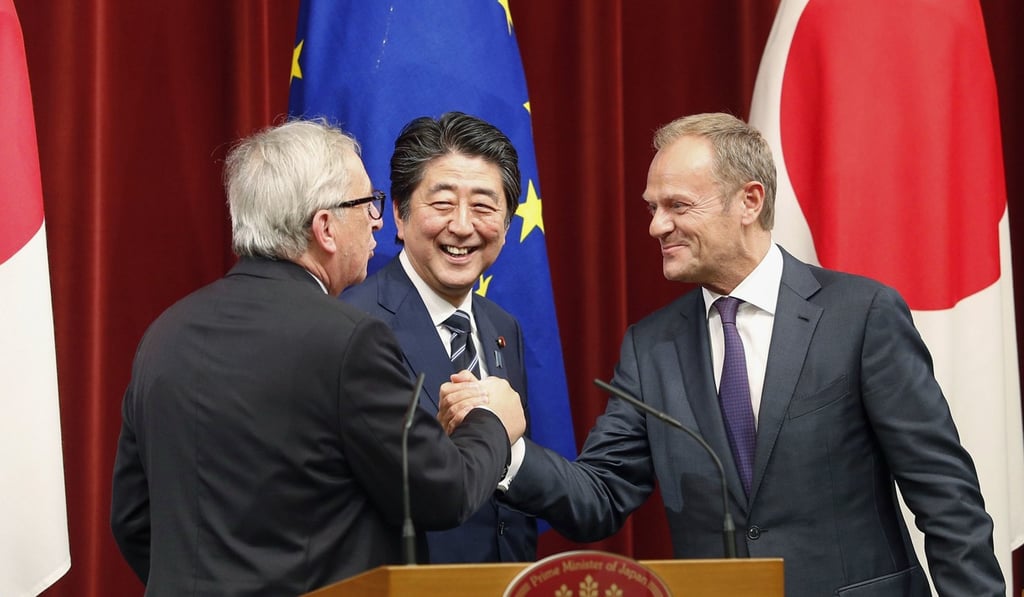
If Abe is successful in convincing politicians and party members, who will vote on the LDP president, that he is the man for the job, then he will be closing in on the record for the longest-serving Japanese leader since the end of the second world war. Eisaku Sato currently holds that record, serving for 2,797 days from November 9, 1964, to July 7, 1972. Abe returned to the post of prime minister after serving only 365 days from September 2006. He has now served 2,030 days since starting his second term on December 16, 2012.
Abe's nuclear disaster: why was Japan shut out of North Korea talks?
“Abe’s poll numbers have rebounded strongly in recent weeks, and the main reason is that his main challengers are quite unpopular among conservatives,” said Yoichi Shimada, a professor at Fukui Prefectural University who has in the past advised Abe on foreign policy.