-
Advertisement
The Philippines
This Week in AsiaPolitics
Richard Heydarian

On Reflection | As Muslims vote on self-rule in Philippines, Duterte’s legacy is in God’s hands

  • Referendum on establishing a ‘Bangsamoro’ – or nation of Moros – looks likely to pass
  • But as a recent terrorist attack in Jolo shows, the challenge has just begun for a president who promised ‘a Mindanao governed in peace’

Reading Time:4 minutes
Why you can trust SCMP
Philippine President Rodrigo Duterte has vowed to bring about ‘a Mindanao that is governed in peace’. Photo: EPA

More than two million Filipinos flocked to polling stations this month in a historic referendum that will determine the future of the southern Philippine island of Mindanao. Residents of Muslim-majority regions are deciding on the establishment and precise composition of the so-called “Bangsamoro” (nation of Moros).
As the first Filipino president from Mindanao, Rodrigo Duterte has staked his political legacy on the successful establishment of the new political entity. Authoritative surveys and partial results suggest the referendum is likely to pass with large majority support, with the new political entity encompassing almost all Muslim-majority provinces and urban centres, including the much-prized Cotobato City.
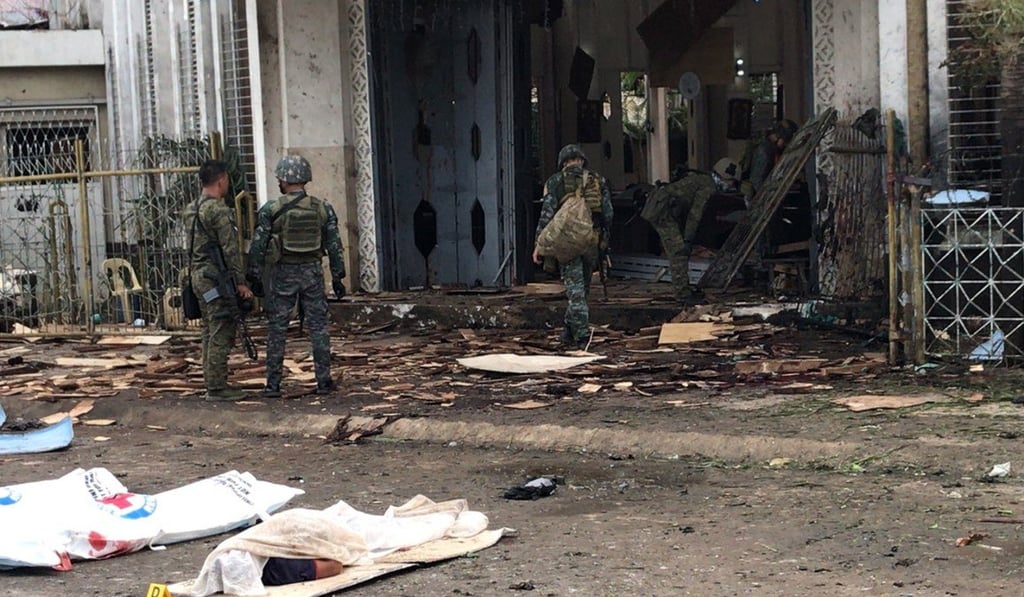
But as shown by the recent terrorist attack in Jolo, which targeted a Catholic Church and led to the death and injury of more than 100 people, there is no room for complacency. The path ahead is riddled by unimaginably difficult challenges, especially given the depth of poverty in the southern Philippines as well as the ubiquity of religious extremism in the area.
Advertisement
Filipino soldiers cover the bodies of victims at a cathedral in Jolo where two bombs exploded, killing more than 20 people. Photo: EPA

The proposed political entity, officially named Bangsamoro Autonomous Region in Muslim Mindanao (BARMM), is ambitious in its scope and objectives. It will replace the three-decades-old Autonomous Region of Muslim Mindanao (ARMM), a much smaller experiment at granting political autonomy to the Moros.

The ARMM is largely deemed a failure, given its limited geographical scope, covering mostly impoverished provinces dominated by the Tausug ethnic group, as well as the dearth of functioning state institutions in the area, thanks to the prevalence of vicious warlordism and limited support from the national government.

Advertisement
Select Voice
Choose your listening speed
Get through articles 2x faster
1.25x
250 WPM
Slow
Average
Fast
1.25x