Advertisement
Nepal
This Week in AsiaPolitics

India’s Hindu nationalists see Nepal’s political chaos as chance to boost royalist calls, target secular state

  • China has urged political stability as fractures in the Nepal Communist Party deepen, with critics warning of blatant interference in a domestic matter
  • But the real worry is that disillusioned residents in the secular state will increasingly find an icon in Indian PM Narendra Modi

Reading Time:5 minutes
Why you can trust SCMP
3
Gyanendra Bir Bikram Shah Dev, the last king of Nepal, during his 71st birthday in July 2017 at his residence in Kathmandu. Photo: Getty Images
Sonia Sarkar
In his sprawling house at the Himalaya Mahalaxmi Tea Garden in the eastern Nepal town of Damak, 73-year-old Gyanendra Bir Bikram Shah Dev, the last king of Nepal, spends most of his time reading newspapers and books. But while he is sequestered away from public life, the 239-year-old Hindu monarchy he once represented is again a focus of public protests.

About 400km away, in Nepal‘s capital of Kathmandu, hordes have been rallying for the restoration of the monarchy, which was overthrown by Maoists in 2008 after they joined mainstream politics following a decade of civil war. Last week, nearly 23,000 people marched on the streets, some armed with slogans including “King, please come back and save our country”.

While Nepal is now a secular republic, years of political deadlock, and more recently a political crisis sparked when the prime minister dissolved parliament in December, continue to fuel calls for a return to the past in the Himalayan nation of 30 million people.

Protesters have also called for Nepal, a landlocked country sandwiched between India and China, to be a “Hindu Rashtra” – a Hindu state. About eight in 10 of the populace are Hindu, while the rest are Buddhists, Muslims, Christians and others
Advertisement
While China sent a top official to Nepal – a recipient of large amounts of Chinese aid and investment – to assess the situation last month, India has not officially shown any interest in involving itself in domestic developments. Still, several Indian Hindu groups and social media influencers, including a former Indian Army general close to the ruling Bharatiya Janata Party (BJP), have been promoting Hindu nationalism in Nepal.
“It‘s our responsibility to support the Nepalese,” said Ramesh Shinde, the national spokesman of the right-wing Hindu group Hindu Janjagruti Samiti (HJS), who has been campaigning online for Hindu Rashtra in Nepal. The HJS, which once demanded that Indian Prime Minister Narendra Modi “scrap” Nepal’s secular constitution, has over 47,000 followers on Twitter and organises an annual convention in India inviting Hindus from neighbouring South Asian nations to attend.
Advertisement
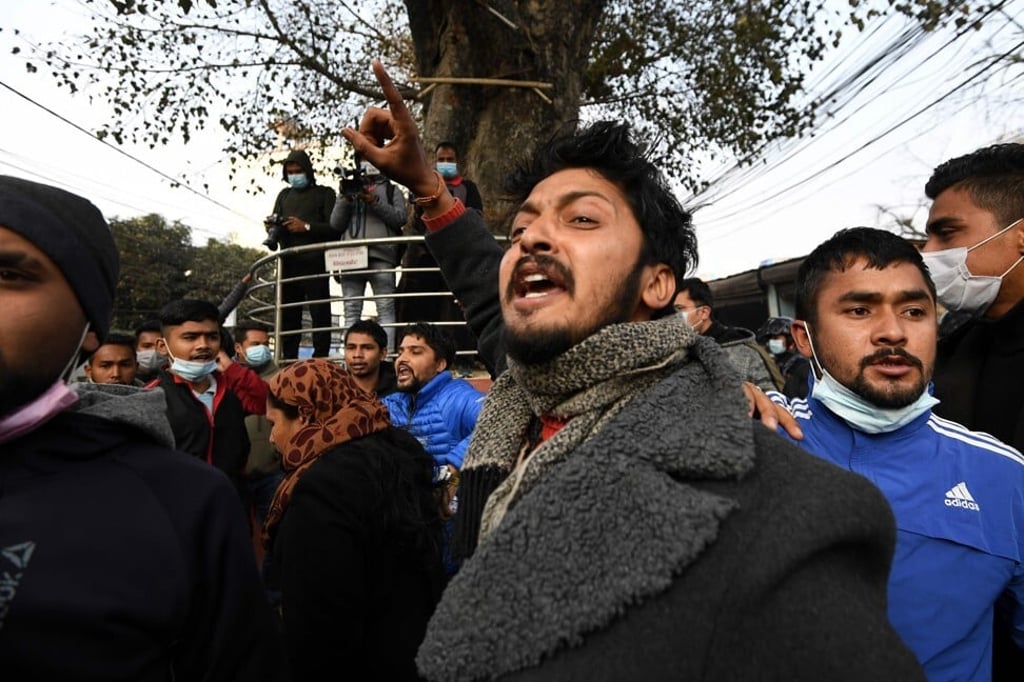
Protesters from the Nepal Student Union, which is affiliated with the opposition Nepali Congress party, chant slogans during a demonstration against the dissolution of the country's parliament, in Kathmandu on January 13. Photo: AFP
Advertisement
Select Voice
Choose your listening speed
Get through articles 2x faster
1.25x
250 WPM
Slow
Average
Fast
1.25x