South China Sea: will the Whitsun Reef dispute come between Beijing and Manila?
- The growing row sparked by Chinese vessels in the South China Sea is causing a headache for Philippine President Duterte, who has been nurturing ties with Beijing since 2016
- Beijing’s next moves could affect next year’s Philippine polls, analysts say, and Duterte’s antagonism towards the US could hurt him

For Philippine defence officials, it was a replay of an old nightmare. Early last month, more than 200 Chinese fishing vessels were sighted anchored off the Whitsun Reef, a boomerang-shaped coral formation within Manila’s exclusive economic zone (EEZ) in the South China Sea’s Spratly Islands.
The fleet, which had been moored there for weeks in clusters without doing any fishing, reportedly included ships from the People’s Armed Forces Maritime Militia, which Beijing uses to seize maritime territory non-violently.
Beijing says the ships are sheltering from bad weather, and that they are not militia vessels.
“Satellite imagery made available in the public domain shows the Chinese boats have been entering and exiting the area at will, virtually unobstructed, since late last year,” said Collin Koh, a research fellow at Singapore’s S. Rajaratnam School of International Studies (RSIS). It was clear that at least some of the crews were maritime militia, he added.
The incident was reminiscent of a similar action in 2012, when Chinese vessels inundated the Scarborough Shoal, also within the Philippine EEZ, and blocked Filipino fisherfolk’s access. The ships never left, and Manila lost control of the shoal as well as 38 per cent of its total EEZ. Analysts expect China to build an artificial island base on the shoal.
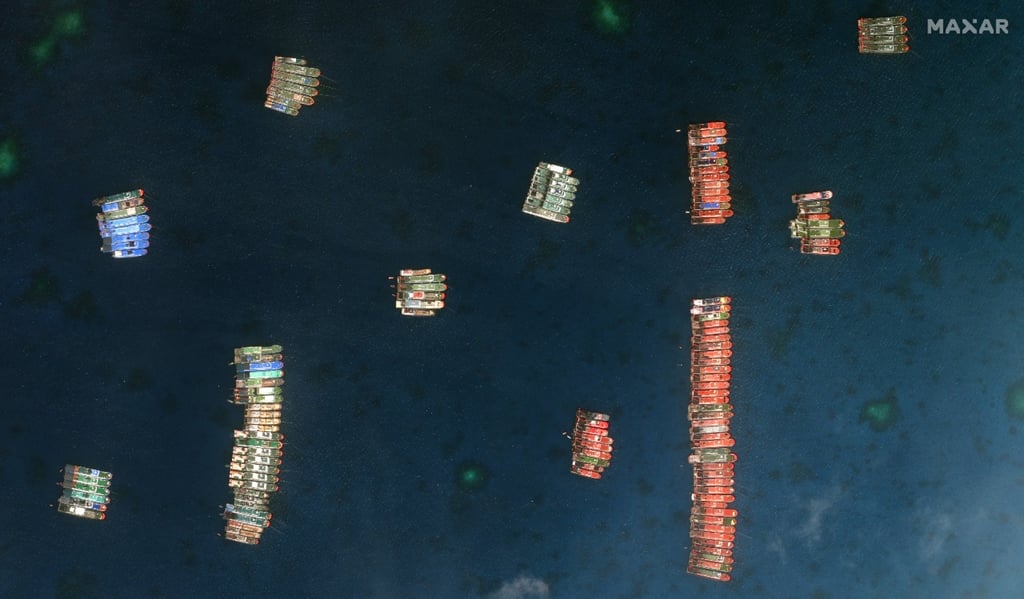
But in the case of Whitsun Reef, China has run into a spirited reaction from the Philippine military as well as other countries.
Also known as the Julian Felipe Reef in the Philippines and Niu’e Jiao in China, it is part of the Union Banks, a submerged atoll on which there are currently Chinese and Vietnamese bases and is in turn part of the Spratly Islands – which are contested by six governments.