Advertisement
China-Asean relations
This Week in AsiaPolitics

US-China rivalry: is the pressure on for Asean countries to choose sides?

  • While Southeast Asian nations have maintained a studied neutrality as Beijing and Washington clash over issues such as the South China Sea, experts say some alignment has already happened
  • But as the interests of China and the US diverge, the window of opportunity to not officially take a side is narrowing

Reading Time:6 minutes
Why you can trust SCMP
32
Experts say Southeast Asian nations are adopting a strategy of public hedging to keep their options open, as their economic and geopolitical considerations may vary. Photo: AP
Maria Siow
“Don’t force us to choose” has been a common refrain in Southeast Asia as Washington and Beijing clash over trade, technology and the South China Sea. But to political science professor Khong Yuen Foong, the 10 member states of the Association of Southeast Asian Nations (Asean) have already largely aligned themselves with either China or the United States.
Khong, vice dean for research and development at Singapore’s Lee Kuan Yew School of Public Policy, said at a recent webinar that Cambodia and Laos were clearly closer to China, having developed stronger political and economic ties with Beijing in recent years.
Vietnam and Singapore, on the other hand, had found “greater strategic comfort with the US”, he said, adding that countries such as Thailand, the Philippines and Malaysia had moved away from the US in recent years to become more embedded in the Chinese orbit.

Possibly the most neutral country, in Khong’s view, was Indonesia, which was “smack in the middle”.
Advertisement

“When these Asean countries say they do not want to choose, they are saying they do not want to move too far away from their current positions because they are comfortable with them,” he said. “Yet it is important to note that these positions are not cast in stone. They will shift over time, and in that sense, the political strategic alignments of the majority [of nations] in Southeast Asia are up for grabs.”

These positions, experts say, include a strategy of public hedging to keep their options open, as the countries’ economic and geopolitical considerations may vary.
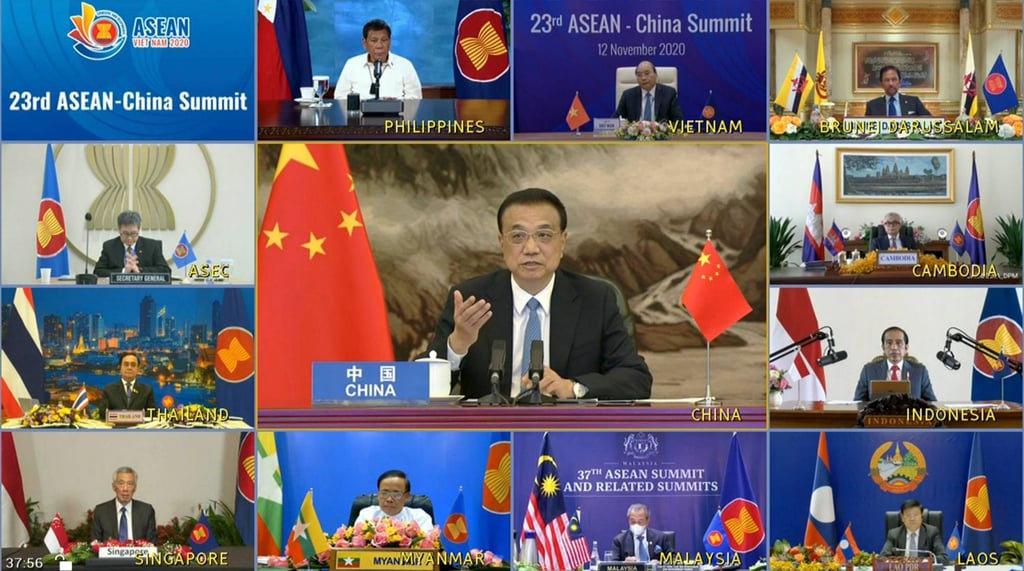
China’s Premier Li Keqiang addresses Asean leaders in November 2020. Photo: AFP

Mark N. Katz, a government and politics professor at George Mason University in the US, said Southeast Asian states seeking close relations with China would not want to cut ties with the US either.

Advertisement
Select Voice
Choose your listening speed
Get through articles 2x faster
1.25x
250 WPM
Slow
Average
Fast
1.25x