Advertisement
South China Sea aerial arms race catches Southeast Asia off guard
- Aukus pact focused minds on possibility of naval arms race, but bigger story may be in the skies, where Chinese fighters have buzzed edges of Malaysian airspace
- Most countries in the region are ill-prepared to take on China. Vietnam and Singapore might stand a chance, but Malaysia and the Philippines need modernisation
11-MIN READ11-MIN
52

The unstable peace in the South China Sea was not far from the mind of Malaysia’s Prime Minister Ismail Sabri Yaakob when he offered his initial reactions to the recently announced defence partnership between the United States, Britain and Australia.
The trilateral pact had the potential to “provoke other powers to be more aggressive in the region, especially the South China Sea”, Ismail Sabri said following a call with his Australian counterpart Scott Morrison.
In the sharply worded statement, Ismail Sabri also warned of a renewed “nuclear arms race” that could arise out of the so-called Aukus deal.
Advertisement
Neighbouring Indonesia too voiced similar concerns, but for Kuala Lumpur – among the Southeast Asian claimants disputing Beijing’s vast claims on the South China Sea – the spectre of overt aggression in the waters has been all too real in recent months.
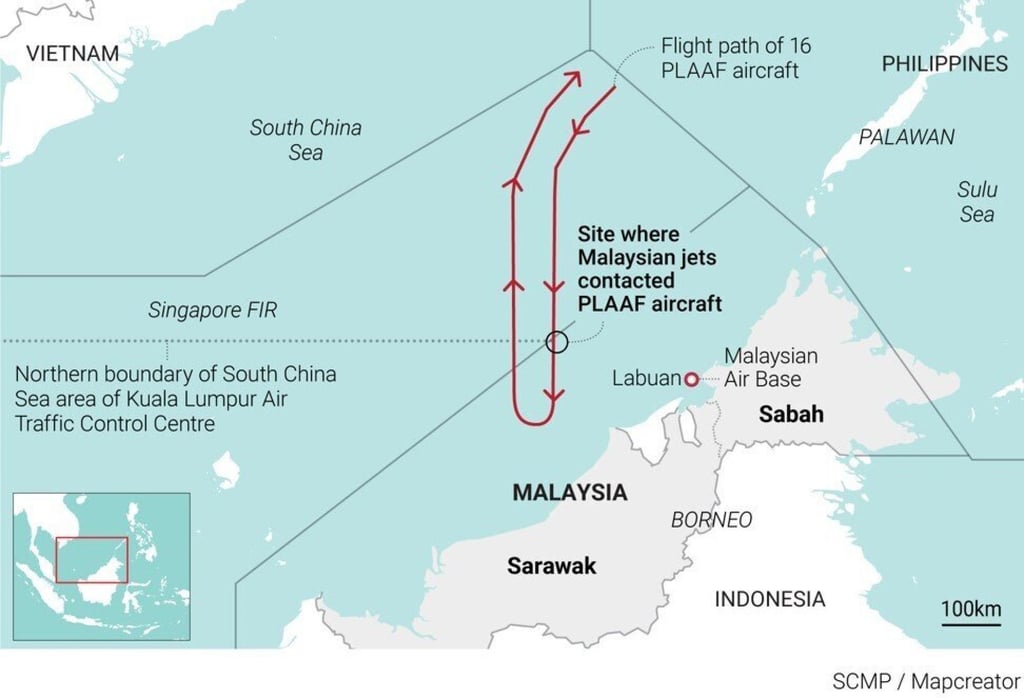
While Malaysia has for years contended with heightened Chinese military activity in the neighbourhood, a May 31 patrol by 16 Chinese military transport planes in waters just off the state of Sarawak in Borneo served as a wake-up call.
Advertisement
Malaysia reacted with alarm, lodging a démarche to the Chinese envoy and characterising the incident as an “intrusion” and a “serious threat to national sovereignty” even though the planes only skirted Malaysia’s territorial air space.
Advertisement
Select Voice
Select Speed
1.00x