Advertisement
Japan beats China as an investor in Asean but why does survey show trust in it is declining?
- Singapore think tank survey finds dip in confidence in Japan, even though it is Southeast Asia’s larger investor, beating China
- Experts say Japan’s domestic politics, tense relations with neighbours and Covid-19 management have not inspired confidence in its global leadership
4-MIN READ4-MIN
29

Japan might rank among the top holiday destinations for Southeast Asians, reflecting the good impression that most have of the country. But it’s a different story when it comes to how much trust those in the region have towards Japan or how they view its political and economic influence, as the latest annual State of Southeast Asia Survey shows.
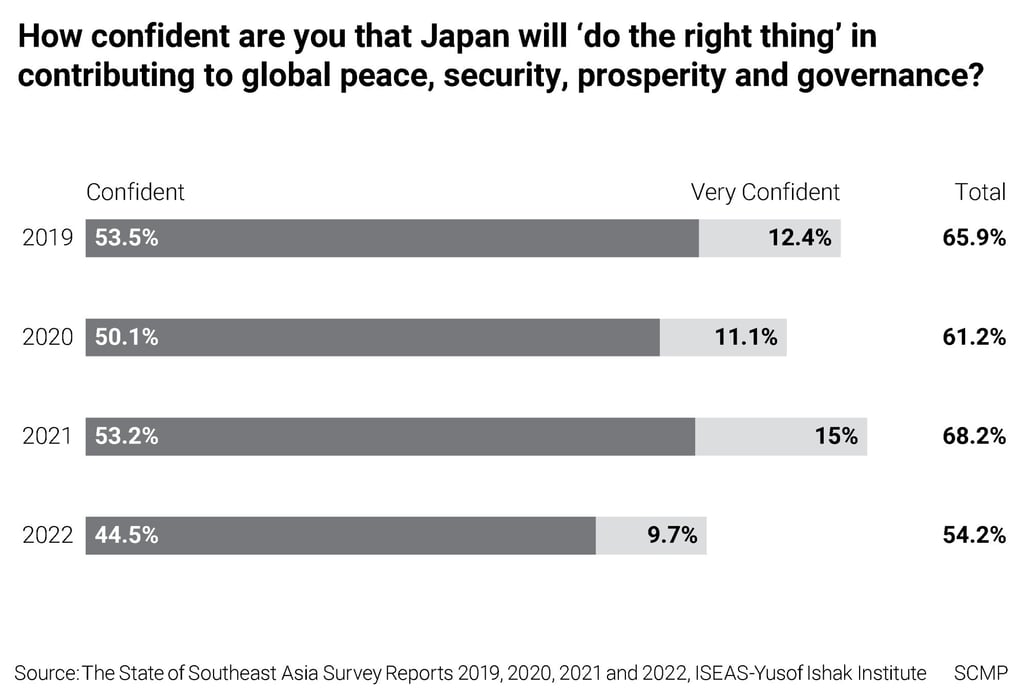
Released last week by Singapore think tank ISEAS-Yusof Ishak Institute, the survey – which canvassed 1,677 respondents from a range of backgrounds including government and academia – found that 54.2 per cent said they had confidence in Japan to “do the right thing” in contributing to global peace, security, prosperity and governance.
This number “declined significantly” from last year’s 68.2 per cent, the survey report said. A check of the findings from previous surveys since 2019 when the survey first began found this was the first time it fell to below 60 per cent.
When it came to assessing influence in Southeast Asia, only 2.6 per cent of respondents in this year’s survey picked Japan as the most influential economic power, down from 4.1 per cent last year.
Advertisement
In contrast, just over three-quarters of respondents picked China, even though Japan has invested more in the region, according to an Australian National University study last year which found that in 2018, Japan invested US$20.9 billion in Southeast Asia, more than twice China’s US$9.9 billion.
So why has Japan seemingly lost ground? The survey offered only a few clues, when it drilled down into the perceptions of respondents. One-fifth of them said they had “no confidence” or “little confidence” that Japan would “do the right thing” to contribute to the global good. Of these 332 people, four in 10 said their lack of confidence stemmed from a belief that Japan did not have the capacity or political will for global leadership. Meanwhile, close to three in 10 said Japan was distracted by domestic affairs and relations with China, South Korea and Taiwan.

Asked for their views, experts suggested that Japan’s domestic politics and Covid-19 management in the last two years contributed to a decline in trust.
Advertisement
Select Voice
Select Speed
1.00x