Advertisement
South China Sea
This Week in AsiaPolitics

South China Sea: EU offers encrypted tool to fight maritime security threats in Indo-Pacific

  • Officials said the IORIS platform was like a ‘very secure Facebook’, which allows member nation’s navies and coastguards to communicate and coordinate
  • The Philippines hopes the system – which China is excluded from – will aid its deployment of BrahMos anti-ship cruise missiles from India

Reading Time:3 minutes
Why you can trust SCMP
A Philippine coastguard ship patrols near Whitsun Reef in the South China Sea last year. Photo: Philippine Coast Guard Handout via AP
Raissa Roblesin Manila
The European Union is seeking to ramp up its maritime security influence in the Indo-Pacific by offering access to a web-based platform that enables member countries’ navies and coastguards to communicate in real-time.
Trials of the Indo-Pacific Regional Information Sharing (IORIS) platform are currently under way in the Philippines, where it is being used to conduct joint disaster relief exercises, navy chief Rear Admiral Caesar Valencia told a forum in Manila on Monday.

He said the IORIS platform would “contribute to maintaining peace and stability in the region” by allowing the countries using it to act as “each other’s eyes and ears” – especially important when deploying supersonic anti-ship cruise missiles.
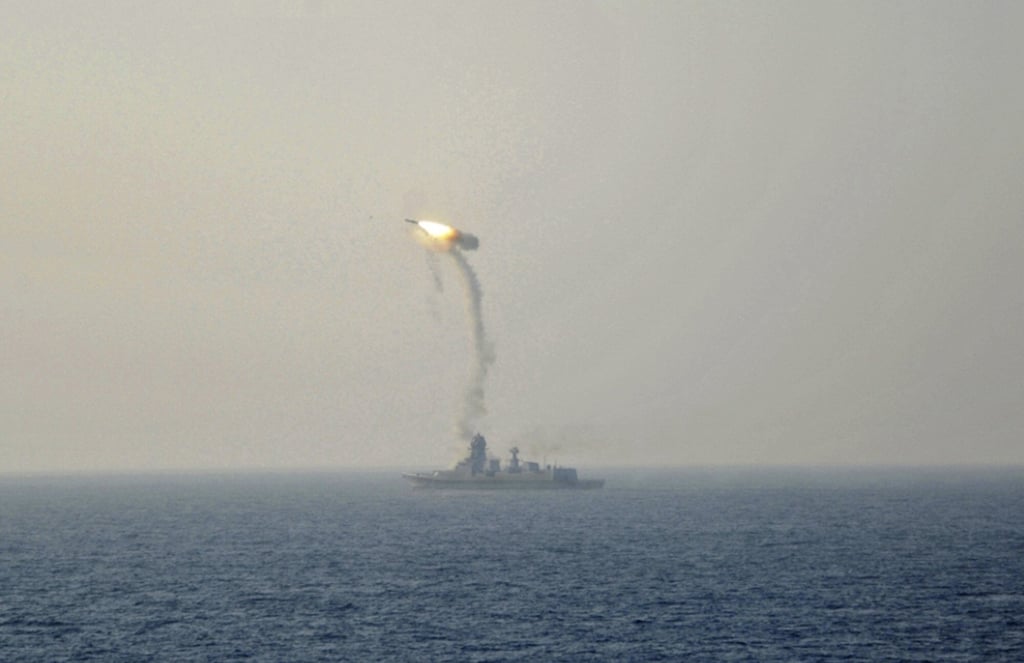
A BrahMos supersonic cruise missile is test-fired from an Indian warship in 2015. Photo: SD Rokade/Indian Defence Ministry Handout via AFP
In January, Manila placed an order with India for US$375 million worth of BrahMos missiles, which can travel at up to three times the speed of sound, have a range of 290km and were jointly developed with Russia.
Advertisement

Valencia said the missiles would “significantly contribute to the country’s deterrence capabilities”, aided by the use of IORIS, which “will allow us to enhance maritime surveillance and maximise the capacity of such capabilities given the vastness of the sea and the myriad of security threats at our doorsteps”.

The Philippine navy chief was speaking at a Foreign Correspondents Association of the Philippines’ forum on the EU’s Indo-Pacific strategy that was co-sponsored by the French embassy. Under a strategy announced last year, the EU aims to increase port calls and freedom of navigation exercises in the Indo-Pacific to “promote an open and rules-based regional security architecture”.

Advertisement
Luc Véron, the EU’s ambassador to Manila, told the forum that the Indo-Pacific was particularly important as 60 per cent of the world’s maritime trade transits the region, with one-third of that passing through the South China Sea.
Advertisement
Select Voice
Choose your listening speed
Get through articles 2x faster
1.25x
250 WPM
Slow
Average
Fast
1.25x