
US aircraft carrier’s Vietnam port call ‘positive expression’ of commitment to peace in South China Sea
- The port call marks the third visit of a US aircraft carrier to Vietnam since the end of the Vietnam war, amid rising tensions in the South China Sea
- The visit, a ‘new normal’ given improved bilateral ties, is also proof of Vietnam’s ‘bamboo policy’ of balancing the interests of competing powers, analysts say
The USS Ronald Reagan, a nuclear-powered Nimitz-class aircraft carrier, docked in Da Nang for a six-day visit, with cultural activities such as a US Navy band concert and a culinary exchange on the itinerary.
Analysts told This Week in Asia that geopolitics factored heavily in both countries’ motivations.
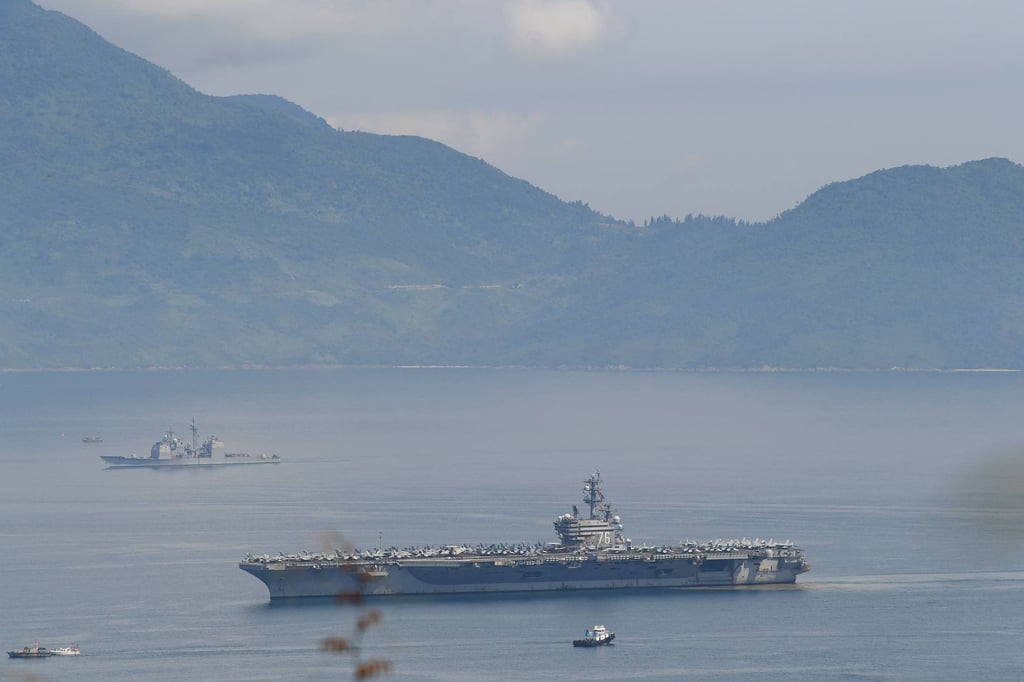
Sunday’s port call marks the third visit of a US aircraft carrier to Vietnam since the end of the Vietnam war, with the first ship arriving in March 2018 and the second in March 2020. A trip planned for last year was abruptly cancelled without official explanation.
In a statement on Sunday, the commander of the carrier strike group Rear Admiral Patrick Hannifin “visits like this reinforce our partnership and commitment to confronting shared challenges in the maritime domain.” The aircraft carrier arrived in Vietnam accompanied by two escort ships, the guided-missile cruisers USS Antietam and USS Robert Smalls.
Retired Major General Le Van Cuong, former director of the Strategic Studies Institute at the Ministry of Public Security, told This Week in Asia that relations between Vietnam and the US had advanced to the point where such port calls were the new normal.
“As the two sides have established a comprehensive partnership, it is completely normal for a US aircraft carrier to come to Vietnam,” he said.
The visit would serve Vietnam’s “bamboo policy” of balancing the interests of competing powers, Doanh added.
“The invitation of the US aircraft carrier to Vietnam is also proof that Vietnam is implementing the bamboo diplomacy policy, multilateralising and diversifying relations with all countries,” he said, pointing out that Defence Minister Phan Van Giang had just concluded a visit to New Delhi that ended with his Indian counterpart offering Vietnam a new warship.
Vietnam’s Ministry of Foreign Affairs on May 25 called for China to withdraw a survey ship and its coastguard escorts from the nation’s exclusive economic zone. While the ship left earlier this month, others have reportedly returned to the disputed waters.
Carl Thayer, professor emeritus at the University of New South Wales and specialist on Vietnamese defence, said while the USS Ronald Reagan’s visit was likely to have been planned far in advance, current events at sea had made its arrival particularly timely.
“China’s stepped-up assertiveness in Vietnamese waters in May to June no doubt reinforced a convergence of views in Hanoi and Washington that the visit of the USS Ronald Reagan was timely for the signal it would send to Beijing,” said Thayer, adding that China hoped its increased presence near oil and gas fields would pressure Vietnam to desist from its drilling and exploration.
“China is asserting its claims to sovereignty by physically sailing near oil exploration blocks where Russian oil companies Zarubezhneft and Gazprom are active,” he said.
Such tactics, Thayer pointed out, had worked in the past.
Vietnam twice forced the Spanish energy company Repsol to scrap offshore drilling projects in 2017 and 2018 under Chinese pressure. In 2019, a months-long standoff took place between the Chinese coastguard and drillers working on a joint Russian-Vietnamese venture. Rosneft, the Russian state oil company working at the site, eventually withdrew from the field.
“Beijing’s actions are part of a long-term strategy to force foreign oil companies from operating in Malaysian, Philippine and Vietnamese waters claimed by China,” said Thayer.
Vietnam was “always vigilant” with regard to Chinese activities in the South China Sea, including the possibility of open warfare, Doanh said, adding that Hanoi also considered “options to deal with China’s infringements of sovereignty, including the worst one”.
The consensus in Hanoi, however, was that a naval war in the South China Sea was extremely unlikely in the coming years, said Cuong, who added that China did not currently have the bandwidth for a war with its southern neighbour.
“It is scientifically predicted that in the next four to five years, it is very unlikely that a military conflict at sea between Vietnam and China will happen because China still has a lot of problems to be resolved domestically as well as externally,” Cuong said.
Chinese harassment at sea, he added, remained Vietnam’s primary maritime threat.
“China’s use of coastguard ships, oil and gas exploration ships, and maritime militia ships to violate Vietnam’s exclusive economic zone is still common,” he said.


