Advertisement
Indonesia
This Week in AsiaPolitics

Indonesia election: where Joko Widodo’s would-be successors stand on US-China ties, defence and the economy

  • All three candidates share some policy platforms, such as modernising Indonesia’s armed forces and maintaining a free and active foreign policy
  • But they differ on their economic strategies, campaign rhetoric – and desire to either preserve or abandon the outgoing president’s legacy

Reading Time:6 minutes
Why you can trust SCMP
1
Supporters of presidential candidate and incumbent Defence Minister Prabowo Subianto and vice presidential candidate and incumbent Solo Mayor Gibran Rakabuming Raka, Joko Widodo’s son, attend an event on Wednesday in Jakarta before registering as candidates with the General Elections Commission. Photo: AFP
Resty Woro Yuniar
Indonesia’s long-drawn-out presidential election process has officially entered its final stages, with some of the country’s biggest political names formally submitting their nomination papers and launching their policy platforms.
Ahead of the opening of the nomination process, much of the national intrigue involved the identity of the running mate for Prabowo Subianto, current President Joko Widodo’s former rival-turned-ally. As long speculated, the 72-year-old defence minister revealed last weekend that his running mate would be Gibran Rakabuming Raka, Widodo’s 36-year-old son and mayor of the city of Solo.

Speculation has also swirled around who would get the outgoing president’s stamp of approval: Prabowo or former Central Java governor Ganjar Pranowo. Pranowo, 54, leads the ticket for Widodo’s ruling Indonesian Democratic Party of Struggle, alongside his vice-presidential candidate Mohammad Mahfud, 66, the outgoing coordinating minister of political, legal and security affairs.
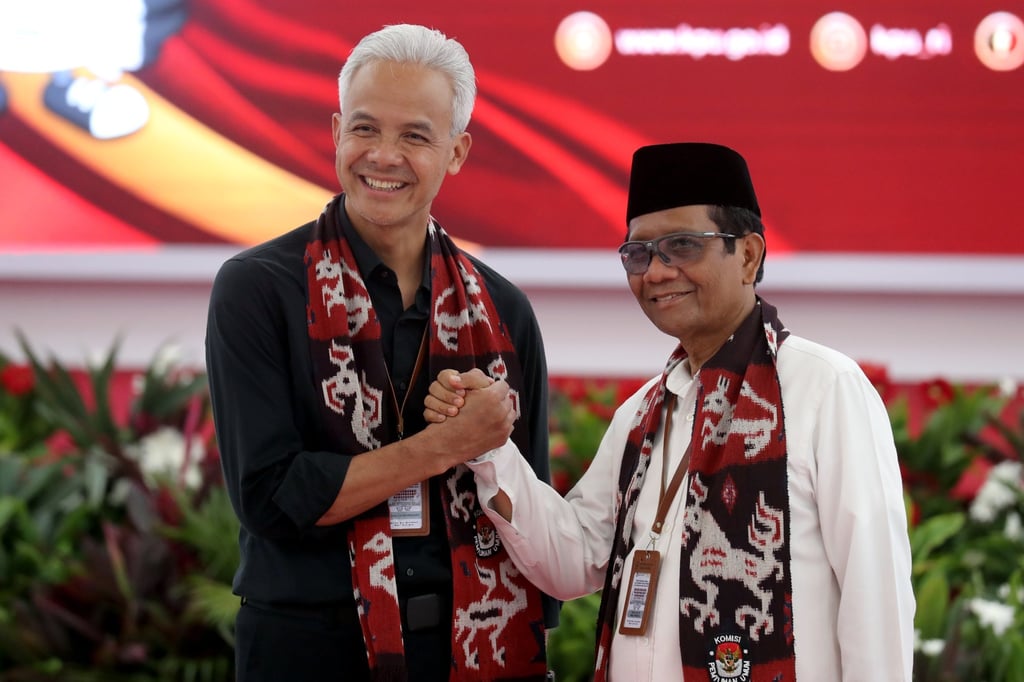
Indonesian presidential candidate Ganjar Pranowo (left) and his running mate Mohammad Mahfud, commonly known as Mahfud MD, pose for photos as they register their candidacy in Jakarta on October 19. Photo: EPA-EFE

Rounding out the list of candidates is Anies Baswedan – like Widodo, a former governor of Jakarta – and Muhaimin Iskandar, 57, deputy speaker of the House of Representatives. Supported by a coalition of parties named the Coalition of Change for Unity, the 54-year-old Anies has styled himself as the antithesis of Widodo, who is constitutionally barred from running for a third term.

Advertisement

All three candidates share some common policy platforms, such as a commitment to modernising Indonesia’s armed forces and maintaining a free and active foreign policy. But they differ, analysts say, on their economic strategies, campaign rhetoric – and desire to either preserve or abandon the outgoing president’s legacy.

Foreign-policy objectives

All three candidates have vowed to maintain Indonesia’s long-standing commitment to a neutral and non-aligned foreign policy, while also being active on the international stage to champion world peace – including by advocating for Palestinians amid the ongoing Israel-Gaza war, with Prabowo going the furthest in this regard by saying he would push to open an Indonesian consulate in Palestinian territory if elected.
Advertisement

Closer to home, rising regional tensions are also reflected in the candidates’ policy platforms, with analyst Ahmad Rizky Umar predicting that Ganjar would veer closest to “the pattern established by Jokowi” – as Widodo is popularly known- “by delegating foreign political issues” to his foreign minister.

Advertisement
Select Voice
Choose your listening speed
Get through articles 2x faster
1.25x
250 WPM
Slow
Average
Fast
1.25x