-
Advertisement
Middle East
This Week in AsiaPolitics

Israel-Gaza war: Arab, Muslim summits won’t stop ‘Israel’s carnage’ amid lack of will to confront US

  • More than a month into the conflict, Arab and Muslim states have not sought to build a diplomatic consensus on bringing about a ceasefire in Gaza
  • A ‘general weakness versus the US’, differing views of Hamas and a preoccupation the war would affect domestic legitimacy are other factors impeding a united front, observers say

Reading Time:4 minutes
Why you can trust SCMP
37
Buildings destroyed in Israeli airstrikes in the southern Gaza Strip city of Khan Younis. Photo: Xinhua
Tom Hussain
Arab and Muslim leaders will meet in Saudi Arabia over the weekend for back-to-back emergency summits over the war in Gaza, but the talks are not expected to yield much beyond strongly worded statements against Israel and its Western supporters, analysts said.

More than a month into the conflict, neither the 22-member League of Arab States nor the 57-member Organisation of Islamic Cooperation have made any attempt to build a consensus on taking collective diplomatic action to bring about a ceasefire in Gaza.

Apparently lacking the political will to jointly confront the United States over its refusal to constrain Israel’s military offensive, the Arab world’s predominantly autocratic administrations are instead preoccupied with preventing the Gaza conflict from expanding into a regional war pitting Israel and the West against Iran and allied political militias like Lebanese Hezbollah and Yemen’s Houthi rebel movement, observers said.

“I think they are unable to stop the massacre against the Palestinians, but on the regional conflagration side, they may be able to make a difference through diplomatic channels with the US, Israel and Iran,” said Ahmed Aboudouh, an associate fellow of the Middle East and North Africa programme at Britain’s Chatham House think tank.
Advertisement

A ceasefire in Gaza and stopping the conflict from expanding “may be the only objective that has all Arab states’ backing, as they worry the war would blow up the ‘new Middle East’ many of these states already threw their weight behind”, he said, referring to the regional trend towards normalising relations with Israel since Bahrain, Morocco, Sudan and the United Arab Emirates signed the US-sponsored Abraham Accords in September 2020.

“Everything else is sadly subject to debate,” Aboudouh said.
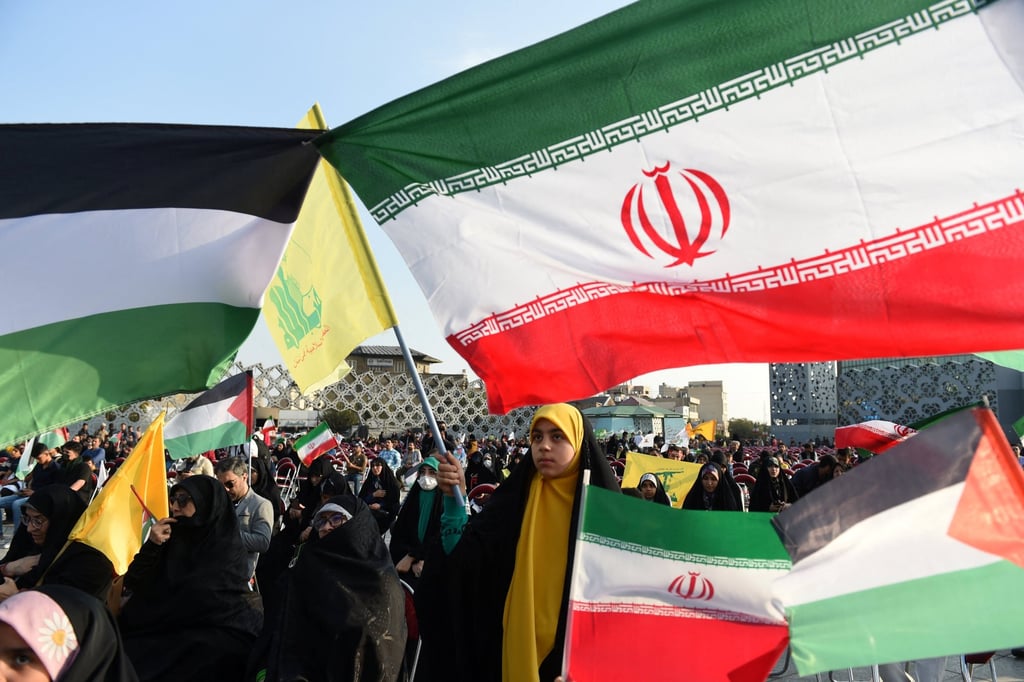
People in Tehran attend a gathering in support of Palestinians. Photo: Reuters

While Arab governments “all share the view that Israel’s carnage of Palestinians must stop”, he said there were three reasons why they had not acted effectively to achieve that objective.

Advertisement
Select Voice
Select Speed
1.00x