Advertisement
India
This Week in AsiaPolitics

Under Modi 3.0, India’s China focus, Pakistan pressure, regional sway to persist

  • India’s PM had to rely on coalition partners to cling on for a third term. But analysts don’t expect it to alter his foreign policy priorities

Reading Time:3 minutes
Why you can trust SCMP
Indian Prime Minister Narendra Modi speaks at his swearing-in ceremony on Sunday. On the same day, unidentified militants opened fire on a bus carrying Hindu pilgrims in Indian-administered Kashmir, killing nine. Photo: Bloomberg
Biman Mukherji
Narendra Modi’s swearing-in ceremony offered a preview of India’s foreign policy priorities during his third term as prime minister, with analysts citing the attendance of several South Asian leaders and Pakistan’s absence as signals that New Delhi will focus on bolstering regional ties.
The snub of Pakistan at Sunday’s event, which followed Modi’s narrow victory in this year’s general election, is likely tied to Delhi’s long-standing anger over Islamabad allowing militants to launch attacks from its territory against Indian-administered Kashmir.

The two countries have fought over the disputed region, including in several wars, since their independence in 1947.
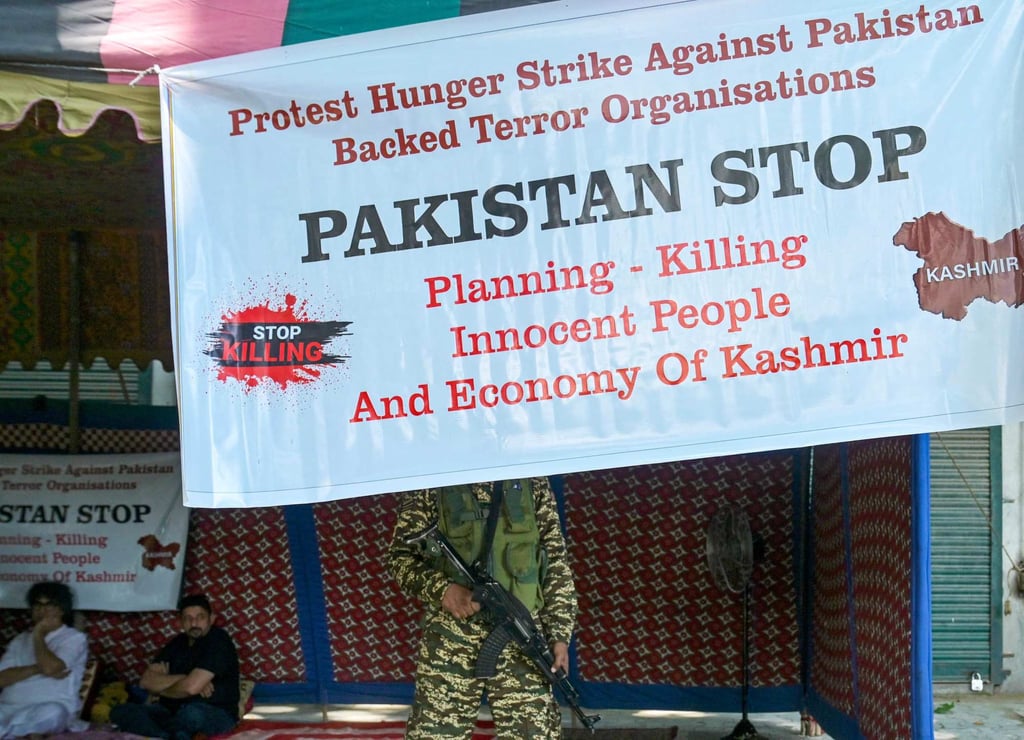
An Indian paramilitary trooper stands guard in Srinagar as Bharatiya Janata Party activists protest on Tuesday against the killing of Hindu pilgrims in Reasi, Indian-administered Kashmir. Photo: AFP
On the same day as Modi’s swearing-in, unidentified militants opened fire on a bus carrying Hindu pilgrims in Reasi, Indian-administered Kashmir, killing nine people and injuring 33 others, according to local police.
Advertisement

“Ultimately Pakistan has not been able to control terrorism from its soil. The Indian government is legitimate in saying that unless it restrains [terrorist groups], we can’t talk with Pakistan,” said Pushpesh Pant, former dean of the School of International Studies at Delhi’s Jawaharlal Nehru University.

A representative from Pakistan was invited to attend Modi’s two previous swearing-in ceremonies in 2014 and 2019.

Advertisement

The Indian prime minister’s Bharatiya Janata Party failed to secure an outright majority in this year’s election, forcing him to rely on other parties to stay in power. Despite this dependency on coalition partners, Modi signalled that his foreign policy approach would remain consistent with Islamabad’s exclusion for the weekend ceremony, according to Pant.

Advertisement
Select Voice
Choose your listening speed
Get through articles 2x faster
1.25x
250 WPM
Slow
Average
Fast
1.25x