Advertisement
India
This Week in AsiaPolitics

Why China-Russia ‘troika’ talks are back on India’s table

New Delhi’s cautious openness to reviving the long-dormant Russia-India-China dialogue signals a careful hedging of its geopolitical bets

Reading Time:3 minutes
Why you can trust SCMP
7
Russian President Vladimir Putin, Indian Prime Minister Narendra Modi and Chinese President Xi Jinping hold a meeting on the sidelines of a G20 summit in 2019. Photo: Sputnik / AFP
Maria Siow
As friction with the West builds over energy imports and trade, India is weighing a delicate recalibration: reviving its long-dormant trilateral dialogue with Russia and China, even as it insists it remains committed to its partnerships with the US and its allies.

India indicated earlier this month its openness to resuming the Russia-India-China (RIC) dialogue, a platform established in the early 2000s to foster coordination among the three Eurasian powers.

Describing the RIC as a consultative mechanism for addressing shared regional and global challenges, New Delhi’s Ministry of External Affairs emphasised on July 17 that any decision on resuming talks would be taken “in a mutually convenient manner”. No timeline was provided for when this might happen.

Advertisement

The move came just weeks after Russian Foreign Minister Sergey Lavrov had voiced strong support for reviving the format. Speaking at a conference last month, Lavrov reaffirmed Moscow’s desire to “confirm our genuine interest in the earliest resumption of the work within the format of the troika – Russia, India, China – which was established many years ago on the initiative of former Russian prime minister Yevgeny Primakov”.
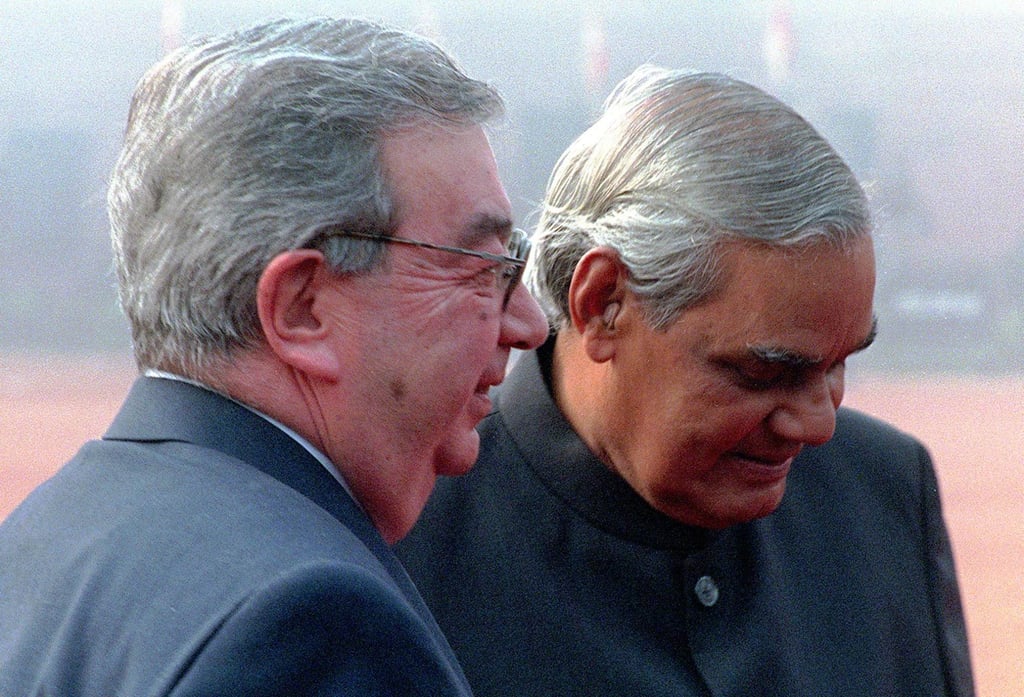
Former Russian PM Yevgeny Primakov (left) with his Indian counterpart Atal Behari Vajpayee in 1998, the year he called for the creation of a “strategic triangle” between Russia, India and China. Photo: AFP
Analysts suggest the impetus behind India’s overture stems from growing frustration with what it perceives as Western “double standards”. Sriparna Pathak, a professor of China studies and international relations at O.P. Jindal Global University in India, pointed to recent warnings from Nato chief Mark Rutte that India could face “100 per cent secondary sanctions” for buying Russian oil.
Advertisement
Advertisement
Select Voice
Choose your listening speed
Get through articles 2x faster
1.25x
250 WPM
Slow
Average
Fast
1.25x