In Ayodhya, a centuries-old Hindu-Muslim dispute that can still sway Indian elections
- The Ram Janmabhoomi temple is at the heart of a bitter political and legal dispute that has seen temples razed and thousands killed.
- The legal battle between Hindus and Muslims over the site began in 1885 and is ongoing today

Sanjay Kumar, a highly trained soldier about 30 years old, holds an assault rifle in his right hand while he feeds nuts to a palm squirrel with his left. His eyes are alert, constantly scanning visitors while feeding his companion. He stands just a few feet from a makeshift tent, a structure of roughly 250 square feet. It is no ordinary place; rather, it is perhaps India’s most religiously sensitive and politically contentious site.
Kumar is one of hundreds of police, paramilitary and armed troops stationed in Ayodhya, in the northern Indian state of Uttar Pradesh, to guard the Ram Janmabhoomi – the birthplace of the Hindu god Ram. The influence of Bollywood is mostly absent from this old temple town. Instead, years of persecution, religious confrontation and political one-upmanship have left their mark.
Uttar Pradesh is India’s most populous state – if its 200 million people occupied a separate nation, it would be the world’s fifth-most populous. The northern state is also India’s most politically influential. It sends more lawmakers to parliament than any other and whoever holds Uttar Pradesh invariably controls parliament. It is also home to about 38 million Muslims – a significant voting bloc for parties willing to court them.
The Ram Janmabhoomi temple is at the heart of a bitter political and legal dispute. Entry is strictly policed. Four layers of hawkish security personnel frisk visitors, who are not allowed to carry metal objects, coins or mobile phones. The narrow passage from entry to exit runs 2km and can fit just one individual at a time, enclosed by metal fences. A 3.66-metre-high barrier, painted bright yellow, encircling the entire 2.77-acre disputed zone, adds to the sense this is no mere place of worship.
Until the 16th century, a temple for Ram – an ancient king Hindus believe to be a perfect human – stood at this site. But the temple was demolished by the Mughal ruler Babur and the Babri Mosque was built in its place. For centuries, the site remained a thorn in the side of Hindu kings who recaptured much of the northern Indian regions from the Mughals.
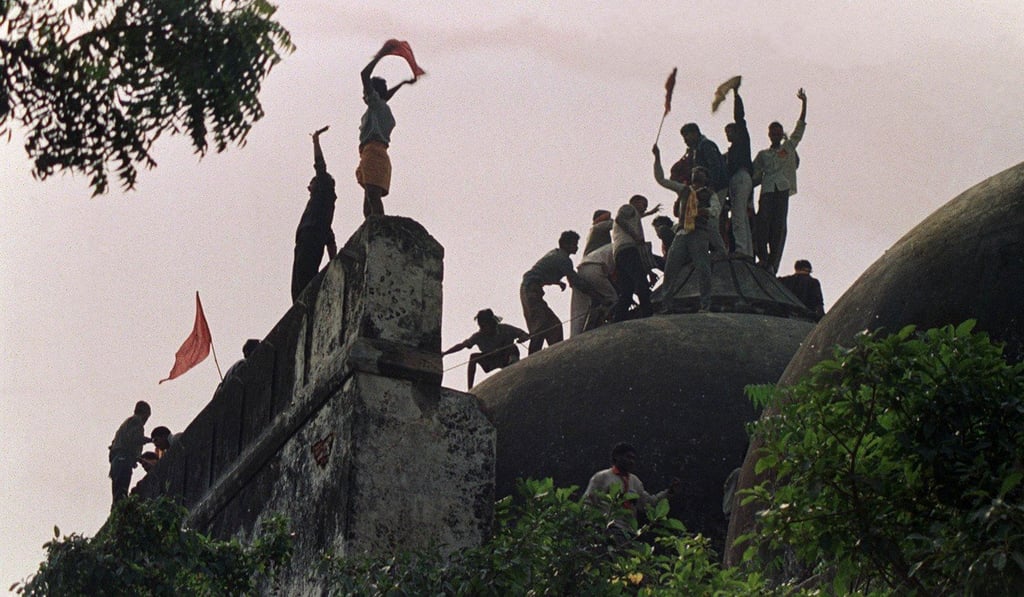
Ram’s idol was smuggled into the mosque and installed there in 1949, two years after Indian independence, by dozens of Hindu supporters attempting to seize control of the site. The mosque was razed in 1992 by Hindu extremists who marched on the site under the guise of a political rally. Ensuing riots claimed as many as 2,000 lives, a notorious flashpoint and source of Hindu-Muslim resentment in India’s modern history. The long-running dispute remains central to the acrimony between the two faiths in the region.